Composer Charles Gounod. Libretto by Jules Barbier and Michel Carré.
recommended for age 14 and older
Opera in five acts (1869)
In French. With surtitles in German and English. New Production.
On his futile search for the meaning of life, the ageing scholar Faust makes a pact with the Devil. Méphistophélès buys his soul and promises him eternal youth and love. Faust falls in love with Marguerite, however she soon leaves him. After she has killed their child, Marguerite succumbs to madness, but emerges morally superior from the encounter with Faust.
Of the numerous scorings of the most famous material in the history of German literary, the opera by the Frenchman Charles Gounod is perhaps the best known. In the 19th century the French opera developed an immense fondness for the German material, but it was often very free with the restructuring for the libretto. From the original the successful French librettist duo, Michel Carré and Jules Barbier (also the authors of the text of Les Contes d’Hoffmann) actually made a most effective opera text with a pronounced dramaturgy of contrasts – drinking scenes are contrasted with intimate ballads, soldier choirs with the church service hymns of supplication. Not least of all because of its immortal arias, after Bizet’s Carmen, Gounod’s Faust has become the most successful French opera.
Synopsis
Place: Germany
Time: 16th century
Act 1
Faust's cabinet
Faust, an aging scholar, determines that his studies have come to nothing and have only caused him to miss out on life and love ("Rien! En vain j'interroge"). He attempts to kill himself (twice) with poison but stops each time when he hears a choir. He curses hope and faith, and asks for infernal guidance. Méphistophélès appears (duet: "Me voici") and, with a tempting image of Marguerite at her spinning wheel, persuades Faust to buy Méphistophélès's services on Earth in exchange for Faust's in Hell. Faust's goblet of poison is magically transformed into an elixir of youth, making the aged doctor a handsome young gentleman; the strange companions then set out into the world.
Act 2
At the city gates
A chorus of students, soldiers and villagers sings a drinking song ("Vin ou Bière"). Valentin, leaving for war with his friend Wagner, entrusts the care of his sister Marguerite to his youthful friend Siebel ("O sainte médaille ... Avant de quitter ces lieux"). Méphistophélès appears, provides the crowd with wine, and sings a rousing, irreverent song about the golden calf ("Le veau d'or"). Méphistophélès predicts Wagner will not return from the war and maligns Marguerite, and Valentin tries to strike him with his sword, which shatters in the air. Valentin and friends use the cross-shaped hilts of their swords to fend off what they now know is an infernal power (chorus: "De l'enfer"). Méphistophélès is joined by Faust and the villagers in a waltz ("Ainsi que la brise légère"). Marguerite appears and Faust declares his admiration, but she refuses Faust's arm out of modesty, a quality that makes him love her even more.
Act 3
Feodor Chaliapin as Méphistophélès, 1915
Marguerite's garden
The lovesick boy Siebel leaves a bouquet for Marguerite ("Faites-lui mes aveux"). Faust sends Méphistophélès in search of a gift for Marguerite and sings a cavatina ("Salut, demeure chaste et pure") idealizing Marguerite as a pure child of nature. Méphistophélès brings in a decorated box containing exquisite jewelry and a hand mirror and leaves it on Marguerite's doorstep, next to Siebel's flowers. Marguerite enters, pondering her encounter with Faust at the city gates, and sings a melancholy ballad about the King of Thule ("Il était un roi de Thulé"). Marthe, Marguerite's neighbour, notices the jewellery and says it must be from an admirer. Marguerite tries on the jewels and is captivated by how they enhance her beauty, as she sings in the famous aria, the Jewel Song ("Oh dieu! Que de bijoux ... Ah! je ris de me voir si belle en ce miroir"). Méphistophélès and Faust join the women in the garden and romance them. Marguerite allows Faust to kiss her ("Laisse-moi, laisse-moi contempler ton visage"), but then asks him to go away. She sings at her window for his quick return, and Faust, listening, returns to her. Under the watchful eye and malevolent laughter of Méphistophélès, it is clear that Faust's seduction of Marguerite will be successful.
Act 4
Marguerite's room / A public square outside her house / A cathedral
[Note: The scenes of act 4 are sometimes given in a different order and portions are sometimes shortened or cut in performance.][9] After being made pregnant and seemingly abandoned by Faust, Marguerite has given birth and is a social outcast. She sings an aria at her spinning wheel ("Il ne revient pas"). Siebel stands by her. The scene shifts to the square outside Marguerite's house. Valentin's company returns from the war to a military march ("Déposons les armes" and "Gloire immortelle de nos aïeux", the well-known "soldiers' chorus"). Siebel asks Valentin to forgive Marguerite. Valentin rushes to her cottage. While he is inside Faust and Méphistophélès appear, and Méphistophélès, knowing that Marguerite is not in there alone, sings a mocking burlesque of a lover's serenade under Marguerite's window ("Vous qui faites l'endormie"). Valentin takes the bait and comes out of the cottage, now knowing that Faust has debauched his sister. The two men fight, but Faust is reluctant to hurt the brother of the woman he adores. Méphistophélès blocks Valentin's sword, allowing Faust to make the fatal thrust. With his dying breath Valentin blames Marguerite for his death and condemns her to Hell before the assembled townspeople ("Ecoute-moi bien Marguerite"). Marguerite goes to the church and tries to pray there but is stopped, first by the sadistic Méphistophélès and then by a choir of devils. She finishes her prayer but faints when she is cursed again by Méphistophélès.
Act 5
The Harz mountains on Walpurgis Night / A cavern / The interior of a prison
Méphistophélès and Faust are surrounded by witches ("Un, deux et trois"). Faust is transported to a cave of queens and courtesans, and Méphistophélès promises to provide Faust with the love of the greatest and most beautiful women in history. An orgiastic ballet suggests the revelry that continues throughout the night. As dawn approaches, Faust sees a vision of Marguerite and calls for her. Méphistophélès helps Faust enter the prison where Marguerite is being held for killing her child. They sing a love duet ("Oui, c'est toi que j'aime"). Méphistophélès states that only a mortal hand can deliver Marguerite from her fate, and Faust offers to rescue her from the hangman, but she prefers to trust her fate to God and His angels ("Anges purs, anges radieux"). At the end she asks why Faust's hands are covered in blood, pushes him away, and falls down motionless. Méphistophélès curses, as a voice on high sings "Sauvée!" ("Saved!"). The bells of Easter sound and a chorus of angels sings "Christ est ressuscité!" ('"Christ is risen!"). The walls of the prison open, and Marguerite's soul rises to heaven. In despair Faust follows it with his eyes; he falls to his knees and prays. Méphistophélès is turned away by the shining sword of the archangel.
 en
en 
 de
de it
it fr
fr es
es ru
ru jp
jp ro
ro








 National Theatre Munich
 Fri 24 Jul 2026 - Thu 30 Jul 2026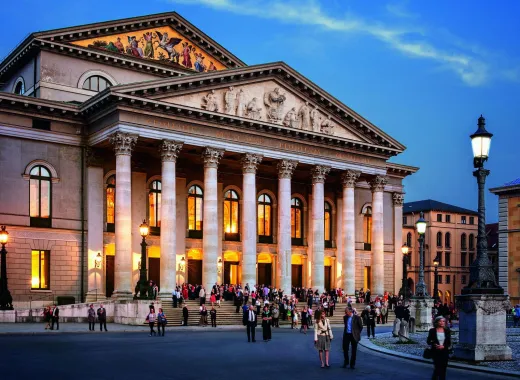




 RM Europa Ticket GmbH
  Call now
 Book now