
 RO
RO EN
EN DE
DE IT
IT FR
FR ES
ES RU
RU JP
JP
© Wiener Staatsoper
Liliacul cu Jonas Kaufmann
Cumpara bilete
 Octombrie 2052 Octombrie 2052 | ||||||
|---|---|---|---|---|---|---|
Lu | Ma | Mi | Jo | Vi | Sa | Du |
Liliacul – Johann Strauss | Operă
Text de Richard Genée & Karl Haffner
Actul 1 – aprox. 50 min
Pauză – aprox. 25 min
Actul 2 – aprox. 55 min
Pauză – aprox. 25 min
Actul 3 – aprox. 50 min
Acțiunea
Acțiunea se petrece în ultima zi a anului 1870 și în noaptea de revelion 1870-1871, în castelul austriac Weinberg.
Actul I
În casa familiei Eisenstein se întâlnesc câteva din personajele principale. Dr. Falke, prietenul domnului Gabriel Eisenstein, pune la cale o farsă, pentru a se răzbuna pe Gabriel, pentru o poveste mai veche, când acesta, după un bal mascat, l-a lăsat pe Falke beat într-o grădină publică, îmbrăcat în costum de liliac, spre batjocura mulțimii, motiv pentru care lui Falke i-a rămas porecla de „Dr. Liliac”. Ca urmare, face să parvină câte o invitație la balul Prințului Orlofsky, lui Gabriel, soției acestuia, Rosalinda și Adelei, nostima subretă a familiei, din partea surorii sale, balerina Ida. Dar, începând cu noaptea Anului Nou, Gabriel are de ispășit o pedeapsă de pe urma unui proces de ultragiu, pierdut de bâlbâitul avocat Blind. Falke îl convinge însă să se îmbrace elegant, pentru întâlnirea cu „șoriceii” (cum numea Gabriel, cândva, balerinele), de la pușcărie, de fapt de la balul prințului. Adela, la rându-i, după câteva minciuni, nu tocmai bine ticluite, reușește să plece la bal, mai ales că, Rosalinda trebuia să rămână singură, pentru a face față insistențelor lui Alfred, un prieten mai vechi. După plecarea zgomotoasă a lui Gabriel, cu toate încercările Rosalindei de a nu-l primi, Alfred pătrunde în salon și se instalează ca stăpân al casei. Când vine Frank, directorul închisorii, să-l ia pe Gabriel pentru ispășirea pedepsei, confuzia este creată: Alfred trece drept Gabriel și este de acord, pentru a salva reputația Rosalindei, să meargă la pușcărie. Rosalinda, la rându-i, găsește invitația la balul lui Orlofsky, lăsată de Dr. Falke. Hotărârea este luată: va merge la bal, cum i se sugerează în scrisoare, pentru a vedea unde-și petrece Gabriel prima noapte de arest.
Actul II
La balul Prințului Orlofsky, în noaptea de revelion, încep să apară personajele din farsa organizată de Falke, care-l asigură pe prinț că se va distra copios. Adela, îmbrăcată cu rochia stăpânei, află de la sora ei Ida că nu aceasta a invitat-o la bal. Eisenstein, prezentat ca Marchiz de Renard, trebuie să facă față numeroaselor pahare oferite de prinț. O recunoaște pe Adela, dar Falke încearcă să-l convingă că aceasta este domnișoara Olga. Frank, directorul închisorii, este prezentat drept contele Chagrin. La petrecere apare și Rosalinda, mascată în prințesă maghiară. Eisenstein încearcă asupra ei efectul „ceasornicului”, cu care a cucerit atâtea femei. Rosalinda îi reține ceasul, din dorința de a avea argumente împotriva lui Gabriel, pe care l-a recunoscut. În zori, directorul închisorii, Frank dar și Gabriel, își reamintesc că trebuie să se prezinte, fiecare pentru alt motiv, la pușcărie.
Actul III
Ultimul act se petrece la pușcărie, unde facem cunoștință cu un personaj plin de culoare, Frosch, gardianul-șef, care repetă în replicile sale „Veselă pușcărie, domnule!”. Alfred este amuzat de postura sa de arestat. La închisoare sosesc, pe rând, Frank, directorul, apoi Adela și Ida, care-i mărturisesc adevărul că Adela nu este artistă, dar e plină de talent. Apare și Eisenstein, despre care Frank află că nu este Marchizul de Renard. Surprizele continuă: Gabriel, la rându-i află cine a fost arestat în locul său și îl întâlnește pe avocatul Blind, chemat de Alfred. Dorește să se răzbune pentru infidelitatea Rosalindei, dându-se drept Blind. Însă mare îi este surpriza când contesa maghiară, pe care a curtat-o toată noaptea, la balul Prințului Orlofsky își dă masca jos: este soția sa. Dar totul e bine când se termină cu bine: cei doi soți se împacă, iar prințul Orlofsky îi promite Adelei că va ajunge artistă. „Vesela pușcărie”, în care se bea șampanie și toată lumea cântă !
Program si distributie
Gabriel von Eisenstein – Jonas Kaufmann (31 decembrie 2025, 3 ianuarie 2026, 6 ianuarie 2026); Matthäus Schmidlechner (1 ianuarie 2026)
Rosalinde – Diana Damrau (31 decembrie 2025, 3 ianuarie 2026, 6 ianuarie 2026)
Frank – Jochen Schmeckenbecher
Prințul Orlofsky – Daria Sushkova
Alfred, un tenor – Jörg Schneider
Dr. Falke – Adrian Eröd
Adele – Ilia Staple
Frosch – Michael Niavarani
Dirijor muzical – Markus Poschner
Regia – Otto Schenk
Scenografie – Günther Schneider-Siemssen
Costume – Milena Canonero
Coregrafia din Actul 2 „Unter Donner und Blitz” – Gerlinde Dill
Opera de Stat Viena
Practical information
Punctuality
We ask you to arrive punctually for the performances. Late arrivals can only be admitted during the intermission. It is not possible to be admitted after intermission-during the performance.
Admission to the building for performances begins one hour before the start of the performance.
Cloakroom
For security reasons, we ask you to leave coats, jackets and bulky items such as bags or rucksacks in our free cloakrooms. Our cloakrooms are located next to the entrances on Operngasse, on the balcony on the right and left-hand side, as well as in the gallery.
As a box guest, please use the cloakroom in your box.
Program booklets
Program booklets for the performance of the day - in both German and English - are sold before the performance and during intermission by our Audience Service. Program booklets for other performances are available at any time in the opera foyer.
Cell phones
Ringing telephones, and glowing screens disturb the performance. We therefore ask you to silence your cell phones or put them in flight mode during the performance and stow them away accordingly.
Photography & video
Photography and filming during the performance is not permitted. Photography and filming for private purposes is of course permitted at the curtain callor during intermission. The use of smartphones and cameras in the proscenium boxes is prohibited throughout the entire performance to protect the orchestra from falling objects.
Dress code
Many of our guests take the opportunity to dress elegantly for their visit to the opera. When choosing your clothing, please bear in mind that you will be in close contact with other guests in the rows of seats. If you are not sufficiently dressed (e.g. flip-flops, an undershirt as a top or very short shorts), you may be refused admission.
Head coverings that obstruct the view of other guests are not permitted.
Length of the performance
When you select the date on which you want to purchase the ticket, the start and end time of the performance will be displayed. Each event may also include additional details regarding its schedule, and some even provide a complete timeline showing the number of acts, intermissions, and their respective durations.
Payment
Program booklets can only be purchased from our Audience Service by cash. Our box offices and intermission buffets accept both cash and card payments.
"I don't understand Italian"
It doesn't matter! Every seat has its own subtitle tablet, on which you can choose which language you want them to be displayed in. German, English and the original language of the opera are always included! You can choose from a total of up to 8 languages.
There are also trailers and lots of other information about the content, the music or the production, which can be found on the pages of the respective production.
Which opera is good for a first visit?
Of course, this depends entirely on your personal preferences, but experience shows that classical operas are particularly suitable for a first evening at the opera. You will be amazed at how many melodies you know! Whether from movie scenes, music lessons, a TV commercial, sports, ..
For example, the music from George Bizet's opera Carmen is very well known - not least because of its use in the Formula 1 victory ceremony.
Getting Here
The Vienna State Opera can be reached by public transport, bicycle, taxi, or car.
Public Transport Connections
Subway
U1, U2, U4 – Karlsplatz station
Streetcar
Lines 1, 2, D, 62, 71 – Opera or Karlsplatz stations
Bus
Line 59A – Opera or Karlsplatz stations
Local Railway
Badner Bahn – Vienna Opera Station
Arrival by Bicycle
Bicycle stands are located directly to the left and right of the building, providing convenient and secure parking.
Taxi
Taxi stands are situated near the opera, and cabs are available at the main entrance after performances.
Arrival by Car & Parking
Two parking garages near the State Opera provide ample parking facilities for visitors, ensuring a comfortable arrival experience.
Underground parking garage Kärntnerringgarage
Park for 10 hours for €8!
The Vienna State Opera and the ÖPARK-Kärntnerringgarage at Mahlerstraße 8, under the Ringstraßengalerien, offer the audience of the Vienna State Opera a favorable parking package.
You can park for up to 10 hours for just €8 with our evening rate from 5pm to 3am. Any hours before this must be paid for separately (€4/hour; with P-Card: €2.50/hour) To apply, go to P Card | Mein-Contipark.
The new system works simply and without a parking ticket. Simply drive into the garage. When you drive in, your license plate number is recorded and the barrier opens. When paying, all you have to do is enter your license plate number at the machine and pay. You can also pay contactless at the exit terminal with your P Card. When you exit, your car's license plate number is recognised and the barrier opens.
ÖPARK Kärntnerringgarage
A Mahlerstraße 8, 1010 Vienna
Gastronomy & Shops
Opera Café
The Opera Café is open daily from 10:00 to 18:00.
On performance days, it remains open until 22:30.
Drinks and snacks are available at the interval buffets during performances.
Souvenir Store
The Hamtil & Söhne souvenir store is located under the arcades of the Vienna State Opera, on the Herbert-von-Karajan-Platz side.
Opening hours: daily from 10:00 to 19:00.
Accessibility
Due to the historical structure of the Vienna State Opera building, accessibility conditions are not ideal. However, the venue aims to ensure that visitors with reduced mobility can attend performances as smoothly as possible.
All seating areas are accessible by elevator, and barrier-free restrooms are available.
Dedicated wheelchair spaces are provided for wheelchair users.
Wheelchair Spaces
A total of 22 wheelchair spaces are available. Four are located in the stalls and up to 18 (as needed) in the gallery.
In the stalls, wheelchair spaces are positioned on both the left and right sides of the auditorium, once near row 1 and once near row 14. Folding companion seats for these spaces are mounted on the auditorium wall and correspond to the height of rows 15–17. In the gallery, companion seats are also fixed to the wall directly behind the wheelchair spaces.
As availability is limited, wheelchair spaces must be reserved through the ticket store or the order office. For first-time reservations, prior registration with the order office is required.
Access
Barrier-free entry to the building is located on the Herbert-von-Karajan-Platz side, at the beginning of the arcades (swinging door, 87 cm wide).
The stalls and the elevator to the gallery can be reached via the inclined elevator in the opera foyer, located near the Opera Café.
The standard elevator to the gallery is positioned next to it (width 95 cm, depth 140 cm, door clearance 80 cm).
Cloakrooms, interval buffets, and wheelchair-accessible restrooms are available on both levels.
From the Best in Parking Kärntnerstraße underground garage (featuring two disabled parking spaces), Herbert-von-Karajan-Platz can be reached by elevator. The passage from the garage to the opera house is opened one hour before the performance begins and closed again once the audience has exited at the end of the event.
Additional disabled parking spaces are currently available at Helmut-Zilk-Platz 1 and Walfischgasse 1 and 6.
Service dogs are permitted.
Cloakroom
Can I take my coat with me? Where can I leave my backpack? Where is the cloakroom?
Coats, jackets, bulky bags, and other items (e.g., backpacks, suitcases, umbrellas, musical instruments) must be checked in at the free cloakroom.
The main cloakroom is located next to the entrances on the Operngasse side. Additional cloakrooms can be found on the right and left sides of the balcony and in the gallery.
Box seat holders have access to a private cloakroom directly at their box, providing a convenient and exclusive service.
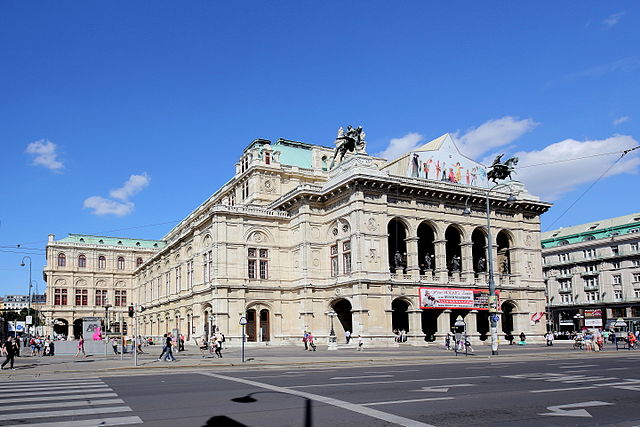
© Wiener Staatsoper

Evenimente asociate