
 EN
EN DE
DE IT
IT FR
FR ES
ES RU
RU JP
JP RO
RO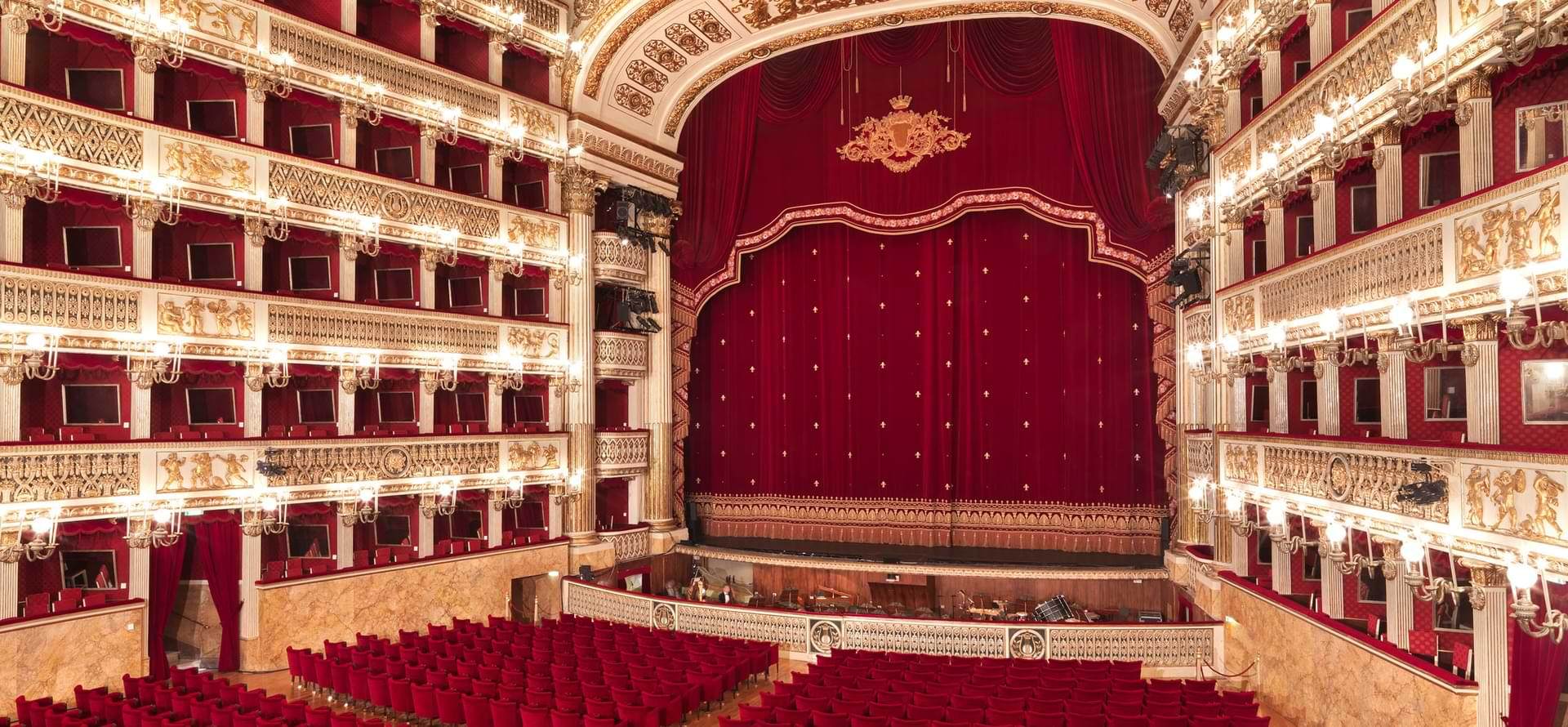
Falstaff
Order tickets
 April 2026 April 2026 | ||||||
|---|---|---|---|---|---|---|
Mo | Tu | We | Th | Fr | Sa | Su |
Synopsis
Act 1
A room at the Garter Inn
Falstaff and his servants, Bardolfo and Pistola, are drinking at the inn. Dr Caius bursts in and accuses Falstaff of burgling his house and Bardolfo of picking his pocket. Falstaff laughs at him; he leaves, vowing only to go drinking with honest, sober companions in future. When the innkeeper presents a bill for the wine, Falstaff tells Bardolfo and Pistola that he needs more money, and plans to obtain it by seducing the wives of two rich men, one of whom is Ford. Falstaff hands Bardolfo a love-letter to one of the wives (Alice Ford), and hands Pistola an identical letter addressed to the other (Meg). Bardolfo and Pistola refuse to deliver the letters, claiming that honour prevents them from obeying him. Falstaff loses his temper and rants at them, saying that "honour" is nothing but a word, with no meaning (Monologue: "L'onore! Ladri ... !" / "Honour! You rogues ... !") Brandishing a broom, he chases them out of his sight.
Ford's garden
Alice and Meg have received Falstaff's letters. They compare them, see that they are identical and, together with Mistress Quickly and Nannetta Ford, resolve to punish Falstaff. Meanwhile, Bardolfo and Pistola warn Ford of Falstaff's plan. Ford resolves to disguise himself and visit Falstaff and set a trap for him.
A young, handsome fellow called Fenton is in love with Ford's daughter Nannetta, but Ford wants her to marry Dr. Caius, who is wealthy and respected. Fenton and Nannetta enjoy a moment of privacy, but are interrupted by the return of Alice, Meg and Mistress Quickly. The act ends with an ensemble in which the women and the men separately plan revenge on Falstaff, the women gleefully anticipating an enjoyable prank, while the men angrily mutter dire threats.
Act 2
A room at the Garter Inn
Falstaff is alone at the inn. Bardolfo and Pistola, now in the pay of Ford, enter and beg Falstaff to allow them to re-enter his service, secretly planning to spy on him for Ford. Mistress Quickly enters and tells him that Alice is in love with him and will be alone in Ford's home that afternoon, from two o'clock until three o'clock, just time for an amorous dalliance. Falstaff celebrates his potential success ("Va, vecchio John" / "Go, old Jack, go your own way").
Ford arrives, masquerading as a wealthy stranger, using the false name "Signor Fontana". He tells Falstaff that he is in love with Alice, but she is too virtuous to entertain him. He offers to pay Falstaff to use his impressive title and (alleged) charms to seduce her away from her virtuous convictions, after which he ("Fontana") might have a better chance of seducing her himself. Falstaff, delighted at the prospect of being paid to seduce the wealthy and beautiful woman, agrees, and reveals that he already has a rendezvous arranged with Alice for two o'clock – the hour when Ford is always absent from home. Ford is consumed with jealousy, but conceals his feelings. Falstaff withdraws to a private room to change into his finest clothes, and Ford, left alone, reflects on the evil of an uncertain marriage and vows to have revenge ("È sogno o realtà?" / "Is it a dream or reality?"). When Falstaff returns in his finery, they leave together with elaborate displays of mutual courtesy.
A room in Ford's house
The three women plot their strategy ("Gaie Comari di Windsor" / "Merry wives of Windsor, the time has come!"). Alice notices that Nannetta is too unhappy and anxious to share their gleeful anticipation. This is because Ford plans to marry her to Dr Caius, a man old enough to be her grandfather; the women reassure her that they will prevent it. Mistress Quickly announces Falstaff's arrival, and Mistress Ford has a large laundry basket and a screen placed in readiness. Falstaff attempts to seduce Alice with tales of his past youth and glory ("Quand'ero paggio del Duca di Norfolk" / "When I was page to the Duke of Norfolk I was slender"). Mistress Quickly rushes in, shouting that Ford has returned home unexpectedly with a retinue of henchmen to catch his wife's lover. Falstaff hides first behind the screen, but realizes that Ford will likely look for him there. The women urge him to hide in the laundry basket, which he does. In the meantime Fenton and Nannetta hide behind the screen for another moment of privacy. Ford and his men storm in and search for Falstaff, and hear the sound of Fenton and Nannetta kissing behind the screen. They assume it is Falstaff with Alice, but instead they find the young lovers. Ford orders Fenton to leave. Badly cramped and almost suffocating in the laundry hamper, Falstaff moans with discomfort while the men resume the search of the house. Alice orders her servants to throw the laundry basket through the window into the River Thames, where Falstaff endures the jeers of the crowd. Ford, seeing that Alice had never intended to betray him, smiles happily.
Act 3
Before the inn
Falstaff, cold and discouraged, glumly curses the sorry state of the world. Some mulled wine soon improves his mood. Mistress Quickly arrives and delivers another invitation to meet Alice. Falstaff at first wants nothing to do with it, but she persuades him. He is to meet Alice at midnight at Herne's Oak in Windsor Great Park dressed up as the ghost of Herne the Hunter who, according to local superstition, haunts the area near the tree, and appears there at midnight with a band of supernatural spirits. He and Mistress Quickly go inside the inn. Ford has realized his error in suspecting his wife, and they and their allies have been watching secretly. They now concoct a plan for Falstaff's punishment: dressed as supernatural creatures, they will ambush and torment him at midnight. Ford draws Dr. Caius aside and privately proposes a separate plot to marry him to Nannetta: Nannetta will be disguised as Queen of the Fairies, Caius will wear a monk's costume, and Ford will join the two of them with a nuptial blessing. Mistress Quickly overhears and quietly vows to thwart Ford's scheme.
Herne's Oak in Windsor Park on a moonlit midnight
Fenton arrives at the oak tree and sings of his happiness ("Dal labbro il canto estasiato vola" / "From my lips, a song of ecstasy flies") ending with "Lips that are kissed lose none of their allure." Nannetta enters to finish the line with "Indeed, they renew it, like the moon." The women arrive and disguise Fenton as a monk, telling him that they have arranged to spoil Ford's and Caius's plans. Nannetta, as the Fairy Queen, instructs her helpers ("Sul fil d'un soffio etesio" / "On the breath of a fragrant breeze, fly, nimble spirits") before all the characters arrive on the scene. Falstaff's attempted love scene with Alice is interrupted by the announcement that witches are approaching, and the men, disguised as elves and fairies, soundly thrash Falstaff. In the middle of the beating, he recognizes Bardolfo in disguise. The joke is over, and Falstaff acknowledges that he has received his due. Ford announces that a wedding will ensue. Caius and the Queen of the Fairies enter. A second couple, also in masquerade, ask Ford to deliver the same blessing for them as well. Ford conducts the double ceremony. Caius finds that instead of Nannetta, his bride is the disguised Bardolfo, and Ford has unwittingly blessed the marriage of Fenton and Nannetta. Ford accepts the fait accompli with good grace. Falstaff, pleased to find himself not the only dupe, proclaims that all the world is folly, and all are figures of fun ("Tutto nel mondo è burla ... Tutti gabbati!...Ma ride ben chi ride La risata final." / "Everything in the world is a jest ... but he laughs well who laughs the final laugh"). The entire company repeats his proclamation in an exuberant ten-voice fugue.
Program and cast
Opera in Italian with surtitles in Italian and English.
Duration: approximately 3 hours, with interval.
Lyric comedy in three acts,
libretto by Arrigo Boito,
music by Giuseppe Verdi
Director | Marco Armiliato,
Set Design | Laurent Pelly
, Set Design | Barbara de Limburg
, Costume Design | Laurent Pelly,
Lighting Design | Joël Adam
Cast:
Sir John Falstaff | Luca Salsi
Ford | Andrzej Filończyk
Fenton | Francesco Demuro
Dr. Cajus | Gregory Bonfatti
Bardolfo | Enrico Casari
Pistola | Piotr Micinski
Mrs. Alice Ford | Maria Agresta
Nannetta | Désirée Giove #
Mrs. Quickly | Anita Rachvelishvili
Mrs. Meg Page | Caterina Piva
Orchestra and Chorus of the Teatro di San Carlo,
Chorus Master | Fabrizio Cassi
Teatro San Carlo Naples Italy
Teatro di San Carlo Napoli; San Carlo Opera House; Real Teatro di San Carlo Naples.
The Real Teatro di San Carlo (Royal Theatre of Saint Charles), its original name under the Bourbon monarchy but known today as simply the Teatro di San Carlo, is anopera house in Naples, Italy. It is located adjacent to the central Piazza del Plebiscito, and connected to the Royal Palace.
It is one of the oldest continuously active venue for public opera in the world, opening in 1737, only five years after the Manoel Theatre in Malta and decades before both the Milan's La Scala and Venice's La Fenice theatres.
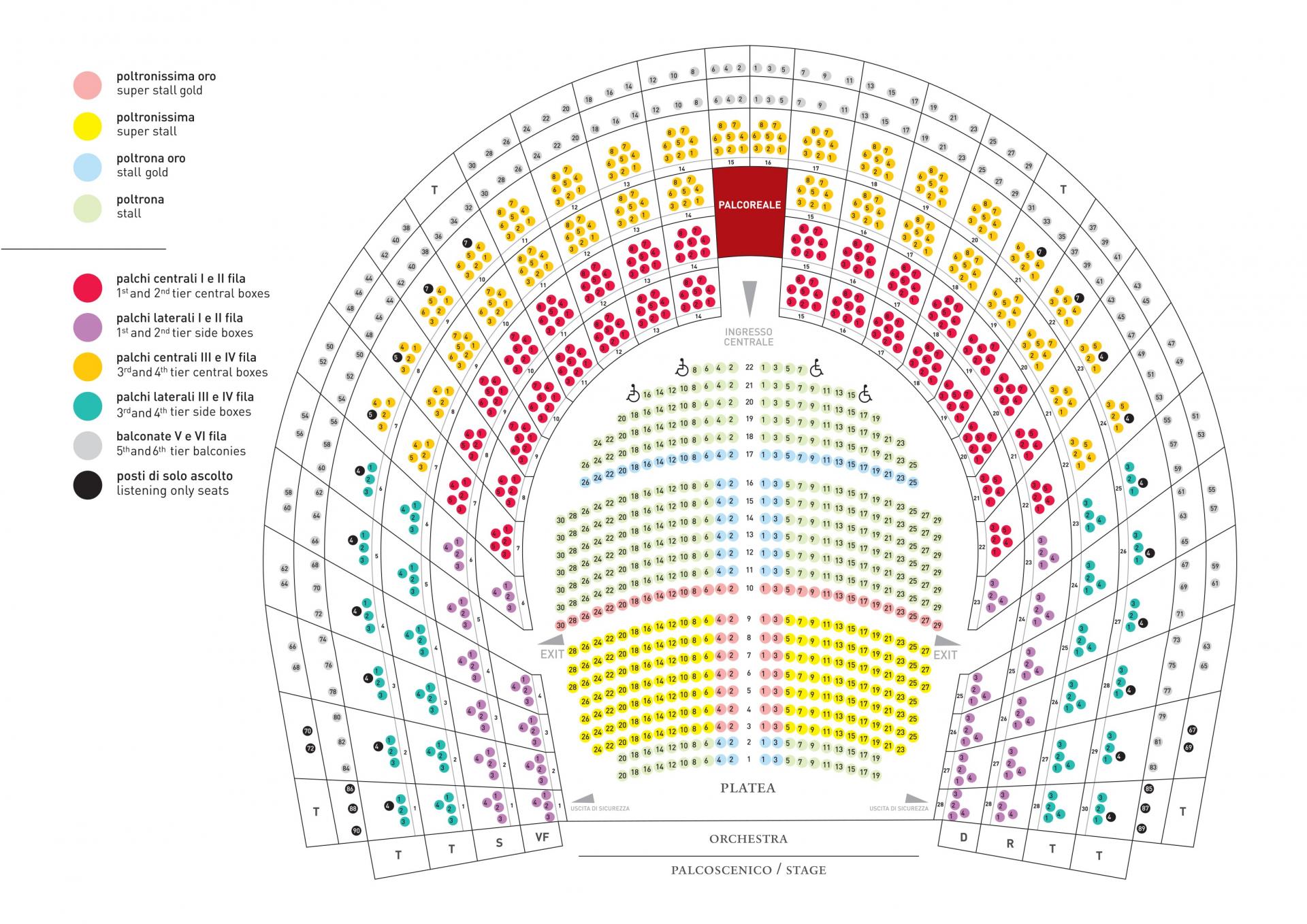
The opera season runs from late January to May, with the ballet season taking place from April to early June. The house once had a seating capacity of 3,285.but nowadays has been reduced to 1414 seats.[3] Given its size, structure and antiquity was the model for the following theatres in Europe.
History of the opera house
Commissioned by the Bourbon King Charles VII of Naples (Carlo VII in Italian), Charles wanted to endow Naples with a new and larger theatre to replace the old, dilapidated, and too-small Teatro San Bartolomeo of 1621, which had served the city well, especially after Scarlatti had moved there in 1682 and had begun to create an important opera centre which existed well into the 1700s.
Thus, the San Carlo was inaugurated on 4 November 1737, the king's name day, with the performance of the opera Domenico Sarro's Achille in Sciro, which was based on the 1736 libretto by Metastasio which had been set to music that year by Antonio Caldara. As was customary, the role of Achilles was played by a woman, Vittoria Tesi, called "Moretta"; the opera also featured soprano Anna Peruzzi, called "the Parrucchierina" and tenor Angelo Amorevoli. Sarro also conducted the orchestra in two ballets as intermezzi, created by Gaetano Grossatesta, with scenes designed by Pietro Righini. The first seasons highlighted the royal preference for dance numbers, and featured among the performers famous castrati.
In the late 18th century, Christoph Willibald Gluck was called to Naples by the impresario Tufarelli to direct his 1852 Clemenza di Tito at the theatre, and Johann Christian Bach in 1761-62 brought two operas, Catone in Utica and Alessandro nell'Indie.
1737: Construction of the Teatro di San Carlo
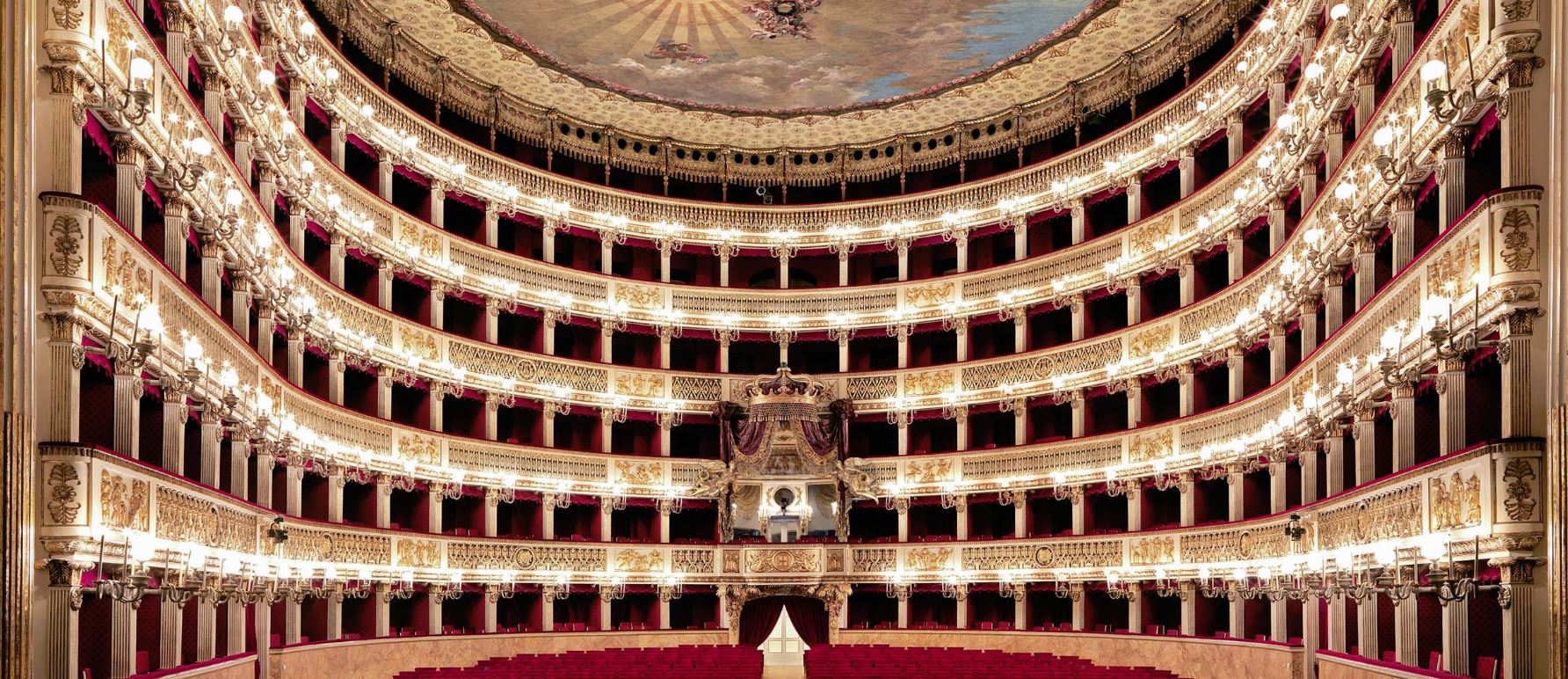
The new opera house was designed by Giovanni Antonio Medrano, a military architect, and Angelo Carasale, the former director of the San Bartolomeo. The horseshoe-shaped auditorium is the oldest in the world. It was built at a cost of 75,000 ducats. The hall was 28.6 meters long and 22.5 meters wide, with 184 boxes, including those of proscenium, arranged in six orders, plus a royal box capable of accommodating ten people, for a total of 1,379 seats. Including standing room, the theatre could hold over 3,000 people. The fastidious composer and violinist Louis Spohr reviewed the size and acoustic properties of this opera house very thoroughly on 15 February 1817 and concluded that:
there is no better place for ballet and pantomime. Military movements of infantry and cavalry, battles, and storms at sea can be represented here without falling into the ludicrous. But for opera, itself, the house is too large. Although the singers, Signora Isabella Colbran, [Prima Donna of the Teatro San Carlo opera company and Rossini's future wife], and the Signori Nozzari, Benedetti, etc., have very strong voices, only their highest and most stentorian tones could be heard. Any kind of tender utterance was lost.
Much admired for its architecture, its gold decorations, and the sumptuous blue upholstery (blue and gold being the official colours of the Bourbons), the San Carlo was now the biggest opera house in the world.[6] In relation to the power of the existing Bourbon Kingdom of the Two Sicilies, Beauvert notes that the design of the house, with its 184 boxes lacking any curtains was so that "no one could avoid the scrutiny by the sovereign" who had his private access from the Royal Palace.
In 1809 Domenico Barbaia was appointed manager of the royal opera houses in Naples and remained in charge until 1841. He soon established a reputation for innovative and dazzling productions, which attracted both the public and leading singers to the opera house.
Related events