
 EN
EN DE
DE IT
IT FR
FR ES
ES RU
RU JP
JP RO
RO
Fauré's Requiem, Beethoven's 3rd Symphony
Order tickets
 April 2032 April 2032 | ||||||
|---|---|---|---|---|---|---|
Mo | Tu | We | Th | Fr | Sa | Su |
The Helios Orchestra is a professional musical ensemble based in Paris, founded in 2015 by Paul Savalle with the aim of bringing classical music to a wide audience in iconic heritage venues. The orchestra's approach combines artistic excellence, accessibility, and the promotion of cultural heritage.
Composed of professional musicians from leading French and European orchestras, the Helios Orchestra performs a wide-ranging repertoire, from Baroque masterpieces to the great works of Romanticism, including major sacred and symphonic pieces. The programs are designed to offer audiences an immersive musical experience, highlighting both the richness of the works performed and the exceptional acoustics of the venues.
The Helios Orchestra distinguishes itself by performing in historic Parisian buildings, particularly churches and monuments of significant cultural importance. This artistic and heritage-focused approach fosters a dialogue between music, architecture, and spirituality, while attracting a broad audience that includes international visitors, those seeking new experiences, and seasoned music lovers and musicians familiar with the classical repertoire.
Alongside these concerts in heritage venues, the Helios Orchestra also performs in concert halls, thus expanding its broadcast formats and artistic possibilities, in order to respond to a diversity of audiences and projects.
Beyond concerts, the Helios Orchestra develops regular collaborations with renowned choirs, soloists, and artists, as well as projects with an event-based or educational focus. Collaboration with different conductors plays a vital role in the ensemble's dynamic, enriching the diversity of interpretations, stimulating the musicians, renewing collective energy, and contributing to a stronger impact on audiences. Each production is the result of in-depth work, with particular attention paid to artistic quality and the overall coherence of the programs offered.
Through its identity, professionalism and artistic vision, the Helios Orchestra has established itself today as an engaged player in Parisian musical life, working towards a vibrant and demanding classical music, resolutely focused on the public, and driven by a strong desire to transmit the classical repertoire.
Program and cast
Gabriel Fauré's Requiem in D minor, Op. 48, written in his prime, is one of his best-known works.
It was premiered on January 16, 1888, at the Church of the Madeleine. This Mass for the Dead is considered one of Fauré's masterpieces and one of the most beautiful requiems of the 19th century. The work, written in a highly personal style, contains several pieces that can be ranked among the most moving in Western choral music.
The Canticle of Jean Racine, Op. 11, is a vocal piece composed in 1865 by Gabriel Fauré, then aged 19. Written for choir (soprano, alto, tenor and bass) with piano or organ, this piece is in the key of D-flat major.
After an introduction played on the piano (or organ), the choir enters section by section. At the fortieth bar, after an instrumental bridge, a modulating central section enters in A-flat major (then B-flat minor), where the work reaches its highest expressive level. Through a slow and solemn return, the piece then evolves back to its initial character.
There is a version for choir, harmonium and string quintet (1866) and a version for choir and orchestra (1906).
Dedicated to César Franck, the score won first prize for composition at the graduation competition of the Niedermeyer School in Paris, where Fauré was a student.
The Symphony No. 3 in E-flat major, known as the Eroica, Op. 55, is one of Ludwig van Beethoven's most significant works. Composed between 1803 and 1804, it was publicly premiered on April 7, 1805, at the Theater an der Wien in Vienna.
Originally dedicated to Napoleon Bonaparte, the symphony had its dedication removed when he proclaimed himself emperor. Beethoven then dedicated it to the memory of "a great man," before officially dedicating it to his patron, Prince Lobkowitz.
With its unprecedented scope, expressive power, and heroic ideal, the Eroica marks a major break with classicism and heralds the advent of musical romanticism. Beethoven himself considered it one of his greatest symphonies.
Composed of professional musicians from leading French and European orchestras, the Helios Orchestra performs a wide-ranging repertoire, from Baroque masterpieces to the great works of Romanticism, including major sacred and symphonic pieces. The programs are designed to offer audiences an immersive musical experience, highlighting both the richness of the works performed and the exceptional acoustics of the venues.
Photo gallery


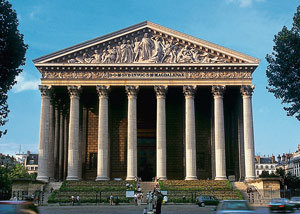
Church of the Madeleine
The parish of La Madeleine wishes to ensure a visible presence in the heart of Paris and to be attentive to our contemporaries. We speak of the base to describe the stone massifs that form the foundation of the church. But this base is also made of living stones made up of associations attentive to the wounded of life such as Ozanam Madeleine, the Espace Formation Informatique. The Foyer de la Madeleine serves more than three hundred meals every day at lunchtime with the aim of encouraging people to meet people who work or spend time in the neighbourhood.

Related events