
 EN
EN DE
DE IT
IT FR
FR ES
ES RU
RU JP
JP RO
RO
© Wiener Staatsoper
The Daughter of the Regiment
Order tickets
 December 2026 December 2026 | ||||||
|---|---|---|---|---|---|---|
Mo | Tu | We | Th | Fr | Sa | Su |
The Daughter of the Regiment – Gaetano Donizetti | Opera
Opéra comique in two acts
Libretto by Jules Henri Vernoy de Saint-Georges & Jean François Alfred Bayard
Language: French
About the work
Marie, raised as a foundling by the 21st Regiment, grows up as a vivandière among her many “fathers” and follows the soldiers into war.
In Tyrol, she falls in love with the young Tonio, who joins the regiment out of love for her. Their happiness is disrupted when an alleged aunt takes Marie to her castle to educate her according to her rank and marry her off to a suitable husband. Marie feels uncomfortable in this unfamiliar world and longs for her simple life. In the end, love prevails: Marie returns to her regiment and to Tonio.
Act 1 – approx. 90 minutes
Interval – 25 minutes
Act 2 – approx. 55 minutes
Storyline
Act 1
The Marquise de Berkenfield and her steward Hortensius are surprised by the arrival of a French regiment on the day of their escape to Austria.
The marquise suddenly finds herself surrounded by villagers: the men are carrying weapons, the women are praying to the Virgin. Perhaps in answer to the prayer, the French retreat to the Marquise's relief(Pour une femme de mon nom). She can go to rest. Left alone, Hortensius meets Sulpice, a sergeant of the 21st regiment. Although Hortensius' fear makes him suspicious, he is given a pass for himself and his mistress.
Sulpice is visited by the young Marie, who was found as a child on a battlefield fifteen years earlier(Au bruit de la guerre, j'ai reçu le jour). She has been adopted as a daughter by the entire 21st regiment(Mon régiment, j'en suis fière vraiment) and has since been marching with the soldiers as a sutler(Nommée à l'unanimité). For some time she has been seeing the Tyrolean partisan Tonio, with whom she has fallen in love. When Sulpice tells Marie, not very happily, that she has been seen at these meetings, she reassures him by telling him that she does not want to see the young man again in future. Tonio is then led in as a prisoner of the troupe(C'est un traître, qu'il périsse). He had risked his life to meet Marie. To save him, Marie tells the soldiers that Tonio had once saved her when she was in danger of falling from a rock while picking flowers(Quoi! La mort à celui qui me sauva la vie!). The soldiers toast this news with their new friend, Marie's rescuer. Marie sings the regimental song(Il est là, morbleu, le beau Vingt-et-unième).
The regiment sets off together with Tonio, but he manages to escape unnoticed and return to Marie(Quoi! Vous m'aimez?). Sulpice surprises them both. Marie has to tell Tonio that she can only marry a soldier from the 21st regiment. But he has no intention of giving up.
Sulpice authorizes an escort for the Marquise de Berkenfield to take her safely to her castle. When the Marquise mentions her name, Sulpice remembers exactly how he had read this name in a letter he had found on the battlefield near the young Marie fifteen years ago. Now it turns out that the marquise is the aunt of the regiment's daughter. Appalled by Marie's behavior, the marquise decides to take her niece to her castle to give her an education befitting her station.
Unfortunately, at this very moment Tonio has enlisted as a soldier(Ah! Mes amis, quel jour de fête!). Now he could marry Marie, but she has to leave both her beloved husband and her regiment(Il faut partir).
Act 2
The Marquise is at home in her castle, where she has just arranged Marie's advantageous marriage to Duke Scipion de Crakentorp. Sulpice, who is supposed to help re-educate Marie, is also at the castle.
The educational program includes musical training, and so Marie is supposed to sing an aria by an Italian composer(Le jour naissait dans le bocage). However, Sulpice tempts Marie to deliberately misbehave(Rataplan, c'est le refrain du régiment). In her performance, she mixes the aria with military songs. The Marquise loses patience, Marie feels miserable(Sous les bijoux et la dentelle, je cache un chagrin sans espoir). Suddenly, the entire regiment enters the castle together with Tonio(C'est elle, notre fille!). The soldiers take Hortensius into custody while Tonio and Sulpice seek out Marie(Tous les trois réunis).
Tonio asks the Marquise for Marie's hand in marriage(Pour me rapprocher de Marie). When she refuses, Tonio reveals what he has learned from his uncle: that the Marquise is not Marie's aunt and that he is therefore prepared to abduct the young woman. Left alone with Sulpice, the Marquise confesses the truth: she herself is Marie's mother, and the girl's father is a certain Captain Robert. She had left the girl behind out of fear that their improper relationship would be discovered.
The guests invited to the signing of the marriage contract appear. Marie refuses to leave her room. The Marquise is at her wit's end and the imposing Duchess de Crakentorp begins to grow impatient. Sulpice tells Marie the secret of her birth, and she can no longer resist. Marie leaves her room and is ready to sign the marriage contract when Tonio and the soldiers suddenly burst in(Au secours de notre fille, nous accourons tous ici). The guests are horrified when they learn that the young girl has been a sutler(Une Fille de régiment), but change their minds as they recognize Marie's feelings(Au fait, elle est charmante!). The Marquise, who does not want to sacrifice her daughter, accepts the marriage to Tonio. Everyone joins in the final chorus Salut à la France.
Program and cast
Marie, young vivandière: Erin Morley
Tonio, young peasant: Xabier Anduaga
Sulpice, sergeant: Misha Kiria
Duchess of Crakentorp: Brigitte Kren
Musical direction: Evelino Pidò
Staging and costumes: Laurent Pelly
Set design: Chantal Thomas
Lighting: Joël Adam
Choreography: Laura Scozzi
Dialogue adaptation: Agathe Mélinand
Vienna State Opera
Public Transport
Subway lines: U1, U2, U4
Trams: 1, 2, D, J, 62, 65
Buses: 59A
Local Railway: Badner Bahn
Stops: Karlsplatz / Opera
Taxi stands are available nearby.
Parking
Parking is only € 6, - for eight hours!
The Wiener Staatsoper and the ÖPARK Kärntner Ring Garage on Mahlerstraße 8, under the “Ringstraßengalerien”, offer the patrons of the Vienna State Opera a new, reduced parking fee. You can park in the Kärntner Ring Garage for up to 8 hours and pay only a flat fee of € 6, -. Just validate your ticket at one of the discount machines inside the Wiener Staatsoper. The normal rate will be charged for parking time greater than 8 hours. The validation machines can be found at the following coat checks: Operngasse, Herbert von Karajan-Platz, and the right and left and balcony galleries.
Important: In order to get the discount, please draw a ticket and do not use your credit card when entering the garage!
After devaluing your ticket in the Wiener Staatsoper you can pay comfortably by credit card or cash at the vending machines.
The machines accept coins and bills up to 50.- Euro. Parking time longer than 8 hours will be charged at the normal rate.
History
The structure of the opera house was planned by the Viennese architect August Sicard von Sicardsburg, while the inside was designed by interior decorator Eduard van der Nüll. It was also impacted by other major artists such as Moritz von Schwind, who painted the frescoes in the foyer, and the famous "Zauberflöten" (“Magic Flute”) series of frescoes on the veranda. Neither of the architects survived to see the opening of ‘their’ opera house: the sensitive van der Nüll committed suicide, and his friend Sicardsburg died of a stroke soon afterwards.
On May 25, 1869, the opera house solemnly opened with Mozart's Don Giovanni in the presence of Emperor Franz Joseph and Empress Elisabeth.
The popularity of the building grew under the artistic influence of the first directors: Franz von Dingelstedt, Johann Herbeck, Franz Jauner, and Wilhelm Jahn. The Vienna opera experienced its first high point under the direction of Gustav Mahler. He completely transformed the outdated performance system, increased the precision and timing of the performances, and also utilized the experience of other noteworthy artists, such as Alfred Roller, for the formation of new stage aesthetics.
The years 1938 to 1945 were a dark chapter in the history of the opera house. Under the Nazis, many members of the house were driven out, pursued, and killed, and many works were not allowed to be played.
On March 12, 1945, the opera house was devastated during a bombing, but on May 1, 1945, the “State Opera in the Volksoper” opened with a performance of Mozart's THE MARRIAGE OF FIGARO. On October 6, 1945, the hastily restored “Theaters an der Wien” reopened with Beethoven's FIDELIO. For the next ten years the Vienna State Opera operated in two venues while the true headquarters was being rebuilt at a great expense.
The Secretary of State for Public Works, Julius Raab, announced on May 24, 1945, that reconstruction of the Vienna State Opera would begin immediately. Only the main facade, the grand staircase, and the Schwind Foyer had been spared from the bombs. On November 5, 1955, the Vienna State Opera reopened with a new auditorium and modernized technology. Under the direction of Karl Böhm, Beethoven’s FIDELIO was brilliantly performed, and the opening ceremonies were broadcast by Austrian television. The whole world understood that life was beginning again for this country that had just regained its independence.
Today, the Vienna State Opera is considered one of the most important opera houses in the world; in particular, it is the house with the largest repertoire. It has been under the direction of Dominique Meyer since September 1, 2010.
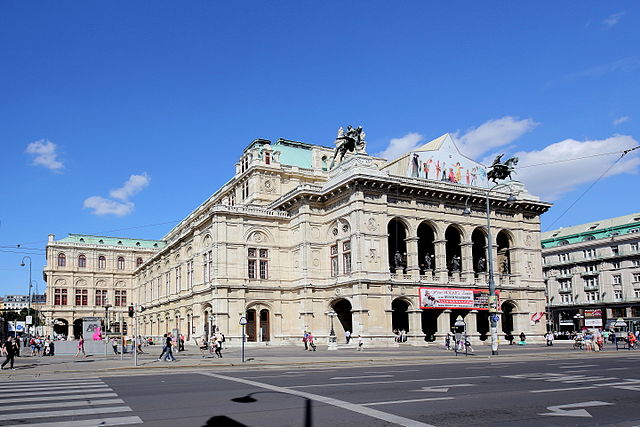
© Wiener Staatsoper
Related events