
 EN
EN DE
DE IT
IT FR
FR ES
ES RU
RU JP
JP RO
RO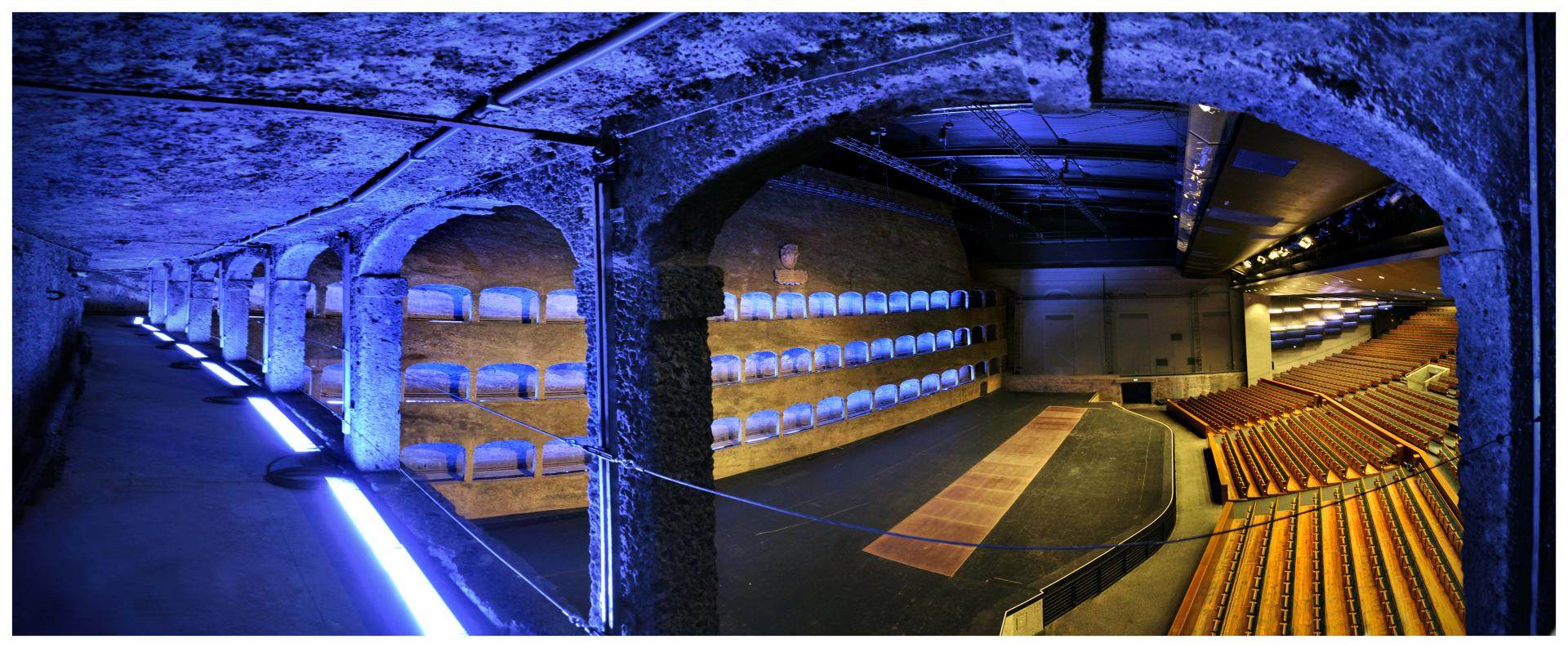
© Salzburger Festspiele / Luigi Caputo
Lucio Silla
Order tickets
 October 2028 October 2028 | ||||||
|---|---|---|---|---|---|---|
Mo | Tu | We | Th | Fr | Sa | Su |
Opera seria in three acts K. 135 (1772)
Libretto by Giovanni de Gamerra
Semi-staged performance
Synopsis
The story concerns the Roman dictator Lucio Silla (Lucius Sulla) who lusts after Giunia, the daughter of his enemy Gaius Marius. Giunia, on the other hand, loves the exiled senator Cecilio.
Act 1
Scene 1: A secluded spot on the banks of the Tiber'
The exiled Senator Cecilio meets his friend Cinna who tells him his betrothed Giunia mourns his death, a lie by the dictator Silla so that he can win her for himself. Cinna advises Cecilio to meet Giunia by the tomb of her father (murdered hero Gaius Marius). Cecilio is filled with joy at the idea and Cinna shares his joy and predicts the freedom of Rome (aria: "Vieni ov' amor t' inita").
Scene 2
Cecilio excited at the prospect of meeting his betrothed sings of his love (aria: "Il tenero momento").
Scene 3: Giunia's apartments
Silla seeks the advice of his sister Celia on his approach with Giunia and she advises subtlety and kindness (aria: "Se lusinghiera speme").
Scene 4
On Silla's approach, Giunia declares her love for Cecilio and her hate for Silla, her father's enemy (aria: "Dalla sponda tenebrosa").
Scene 5
Alone, Silla, insulted, decides to behave as a tyrant (aria: "Il desìo di vendetta, e di morte").
Scene 6
Cecilio waits by the tomb for Giunia.
Scene 7
Giunia arrives (chorus and ariosa: "Fuor di queste urne dolente").
Act 2
An archway decorated with military trophies
Silla is joined by Celia to whom he tells of his plans to wed Giunia and for Celia to wed her beloved Cinna on this day.
Scene 3
Cinna restrains Cecilio who has his sword drawn trying to follow Silla, believing he has been instructed by the spirit of Gaius Marius to seek revenge. Cinna tells him to consider Giunia and his rage is controlled (aria: "Quest' improvviso trèmito").
Scene 4
Giunia consults with Cinna who suggests she accept Silla's proposal and then murder him in their wedding bed. Giunia refuses, stating that vengeance is for Heaven alone to consider. She asks Cinna to make sure that Cecilio stays hidden from danger (aria: "Ah se il crudel periglio").
Scene 5
Cinna resolves to kill Silla himself (aria: "Nel fortunato istante").
Scene 6, Hanging gardens
Silla's love for Giunia starts to bring out his compassion.
Scene 7
Giunia's hateful face angers him again and he threatens her with death but not to die alone (aria: "D' ogni pieta mi spoglio").
Scene 8
With Cecilio, Giunia worries about Silla's words and they part.
Scene 9
Celia asks Giunia to accept Silla's proposal for the sake of happiness saying she is also to be married to Cinna (aria: "Quando sugl' arsi campi").
Scene 10
Giunia ponders her wretchedness.
Scene 11, the Capitol
Silla asks the Senate and the people of Rome to reward him as a hero of Rome with the marriage to Giunia.
Scene 12
When Cecilio appears, there is confrontation (trio: "Quell' orgoglioso sdegno").
Act 3
Scene 1: Entrance to the dungeons
Cecilio has been imprisoned. Cinna and Celia has gained access and Cinna asks Celia to convince Cecilio to repent and forget his love. Cinna promises to marry Celia if she is successful, for which she is hopeful (aria: "Strider sento la procella").
Scene 2
Whilst Cecilio accepts his fate Cinna tells him not to worry, Silla's heart over his head will bring about his own downfall (aria: "De' più superbi il core").
Scene 3
Silla has allowed Giunia one last visit to Cecilio and they say their farewells (aria: "Pupille amate").
Scene 4
Giunia alone with her thoughts of Cecilio's impending death thinks of her own (aria: "Frà I pensier più funesti di morte").
Scene 5: The audience chamber
Before the Senators and the people of Rome, to everybody's surprise, Silla declares that he wishes Cecilio to live and marry Giunia. When questioned on his silence, Cinna declares his hatred of Silla and his intention of killing him. Silla issues his "punishment" to Cinna that he should marry his beloved Celia. He further declares that he will step down as dictator and restore liberty to Rome. He explains that he has seen proof that innocence and a virtuous heart is triumphant over power and glory. The people of Rome celebrate liberty and the greatness of Silla.
Program and cast
Sung in Italian with German and English surtitles
Creative Team
Adam Fischer: Conductor
Birgit Kajtna-Wönig: Semi-staging
Cast
Giovanni Sala: Lucio Silla
Sara Blanch: Giunia
Xenia Puskarz Thomas: Cecilio
Martina Russomanno: Lucio Cinna
Lilit Davtyan: Celia
Ensembles
Salzburg Bach Choir
Michael Schneider: Chorus Master
Rupert Burleigh: Fortepiano
Mozarteum Orchestra Salzburg
Felsenreitschule
It was Max Reinhardt who suggested that the Winter Riding School should be converted, and it was also his idea to transform the Summer Riding School (Felsenreitschule) into a theatre. During the first half of the 17th century conglomerate rock was quarried here for the building of the cathedral. In 1693, during the reign of Prince-Archbishop Johann Ernst Thun, according to plans by the Baroque master architect Johann Bernhard Fischer von Erlach, three tiers of 96 arcades were hewn into the walls of the disused quarry so that from here people could watch equestrian displays and animal baiting events.
In 1926, when Max Reinhardt first attempted to use the Felsenreitschule to stage Goldoni’s Servant of Two Masters for the Salzburg Festival, the ambience was ideal for the “realistic” character comedy in the style of popular theatre: the action took place on a so-called Pawlatschenbühne, a small raised platform, the ground consisted of compressed earth and the audience sat on wooden benches. In 1933 Clemens Holzmeister built a remarkable set for the production of Faust in the Felsenreitschule, the Faust Town which is still regarded as one of the most impressive transformations of this venue. The first opera production in the Felsenreitschule took place in 1948 when Herbert von Karajan conducted Gluck’sOrfeo ed Euridice.
From the end of the 1960s radical conversion and adaptation work took place, mainly according to plans by the “festival architect” Clemens Holzmeister. An understage area, an orchestral pit and a lighting bridge were installed, a weatherproof roll-back roof to offer protection against rain and cool summer evenings, and finally an auditorium with boxes and circles as well as a depot for scenery were created.
Jean-Pierre Ponnelle’s staging of Mozart’s Die Zauberflöte, which was presented here every summer from 1978 to 1986, achieved legendary status. The same is true of Shakespeare’s plays Julius Caesar, Coriolanus and Anthony and Cleopatra in the productions by Peter Stein and Deborah Warner (Coriolanus),which in the early 1990s were internationally acclaimed.
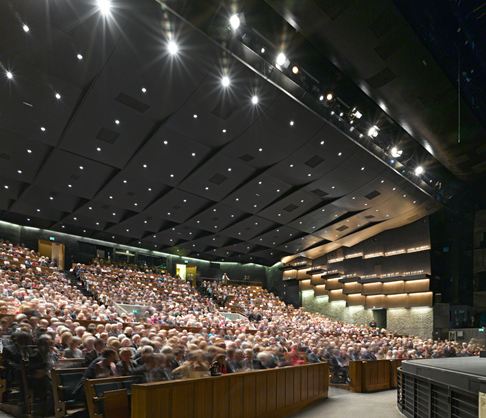
When the Haus für Mozart was built, the Felsenreitschule already received a new audience grandstand, which resulted in improved sightlines and acoustics for the audience.
Improvements are:
- A new roof construction with two fixed girders at the edges and three elements supported by five telescope cantilevers: the slightly inclined pitch roof consisting of three mobile segments resting on five telescope arms will be retractable and expandable within six minutes. Hanging points on the telescope cantilevers for stage technology (chain hoists), improved acoustical and heat protection and two lighting bridges will optimize the stage action.
- New security technology including electrical installations, stage lighting, effect lighting and effect sound.
- In addition, the interior expansion of the 3rd floor will be completed at that time, and the building shell of the newly constructed 4th floor under the roof of the Felsenreitschule will be made available to the Festival – this being the last instance in which new space can be created within the Festival District.

Related events