
 EN
EN DE
DE IT
IT FR
FR ES
ES RU
RU JP
JP RO
RO
Nabucco
Order tickets
June 2027  | ||||||
|---|---|---|---|---|---|---|
Mo | Tu | We | Th | Fr | Sa | Su |
Nabucco – Giuseppe Verdi
Contemporary | Opera
Running time: 3 hours including two intervals
Language: Italian
Surtitle: Hungarian, English, Italian
At age 27, Verdi resolved to never write opera again. He was at a low point in his life, both professionally and personally: His comic opera, Un giorno di regno, had failed, and around the same time he had to bury his two young children, and then his wife. After some convincing by his agent, he read Solera’s libretto, Nabucco, and by spring of 1842, all of Milan was humming “Va, pensiero...” The central point of the opera stands at a historical crossroads: value systems are changing and life is coming under the control of interrelationships starkly contasting previously in place. In the crosshairs of this conflict between vanquisher and vanquished unfolds a family drama in which the music of the Italian master leads the listener through the entire range of possible emotions. The production lifts the story out of the biblical era and places it into the realm of the cosmic.
Parental guidance: The performance is not recommended for children under 14 years of age.
Synopsis
Act I
For I have set my face against this city for evil, and not for good, saith the Lord: it shall be given into the hand of the king of Babylon, and he shall burn it with fire. (Jeremiah 21:10)
Jerusalem. The Hebrews pray for aid in the temple of Solomon as Nabucco, King of Babylon, advances on the city. The High Priest Zaccaria arrives with Nabucco's daughter Fenena, who is being held captive by the Hebrews. He reassures his people that the Almighty will not abandon them. Ismaele and Fenena, who had fallen in love with each other during the period of the Babylonian captivity, remain alone together. He had escaped with help from the girl, who then followed him to Jerusalem. Their discussion is interrupted by the appearance of Abigaille, Fenena's half-sister. She too is in love with Ismaele, whose people she will deliver from Nabucco if only he will reciprocate her feelings, but the youth rejects her offer. The Hebrews retreat to the sanctuary as Nabucco leads his troops into the temple, where Zaccaria threatens to kill Fenena. Ismaele disarms the high priest and hands Fenena over to Nabucco, who orders that the holy edifice be destroyed.
Act II
Behold, the whirlwind of the Lord goeth forth with fury, a continuing whirlwind: it shall fall with pain upon the head of the wicked. (Jeremiah 30:23)
Babylon. In Nabucco's absence, Fenena is serving as regent. Abigaille learns that she is descended from slaves. Calculating that Fenena will soon be ruling over Babylon at Ismaele's side, she swears revenge against her sister and father. Fenena releases the Hebrew captives. The High Priest of Baal declares this to be treason and places Abigaille on the throne, spreading the rumour that Nabucco has died. Zaccaria prays for the Babylonians to give up idolatry. Fenena converts to Judaism. Abigaille and the High Priest of Baal seize her, and the new ruler is about to coronate herself when Nabucco enters. He takes the crown away from her and declares that he is not only a king, he is also God. After he is suddenly struck down by a vengeful bolt of lightning, the victorious Abigaille takes the crown for herself.
Act III
Therefore the wild beasts of the desert with the wild beasts of the islands shall dwell there, and the owls shall dwell therein: and it shall be no more inhabited for ever; neither shall it be dwelt in from generation to generation. (Jeremiah 50:39)
In the hanging gardens of Babylon, Abigaille is being exalted by her court. The High Priest of Baal is urging for the Hebrews to be executed, but before the Queen can order this, the still raving Nabucco appears. Abigaille tricks him into delivering the death sentence, which also applies to Fenena. To no avail, Nabucco pleads for his child's life. On the banks of the Euphrates, the Hebrew captives dream of returning home. Zaccaria prophesies their liberation and the downfall of Babylon.
Act IV
Declare ye among the nations, and publish, and set up a standard; publish, and conceal not: say, Babylon is taken, Baal is confounded, Merodach is broken in pieces; her idols are confounded, her images are broken in pieces. (Jeremiah 50:2)
From his prison cell, Nabucco watches as the Hebrews, together with Fenena, are led in for execution. In his despair, he prays to the God of Israel for forgiveness, vowing that he and his people will take up the Jewish faith. His mind suddenly unclouded, he assembles his troops and leads them to regain the throne and save his daughter's life. Fenena is praying for forgiveness in heaven when Nabucco rushes in and halts the execution. Repenting of her deed, Abigaille poisons herself and begs God for forgiveness. Nabucco converts to Judaism, grants the captives their freedom and sends them on their way home to rebuild the temple. Jews and Babylonians together praise the Lord.
Program and cast
Conductor: Gergely Kesselyák
Nabucco: Alexandru Agache, Michele Kalmandy
Ismaele: István Horváth
Zaccaria: Krisztián Cser, András Palerdi
Abigaille: Eszter Sümegi, Csilla Boross
Fenena: Gabriella Balga
High priest of Baal: Boldizsár Zajkás
Abdallo: Gergely Ujvári
Anna: N. N.
Featuring the Hungarian State Opera Orchestra, Chorus and the students of the Hungarian Dance University
Director: Gergely Kesselyák
Gergely Kesselyák's direction applied to the Opera House's stage by Erika Tóth
Set designer: Edit Zeke
Set designer: Janó Papp
Choreographer: Attila Kozma
Hungarian translation by Ferenc Anger
English translation by Arthur Roger Crane
Chorus director: Gábor Csiki
Composer: Giuseppe Verdi
Librettist: Temistocle Solera
Hungarian State Opera
STANDING ROOM TICKETS - INFORMATION IN CASE OF A FULL HOUSE!
If all the seats are sold out for the selected time, but you still want to see the production on that day, 84 of the extremely affordable standing seats will be sold at the theatre, 2 hours before the start of the performance, with which you can visit the gallery on the 3rd floor. Tickets can be purchased at the ticket office of the Budapest Opera House. We would like to draw your attention to the fact that the stage can only be seen to a limited extent from the standing places and the side seats, but at the same time, following the performance is also supported by television broadcasting on the spot.
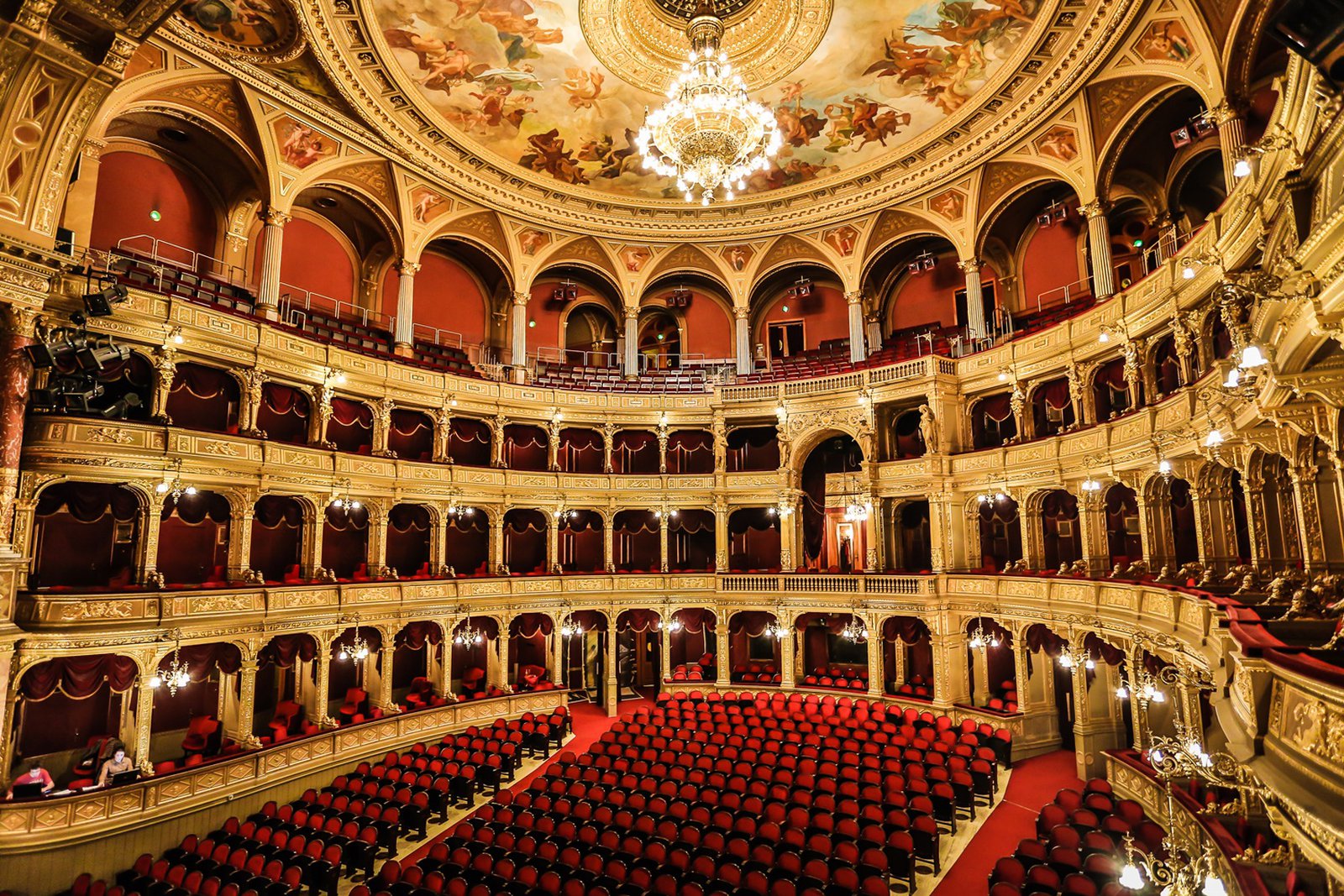
The Opera House is not only one of the most significant art relic of Budapest, but the symbol of the Hungarian operatic tradition of more than three hundred years as well. The long-awaited moment in Hungarian opera life arrived on September 27, 1884, when, in the presence of Franz Joseph I. the Opera House was opened amid great pomp and ceremony. The event, however, erupted into a small scandal - the curious crowd broke into the entrance hall and overran the security guards in order to catch a glimpse of the splendid Palace on Sugar út. Designed by Mikós Ybl, a major figure of 19th century Hungarian architecture, the construction lived up to the highest expectations. Ornamentation included paintings and sculptures by leading figures of Hungarian art of the time: Károly Lotz, Bertalan Székely, Mór Than and Alajos Stróbl. The great bronze chandelier from Mainz and the stage machinery moda by the Asphaleia company of Vienna were both considered as cutting-edge technology at that time.
Many important artists were guests here including Gustav Mahler, the composer who was director in Budapest from 1887 to 1891. He founded the international prestige of the institution, performing Wagner operas as well as Magcagni’ Cavalleria Rusticana. The Hungarian State Opera has always maintained high professional standards, inviting international stars like Renée Fleming, Cecilia Bartoli, Monserrat Caballé, Placido Domingo, Luciano Pavarotti, José Cura, Thomas Hampson and Juan Diego Flórez to perform on its stage. The Hungarian cast include outstanding and renowed artists like Éva Marton, Ilona Tokody, Andrea Rost, Dénes Gulyás, Attila Fekete and Gábor Bretz.
©

Related events