
 EN
EN DE
DE IT
IT FR
FR ES
ES RU
RU JP
JP RO
RO
© Wiener Staatsoper
Norma
Order tickets
 April 2028 April 2028 | ||||||
|---|---|---|---|---|---|---|
Mo | Tu | We | Th | Fr | Sa | Su |
Norma – Vincenzo Bellini | Opera
Melodrama in two acts
Text: Felice Romani
Language: Italian
About the work
Norma is a Gallic druid priestess devoted to the peace-bringing goddess of the moon and fertility.
She refuses to give the warlike Gauls the signal to revolt against Roman rule. The two children she has borne in a secret union with the Roman Pollione are kept hidden from her people. When her partner attempts to betray her with a younger woman, her world begins to collapse. She overcomes the temptation to kill her children and punish her rival. By confessing her own guilt, she ultimately saves their lives.
Act 1 – approx. 90 minutes
Interval – approx. 25 minutes
Act 2 – approx. 60 minutes
Storyline
Act 1
Oroveso, the head of the Druids, obliges the Gauls not to take any action against the hated Roman foreign rule without divine approval. When the moon rises, his daughter, the priestess Norma, proclaims the divine will. The men call upon Irminsul, the god of war: May he give the signal to revolt.
Pollione, the Roman proconsul, secretly has a marriage-like relationship with Norma. They have two children. But Pollione has sneaked into the temple not to see his family, but for the sake of Adalgisa, a young priestess with whom he has fallen in love.
Norma appears before the people. She prophesies the downfall of Rome: "One day it will die, but not because of you. It will perish from its own vices." Her spiritual authority compels the Gauls to join in the prayer to the moon goddess with a plea for peace. She then dismisses the congregation. Once again, she has saved Pollione and her children from the danger of an uprising.
Pollione tells Adalgisa, who is beset by feelings of love and guilt, that he is returning to Rome. Adalgisa decides to follow him.
Norma reveals her fears to her confidante Clotilde about Pollione's estrangement from her. Adalgisa confesses to Norma that she has fallen in love. To her surprise, Norma releases her from her vows. But when it is revealed that her lover is the father of Norma's children, Adalgisa rejects Pollione as a liar. Norma curses him.
Act 2
Norma believes she has to kill her children: with the Gauls, they are certain to die, with the Romans, slavery is "worse than death". She is unable to do so. She now asks Adalgisa to marry Pollione and take care of her two children as their stepmother. But Adalgisa succeeds in giving Norma, who is determined to commit suicide, hope again: she herself wants to persuade Pollione to return to her and the children.
Oroveso warns the Gauls who want to attack the Roman camp to exercise restraint, as Pollione is to be replaced by a much more brutal proconsul.
Clotilde brings Norma the news that Adalgisa's attempt at mediation has failed. Norma gives the signal that the Gauls have been waiting for: open revolt. Pollione is dragged in as a prisoner: he had tried to abduct Adalgisa, who had refused him. Norma makes Pollione a final offer in private: If he is willing to let go of Adalgisa, she will allow him to escape. But his cynical equanimity is only shaken by her threat to have Adalgisa executed in front of him.
Norma calls the people back. She has to denounce the treason of an oath-breaking priestess. But instead of denouncing Adalgisa, she answers the agitated questions about her identity with the words: "It's me." In the face of her self-sacrifice, Pollione professes his love for her again, but Norma leaves his request to forgive him unanswered. Norma confesses to her father Oroveso that she is a mother. Before she is burned at the stake, she manages to persuade the reluctant man to promise to protect her children from the fury of her people.
Program and cast
Pollione: John Osborn
Oroveso: Roberto Tagliavini
Norma: Sonya Yoncheva
Adalgisa: Elmina Hasan
Musical direction: Lorenzo Passerini
Staging: Cyril Teste
Set design: Valérie Grall
Costumes: Marie La Rocca
Video: Mehdi Toutain-Lopez, Nicolas Doremus
Choreography: Magdalena Chowaniec
Lighting: Julien Boizard
Assistant director: Céline Gaudier
Vienna State Opera
Public Transport
Subway lines: U1, U2, U4
Trams: 1, 2, D, J, 62, 65
Buses: 59A
Local Railway: Badner Bahn
Stops: Karlsplatz / Opera
Taxi stands are available nearby.
Parking
Parking is only € 6, - for eight hours!
The Wiener Staatsoper and the ÖPARK Kärntner Ring Garage on Mahlerstraße 8, under the “Ringstraßengalerien”, offer the patrons of the Vienna State Opera a new, reduced parking fee. You can park in the Kärntner Ring Garage for up to 8 hours and pay only a flat fee of € 6, -. Just validate your ticket at one of the discount machines inside the Wiener Staatsoper. The normal rate will be charged for parking time greater than 8 hours. The validation machines can be found at the following coat checks: Operngasse, Herbert von Karajan-Platz, and the right and left and balcony galleries.
Important: In order to get the discount, please draw a ticket and do not use your credit card when entering the garage!
After devaluing your ticket in the Wiener Staatsoper you can pay comfortably by credit card or cash at the vending machines.
The machines accept coins and bills up to 50.- Euro. Parking time longer than 8 hours will be charged at the normal rate.
History
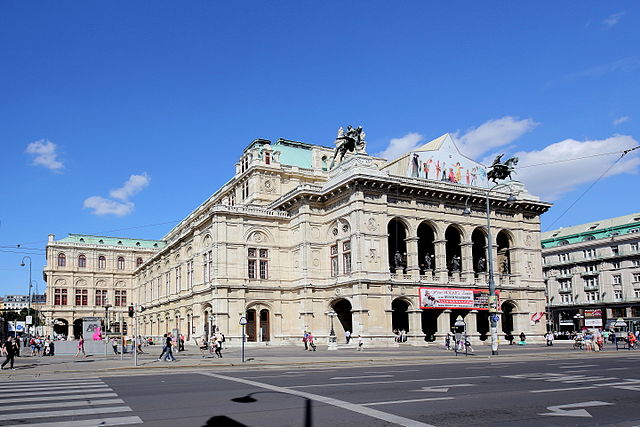
The structure of the opera house was planned by the Viennese architect August Sicard von Sicardsburg, while the inside was designed by interior decorator Eduard van der Nüll. It was also impacted by other major artists such as Moritz von Schwind, who painted the frescoes in the foyer, and the famous "Zauberflöten" (“Magic Flute”) series of frescoes on the veranda. Neither of the architects survived to see the opening of ‘their’ opera house: the sensitive van der Nüll committed suicide, and his friend Sicardsburg died of a stroke soon afterwards.
On May 25, 1869, the opera house solemnly opened with Mozart's Don Giovanni in the presence of Emperor Franz Joseph and Empress Elisabeth.
The popularity of the building grew under the artistic influence of the first directors: Franz von Dingelstedt, Johann Herbeck, Franz Jauner, and Wilhelm Jahn. The Vienna opera experienced its first high point under the direction of Gustav Mahler. He completely transformed the outdated performance system, increased the precision and timing of the performances, and also utilized the experience of other noteworthy artists, such as Alfred Roller, for the formation of new stage aesthetics.
The years 1938 to 1945 were a dark chapter in the history of the opera house. Under the Nazis, many members of the house were driven out, pursued, and killed, and many works were not allowed to be played.
On March 12, 1945, the opera house was devastated during a bombing, but on May 1, 1945, the “State Opera in the Volksoper” opened with a performance of Mozart's THE MARRIAGE OF FIGARO. On October 6, 1945, the hastily restored “Theaters an der Wien” reopened with Beethoven's FIDELIO. For the next ten years the Vienna State Opera operated in two venues while the true headquarters was being rebuilt at a great expense.
The Secretary of State for Public Works, Julius Raab, announced on May 24, 1945, that reconstruction of the Vienna State Opera would begin immediately. Only the main facade, the grand staircase, and the Schwind Foyer had been spared from the bombs. On November 5, 1955, the Vienna State Opera reopened with a new auditorium and modernized technology. Under the direction of Karl Böhm, Beethoven’s FIDELIO was brilliantly performed, and the opening ceremonies were broadcast by Austrian television. The whole world understood that life was beginning again for this country that had just regained its independence.
Today, the Vienna State Opera is considered one of the most important opera houses in the world; in particular, it is the house with the largest repertoire. It has been under the direction of Dominique Meyer since September 1, 2010.
© Wiener Staatsoper
Related events