
 EN
EN DE
DE IT
IT FR
FR ES
ES RU
RU JP
JP RO
RO
© Wiener Staatsoper
Orfeo
Order tickets
 February 2027 February 2027 | ||||||
|---|---|---|---|---|---|---|
Mo | Tu | We | Th | Fr | Sa | Su |
Orfeo – Claudio Monteverdi | Opera
Favola in musica in five acts and a prologue
Text: Alessandro Striggio
Language: Italian
About the work
The happiness of the singer Orpheus and his Eurydice is short-lived: on the day of their wedding, Eurydice dies from a snake bite.
Orpheus refuses to accept fate and decides to descend into the underworld to bring Eurydice back. Through the power of his singing, he gains access to the realm of the dead and persuades its rulers, Proserpina and Pluto, to release Eurydice. However, Orpheus is given the condition not to look back at her during their ascent. On the way, doubt arises in Orpheus’ mind as to whether Eurydice is truly following him, and he turns around. At that moment, he loses his beloved—this time forever.
Part 1 – approx. 60 minutes
Interval – 25 minutes
Part 2 – approx. 60 minutes
Storyline
Prolog
The music in person welcomes the guests. She praises the famous singer Orfeo.
1. - 3. Akt
It is the day of Orfeo and Euridice's wedding. Shepherds and nymphs celebrate the couple with dances and songs.
Orfeo is asked to sing a song. In his song, he thanks the creator of the universe. He expresses his happiness to Euridice about their being together. Euridice expresses her own happiness at Orfeo's love. The god of the wedding is invoked and a ceremony is held.
Orfeo celebrates the beauty of nature with the shepherds. He also recalls his earlier hopelessness, which makes his happiness with Euridice seem even more perfect. A messenger brings terrible news: Euridice has died from the poison of a snake. The happy mood turns to horror. Orfeo refuses to accept his fate. He wants to use the power of his songs to reach the underworld and bring Euridice back. If he does not succeed, he wants to stay with her in the realm of the dead.
Hope has accompanied Orfeo to the entrance to the Inferno. The law forbids her to go any further. She moves away. While Orfeo laments her loss, Caronte stands in his way. He is the ferryman who takes the dead across the River Lethe. He refuses Orfeo the crossing. No living person can enter the realm of the dead.
Orfeo tries to soften Caronte with his song. When the ferryman falls asleep, Orfeo is able to seize his boat and cross the river.
4. - 5. Akt
Proserpina asks her husband Plutone to release Euridice and let her return to life with Orfeo. The ruler of the underworld agrees to do so out of love for her.
However, he makes one condition: Orfeo must not look back at Euridice during his ascent to the light. In gratitude for his granting her permission, Plutone asks Proserpina to forgo her annual visit to the world of the living in future.
Orfeo and Euridice set off. Orfeo has doubts as to whether Euridice is really following him. He turns around after her. He immediately hears voices accusing him of breaking the law. Euridice disappears. Orfeo remains behind in despair.
Orfeo is back in the world of the living. He cannot overcome his pain at the loss of Euridice. An echo seems to comfort him, but above all reflects his own despair back to him. Orfeo once again praises his lost beloved and reviles all other women.
Apollo advises Orfeo not to let himself go. Just as he had previously enjoyed his happiness too much, he is now immersing himself too much in his pain. He advises Orfeo to accept his fate and ascend to heaven with him. There he will find Euridice's image in the sun and the stars. Orfeo agrees. Together, Apollo and Orfeo sing of the peace that Orfeo now hopes to find. A ceremony of the living confirms this hope.
Program and cast
Music / Hope / Echo: Nadezhda Karyazina
Orfeo: Rolando Villazón
Euridice: Florina Ilie
Botin / Proserpina: Margaret Plummer
Plutone: Matheus França
Caronte: Wolfgang Bankl
Apollo: Hiroshi Amako
A Shepherd: Iurii Iushkevich
Musical Direction: Stefan Gottfried
Stage Direction: Tom Morris
Set & Costumes: Anna Fleischle
Lighting: James Farncombe
Video: Nina Dunn
Choreography & Movement Direction: Jane Gibson, Callum Hastie
Vienna State Opera
Public Transport
Subway lines: U1, U2, U4
Trams: 1, 2, D, J, 62, 65
Buses: 59A
Local Railway: Badner Bahn
Stops: Karlsplatz / Opera
Taxi stands are available nearby.
Parking
Parking is only € 6, - for eight hours!
The Wiener Staatsoper and the ÖPARK Kärntner Ring Garage on Mahlerstraße 8, under the “Ringstraßengalerien”, offer the patrons of the Vienna State Opera a new, reduced parking fee. You can park in the Kärntner Ring Garage for up to 8 hours and pay only a flat fee of € 6, -. Just validate your ticket at one of the discount machines inside the Wiener Staatsoper. The normal rate will be charged for parking time greater than 8 hours. The validation machines can be found at the following coat checks: Operngasse, Herbert von Karajan-Platz, and the right and left and balcony galleries.
Important: In order to get the discount, please draw a ticket and do not use your credit card when entering the garage!
After devaluing your ticket in the Wiener Staatsoper you can pay comfortably by credit card or cash at the vending machines.
The machines accept coins and bills up to 50.- Euro. Parking time longer than 8 hours will be charged at the normal rate.
History
The structure of the opera house was planned by the Viennese architect August Sicard von Sicardsburg, while the inside was designed by interior decorator Eduard van der Nüll. It was also impacted by other major artists such as Moritz von Schwind, who painted the frescoes in the foyer, and the famous "Zauberflöten" (“Magic Flute”) series of frescoes on the veranda. Neither of the architects survived to see the opening of ‘their’ opera house: the sensitive van der Nüll committed suicide, and his friend Sicardsburg died of a stroke soon afterwards.
On May 25, 1869, the opera house solemnly opened with Mozart's Don Giovanni in the presence of Emperor Franz Joseph and Empress Elisabeth.
The popularity of the building grew under the artistic influence of the first directors: Franz von Dingelstedt, Johann Herbeck, Franz Jauner, and Wilhelm Jahn. The Vienna opera experienced its first high point under the direction of Gustav Mahler. He completely transformed the outdated performance system, increased the precision and timing of the performances, and also utilized the experience of other noteworthy artists, such as Alfred Roller, for the formation of new stage aesthetics.
The years 1938 to 1945 were a dark chapter in the history of the opera house. Under the Nazis, many members of the house were driven out, pursued, and killed, and many works were not allowed to be played.
On March 12, 1945, the opera house was devastated during a bombing, but on May 1, 1945, the “State Opera in the Volksoper” opened with a performance of Mozart's THE MARRIAGE OF FIGARO. On October 6, 1945, the hastily restored “Theaters an der Wien” reopened with Beethoven's FIDELIO. For the next ten years the Vienna State Opera operated in two venues while the true headquarters was being rebuilt at a great expense.
The Secretary of State for Public Works, Julius Raab, announced on May 24, 1945, that reconstruction of the Vienna State Opera would begin immediately. Only the main facade, the grand staircase, and the Schwind Foyer had been spared from the bombs. On November 5, 1955, the Vienna State Opera reopened with a new auditorium and modernized technology. Under the direction of Karl Böhm, Beethoven’s FIDELIO was brilliantly performed, and the opening ceremonies were broadcast by Austrian television. The whole world understood that life was beginning again for this country that had just regained its independence.
Today, the Vienna State Opera is considered one of the most important opera houses in the world; in particular, it is the house with the largest repertoire. It has been under the direction of Dominique Meyer since September 1, 2010.
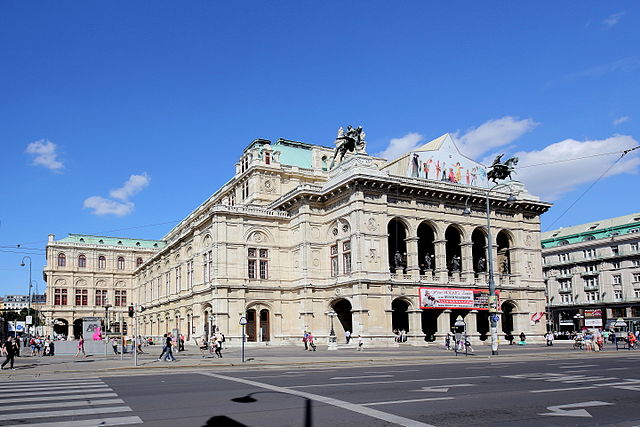
© Wiener Staatsoper
Related events