
 EN
EN DE
DE IT
IT FR
FR ES
ES RU
RU JP
JP RO
RO
Sleeping Beauty
Order tickets
April 2026 | ||||||
|---|---|---|---|---|---|---|
Mo | Tu | We | Th | Fr | Sa | Su |
he famous ballet about the most beautiful fairy tale, returns to TAM in its most famous version.
Sleeping Beauty returns, one of the most beloved shows, staged by the students of the Ukrainian Ballet Academy in Milan. And also this time, the ballet will be accompanied by live music by OFI Orchestra Filarmonica Italiana, conducted by Maestro Marco Dallara.
Sleeping Beauty will be presented in its most famous version in accordance with the tradition of the classical repertoire. The three acts, complex for the virtuosity of the soloists and for the whole to which the dance corps will be called, will take the audience to the enchanted world of a fairy tale with which we have all grown up. High-level sets, rich costumes and technical quality will be at the center of great precision work both at the executive and expressive levels.
Also this time, international guest stars will enrich the show: next to the students, Michal Krčmář and Yuka Masumoto, the first dancers of the Helsinki Opera House, will dance as protagonists.
The ballet is a celebration of the triumph of Good over Evil through pure love and rebirth. It represents the culmination of romanticism, symbolizing hope, inner growth (awakening) and the technical perfection of classical ballet.
Sleeping Beauty is often considered the "ballet of ballets" for the perfect synergy between the music of Tchaikovsky and the choreography of Marius Petipa, here taken up by the teachers of the Academy, as well as for the richness of the choral scenes, the romantic costumes and the high technical difficulty.
Represented for the first time in 1890, it stands out for its technical complexity and the lavish style of the 17th century court.
Iconic moments, easily recognizable, such as the Adagio of the Rose (Act I), the Variation of the Lila Fairy, the Pas de deux of the Blue Bird, and the final Grand Pas de Deux (Act III), will accompany the audience in a crescendo of emotions.
The show is also embellished by the sets of Andrej Sharaev, the costumes of Alice Dardengo and the light drawing curated by Alessandro Cappellini.
SYNOPSIS:
At the court of King Floristano, a party is called for the baptism of Princess Aurora: knights, ladies and the good fairies of the kingdom are invited, who bring with them gifts for the princess.
The witch Carabosse is missing among the guests. To take revenge, the sorceress throws a curse at the little one: at the age of sixteen, the princess will die by stinging herself with a spindle. The Lilla fairy, however, not having yet given her gift, decides to change the curse: the princess will not die, but will only sink into a very long and eternal sleep, which will involve the entire court and which will end only thanks to the kiss of a young prince. Despite the precautions taken in the kingdom, on the day of Princess Aurora's sixteenth birthday, the sorceress Carabosse, disguised as an old beggar, hands a spindle to the princess. Aurora touches the tip of the spindle and faints: the Lila cove, as promised, turns death into sleep, with her gift. The guests fall asleep and the castle is wrapped in strurries and surrounded by a dense forest. One hundred years pass and, in a clearing near the castle, a company of nobles is engaged in a hunting trip, reveling in the dense forest with picnics and dancing. Among these is also Prince Desiré. At a certain point, the atmosphere changes and the lilac fairy appears, who in a dream leads the prince to Aurora, warning him of what happened. The vision of this beautiful princess makes the young prince fall in love who, waking up from the dream, heads to the enchanted castle. Finding the princess, he gives her a kiss, breaking the spell; the court then wakes up and the dances start again; the prince will now be able to marry Princess Aurora.
Program and cast
Students of the Ukrainian Ballet Academy AUB
Michal Krčmář and Yuka Masumoto, first dancers of the Helsinki Opera House.
OFI Italian Philharmonic Orchestra, conducted by Maestro Marco Dallara.
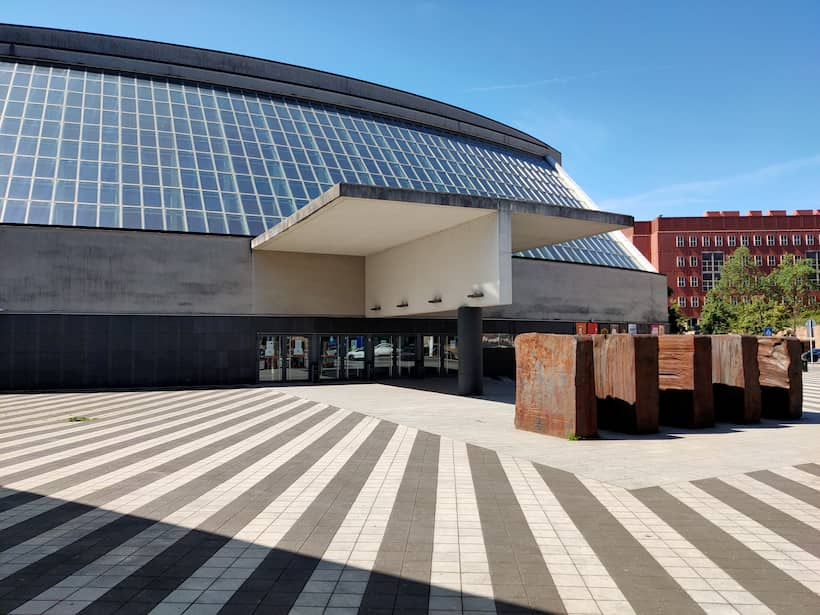
Teatro degli Arcimboldi di Milano
The Teatro degli Arcimboldi is a theatre and opera house in Milan which was built over a twenty-seven month period in anticipation of the closure and subsequent nearly three-year long renovation of Milan's La Scala opera house in December 2001. It is located 4.5 miles from the city centre in an abandoned Pirelli tire factory, in an area known as Bicocca.[1]
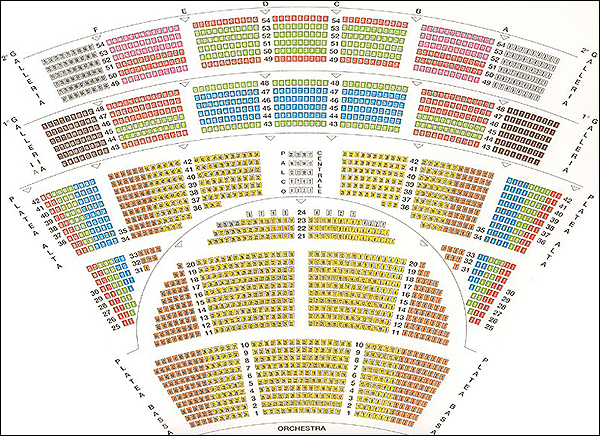
Designed by Vittorio Gregotti working with architects Mario Botta and Elisabetta Fabbri, the fan-shaped 2,375 seat auditorium, created on two levels, was planned to allow for the continuation of La Scala's 2001/2002 opera season and it was inaugurated with a performance of Verdi's La traviata on 19 January 2002.
An unfortunate accident closed the theatre for seventeen days in February 2001, but it reopened and became the La Scala company's venue until the renovated opera house reopened on its traditional day, 7 December, in 2004.
Performances of many different types of music are still given at the Arcimboldi.
Related events