


The Bartered Bride
January 2027 | ||||||
|---|---|---|---|---|---|---|
Mo | Tu | We | Th | Fr | Sa | Su |
The Bartered Bride – Bedřich Smetana | Opera
Comic opera in three acts
Text: Karel Sabina
New German text version: Susanne Felicitas Wolf
in collaboration with Sergio Morabito
Language: German
Act 1 & 2: 90 Minutes
Intermission: 30 Minutes
Act 3: 60 Minutes
Storyline
Backstory
The small farmer Krušina is heavily in debt to the landowner Tobias Mícha. In order to buy his freedom, he contractually promised their daughter Mařenka to Mícha's son as his bride without his wife Ludmila's knowledge.
Mícha has - or had - two sons. The older one from his first marriage was ousted from the court by his stepmother Háta, Mícha's second wife, in favor of her son Vašek, and has since been considered missing. Now Mařenka is to marry Vašek. But Mařenka loves Jeník, a stranger who has found work in the village and who also loves her.
Act 1
A church fair is celebrated in the country. Today, Mařenka is to be introduced to Vašek, the bridegroom her father wants. Mařenka is disturbed by Jeník's carelessness. When she asks him to tell her about his past, Jeník only reveals that he comes from a rich family but was robbed of his inheritance by his stepmother. The two lovers promise to remain faithful to each other forever.
Krušina has commissioned the matchmaker Kecal to arrange Mařenka's marriage to Vašek. Ludmila's objections are brushed aside by the two men, but Mařenka resolutely defends her love for Jeník. She refuses to sign the marriage contract that has been prepared. The village celebrates wildly.
Act 2
The men sing the praises of the carefree power of beer, Jeník praises the power of love, Kecal the power of money. Mařenka has been lying in wait for the dressed-up Vašek. She takes advantage of the fact that they have never seen each other and describes the bride intended for him as a violent monster. She only responds to Vašek's advances towards her to the extent that she makes him swear to renounce Krušina's daughter forever.
In the meantime, Kecal succeeds in persuading Jeník to give up Mařenka by offering him 300 guilders on the one hand and threatening him on the other. However, Jeník sets two conditions: He renounces in no other favor than Mícha's son, and with the wedding, the bride's father's debts must be considered time-barred. Jeník's sale of the bride is sealed before the eyes and to the indignation of the celebrating village.
Act 3
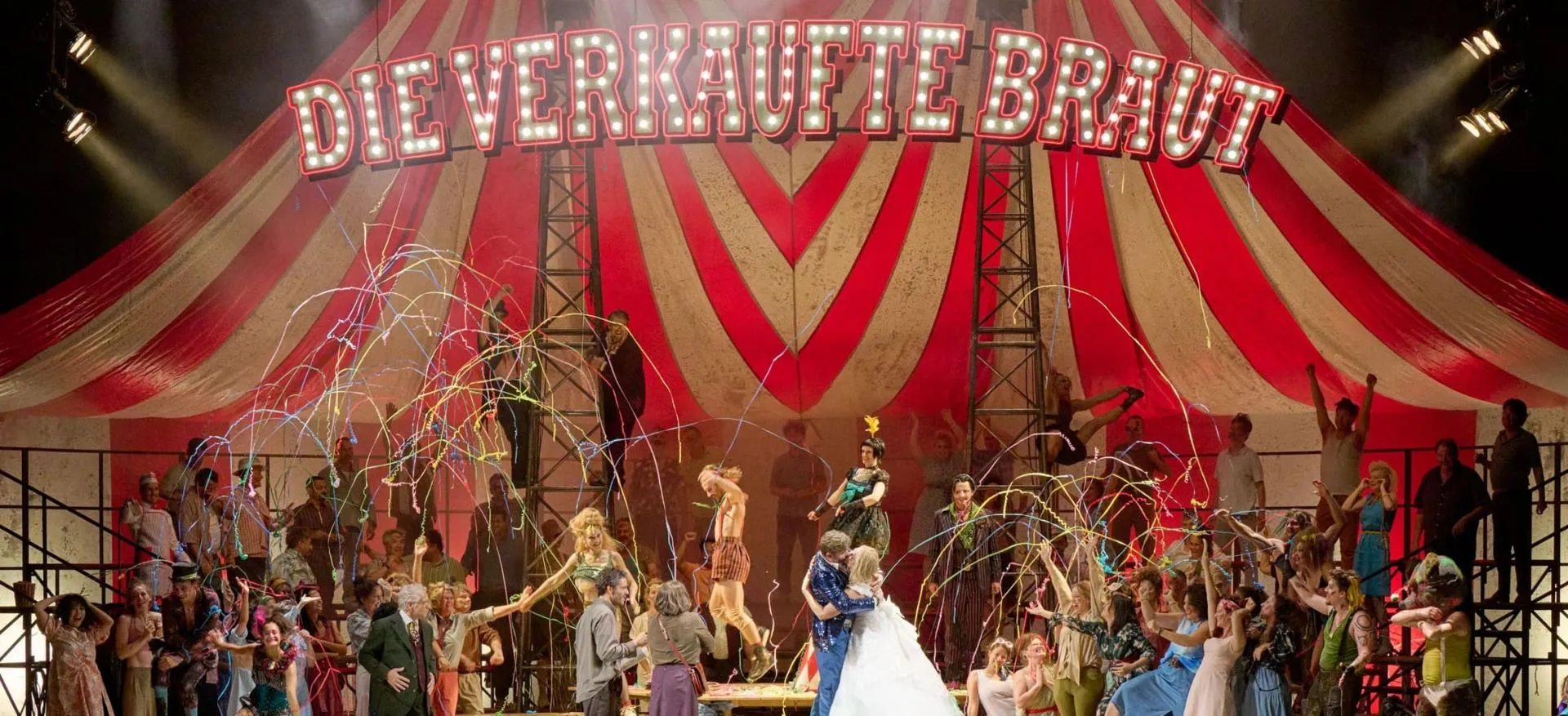
A circus has pitched its tent on the festival meadow. The performers give a demonstration of their art in front of Vašek. Vašek falls in love with the showgirl Esmeralda and she persuades him to stand in for the drunken performer of the dancing bear during the performance. Kecal wants to close the deal in the presence of the parents, but Vašek declares that he will not take Mařenka under any circumstances.
Kecal and Krušina confront Mařenka with Jeník's signature, with which he has sealed her sale. Vašek recognizes Mařenka as the attractive warner from the morning and agrees to marry her. The distraught Mařenka is given a short time to think things over. She cannot understand Jeník's betrayal of love.
When Jeník approaches Mařenka, she rejects all his attempts to explain and only wants to know whether the signature on the contract is his. Jeník says yes. When Jeník, alongside Kecal, pressures her to agree to marry Mícha's son, she herself calls the bride's parents and the whole village together to end the embarrassing situation by agreeing to marry Vašek. Mícha and Háta then recognize Jeník as their rejected son. They and Kecal, who is also bruised, can no longer prevent Mařenka's marriage to Mícha's first-born Jeník. Panic breaks out: The bear is loose! But it is Vašek who is raging in his fur - mother Háta calls him to order. Father Mícha offers Jeník his hand in reconciliation and does not refuse the couple his blessing.
Program and cast
Krušina: Bartosz Urbanowicz
Ludmila: Margaret Plummer
Mařenka: Olga Bezsmertna
Mícha: Hans Peter Kammerer
Háta: Monika Bohinec
Jeník: Pavel Černoch
Vašek: Matthäus Schmidlechner
Kecal: Peter Kellner
Musical Direction: Tomáš Hanus
Staging: Dirk Schmeding
Set Design: Robert Schweer
Costumes: Alfred Mayerhofer
Choreography: Annika Dickel
Lighting: Tim van ’t Hof
Video: Johannes Kulz
Vienna State Opera
Public Transport
Subway lines: U1, U2, U4
Trams: 1, 2, D, J, 62, 65
Buses: 59A
Local Railway: Badner Bahn
Stops: Karlsplatz / Opera
Taxi stands are available nearby.
Parking
Parking is only € 6, - for eight hours!
The Wiener Staatsoper and the ÖPARK Kärntner Ring Garage on Mahlerstraße 8, under the “Ringstraßengalerien”, offer the patrons of the Vienna State Opera a new, reduced parking fee. You can park in the Kärntner Ring Garage for up to 8 hours and pay only a flat fee of € 6, -. Just validate your ticket at one of the discount machines inside the Wiener Staatsoper. The normal rate will be charged for parking time greater than 8 hours. The validation machines can be found at the following coat checks: Operngasse, Herbert von Karajan-Platz, and the right and left and balcony galleries.
Important: In order to get the discount, please draw a ticket and do not use your credit card when entering the garage!
After devaluing your ticket in the Wiener Staatsoper you can pay comfortably by credit card or cash at the vending machines.
The machines accept coins and bills up to 50.- Euro. Parking time longer than 8 hours will be charged at the normal rate.
History
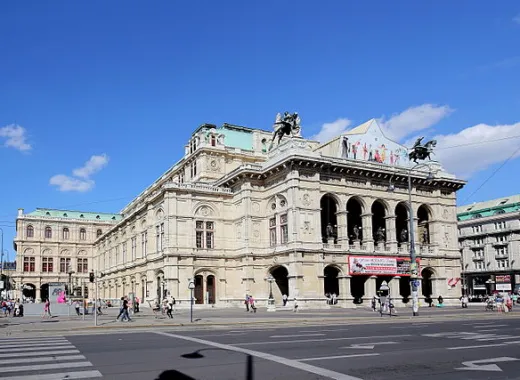
The structure of the opera house was planned by the Viennese architect August Sicard von Sicardsburg, while the inside was designed by interior decorator Eduard van der Nüll. It was also impacted by other major artists such as Moritz von Schwind, who painted the frescoes in the foyer, and the famous "Zauberflöten" (“Magic Flute”) series of frescoes on the veranda. Neither of the architects survived to see the opening of ‘their’ opera house: the sensitive van der Nüll committed suicide, and his friend Sicardsburg died of a stroke soon afterwards.
On May 25, 1869, the opera house solemnly opened with Mozart's Don Giovanni in the presence of Emperor Franz Joseph and Empress Elisabeth.
The popularity of the building grew under the artistic influence of the first directors: Franz von Dingelstedt, Johann Herbeck, Franz Jauner, and Wilhelm Jahn. The Vienna opera experienced its first high point under the direction of Gustav Mahler. He completely transformed the outdated performance system, increased the precision and timing of the performances, and also utilized the experience of other noteworthy artists, such as Alfred Roller, for the formation of new stage aesthetics.
The years 1938 to 1945 were a dark chapter in the history of the opera house. Under the Nazis, many members of the house were driven out, pursued, and killed, and many works were not allowed to be played.
On March 12, 1945, the opera house was devastated during a bombing, but on May 1, 1945, the “State Opera in the Volksoper” opened with a performance of Mozart's THE MARRIAGE OF FIGARO. On October 6, 1945, the hastily restored “Theaters an der Wien” reopened with Beethoven's FIDELIO. For the next ten years the Vienna State Opera operated in two venues while the true headquarters was being rebuilt at a great expense.
The Secretary of State for Public Works, Julius Raab, announced on May 24, 1945, that reconstruction of the Vienna State Opera would begin immediately. Only the main facade, the grand staircase, and the Schwind Foyer had been spared from the bombs. On November 5, 1955, the Vienna State Opera reopened with a new auditorium and modernized technology. Under the direction of Karl Böhm, Beethoven’s FIDELIO was brilliantly performed, and the opening ceremonies were broadcast by Austrian television. The whole world understood that life was beginning again for this country that had just regained its independence.
Today, the Vienna State Opera is considered one of the most important opera houses in the world; in particular, it is the house with the largest repertoire. It has been under the direction of Dominique Meyer since September 1, 2010.


EN
DE
IT
FR
ES
RU
JP
RO
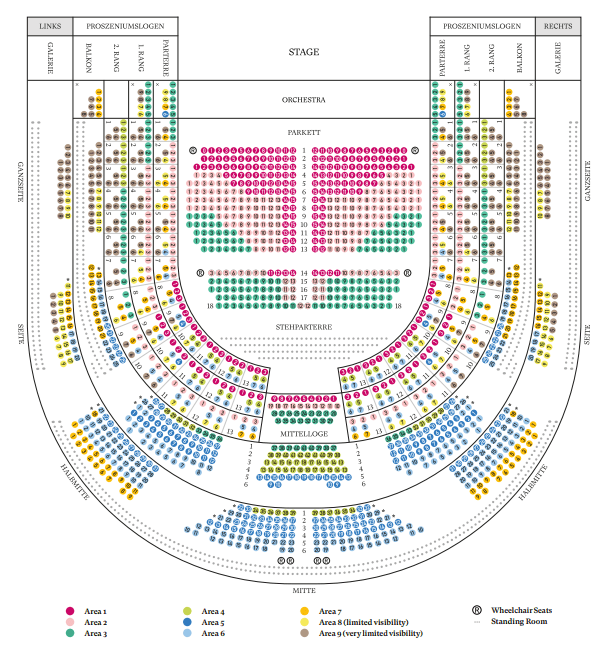
Seating plan