
 EN
EN DE
DE IT
IT FR
FR ES
ES RU
RU JP
JP RO
RO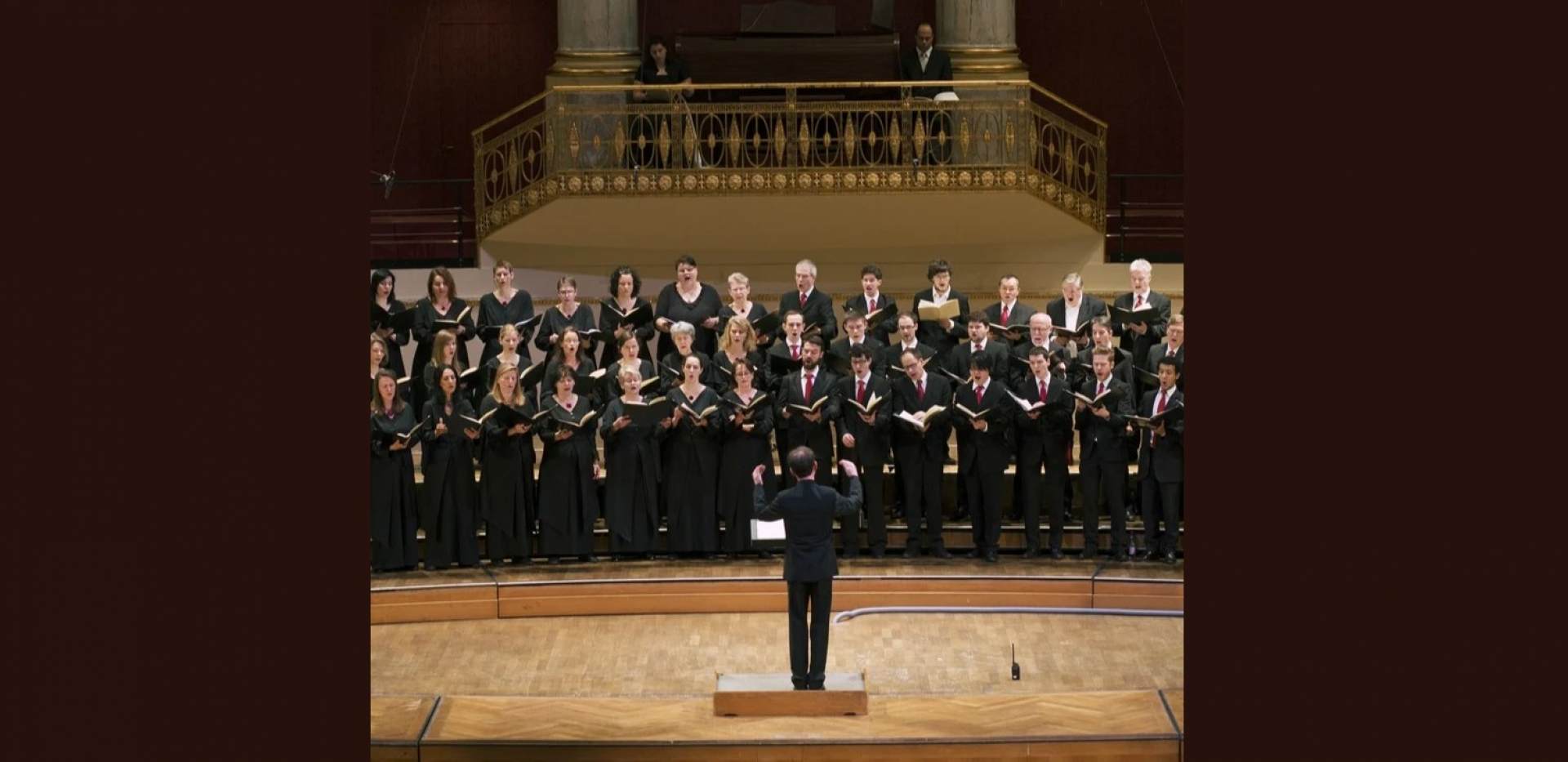
© Lukas Beck
Vienna Chamber Orchestra
Order tickets
June 2026  | ||||||
|---|---|---|---|---|---|---|
Mo | Tu | We | Th | Fr | Sa | Su |
Program and cast
7 June 2026
Performers
Wiener KammerOrchester
Theodore Kerkezos, Saxophon
Francisco Navarro Lara, Dirigent
Programme
George Gershwin
Prélude Nr. 2 »Blue Lullaby« (Drei Préludes) (Bearbeitung für Kammerorchester: Theodore Kerkezos) (1926)
Darius Milhaud
Scaramouche op. 165c (Fassung für Saxophon und Orchester) (1937/1939)
Mikis Theodorakis
Tanzsuite (Ballettmusik zu »Alexis Zorbas«) (Fassung für Saxophon und Orchester) (1988)
***
Ottorino Respighi
Danze ed Arie antiche (1931)
Wolfgang Amadeus Mozart
Symphonie C-Dur K 425 »Linzer Symphonie« (1783)
4 October 2026
Vienna Chamber Orchestra
Elena Bashkirova: Piano
Jan Willem de Vriend: Conductor
Programme
Franz Anton Rosetti:
Symphony in G minor
Wolfgang Amadeus Mozart:
Concerto for Piano and Orchestra in E-flat major, K. 449 (1784)
Intermission
Joseph Haydn:
Symphony in E minor Hob. I/44 “Funeral Symphony” (1772 BC)
14 and 15 November 2026
Vienna Chamber Orchestra
Daniel Ottensamer: Clarinet
Jan Willem de Vriend: Conductor
Programme
Wolfgang Amadeus Mozart:
Overture to »Lucio Silla« K 135 (1772)
Concerto for Clarinet and Orchestra in A major K 622 (1791)
Intermission
Luigi Cherubini:
Song on the Death of Haydn (1804–1805)
Joseph Haydn:
Symphony in G major Hob. I/94 "With the Surprise" (1791)
20 November 2026
Vienna Chamber Orchestra
Martina Neubauer: soprano
Joji Hattori: Moderation, Conductor
Programme
Felix Mendelssohn Bartholdy:
1st movement: Grave – Allegro (String Symphony No. 4 in C minor)
Wolfgang Amadeus Mozart:
Temerari ... Come scoglio »You daring ones ... Like the rock« (Recitative and aria of Fiordiligi from »Così fan tutte« K 588) (1790)
Edward Grieg:
At the Cradle op. 68/5 (Lyric Pieces) (1898)
Carl Maria von Weber:
How sleep approached me... Softly, softly, pious melody (Recitative and Aria of Agathe from »Der Freischütz« J 277) (1817–1821)
Gabriel Fauré:
Pavane op. 50 (arrangement for chamber orchestra: Joji Hattori) (1887)
Charles Gounod:
Ah, I laugh to see myself so beautiful (Juwelen-Arie der Margarethe aus «Faust«) (1859)
Johann Strauss (son):
Greetings, dear little nest (song from "Wiener Blut") (1899)
Intermission
Ralph Vaughan Williams:
Two Hymn-Tune Preludes (1936)
Samuel Coleridge-Taylor:
Four Novelettes, Op. 52
6 December 2026
Vienna Chamber Orchestra
Albrecht Menzel: violin
Pier Carlo Orizio: Conductor
Programme
Joseph Haydn:
Overture to »The World of the Moon« Hob. XXVIII/7 (1777)
Wolfgang Amadeus Mozart:
Concerto for Violin and Orchestra in A major K 219 (1775)
Intermission
Wolfgang Amadeus Mozart:
Symphony in C major, K. 551 "Jupiter Symphony" (1788)
24 January 2027
Vienna Chamber Orchestra
Kateryna Titova: Piano
Michael Bednarik: trumpet
Narek Hakhnazaryan: Conductor
Programme
Max Richter:
On the nature of daylight (2004)
Dmitri Schostakowitsch:
Concerto for Piano, Trumpet and String Orchestra in C minor, Op. 35 (1933)
Intermission
Franz Schubert:
String Quartet in D minor D 810 »Death and the Maiden« (1824)
10 February 2027
Vienna Chamber Orchestra
Robin Paillet: trumpet
Sophie Dervaux: Moderator, conductor
Programme
Peter Wax:
Painful Music (1983)
Jan Kritel Jiri Neruda:
Concerto for Trumpet and String Orchestra in E-flat major
Intermission
Osvaldo Golijov:
Last round (1996)
Felix Mendelssohn Bartholdy:
String Symphony No. 12 in G minor (1823)
21 February 2027
Vienna Chamber Orchestra
Juliette Khalil: soprano
Jan Willem de Vriend: Conductor
Programme
Gustav Mahler:
Symphony No. 4 in G major for large orchestra and solo soprano (1899–1901/1920)
Intermission
Alban Berg:
Seven Early Songs (arrangement for high voice and chamber orchestra: Reinbert de Leeuw) (1905–1908)
14 March 2027
Vienna Chamber Orchestra
Storioni Trio
Wouter Vossen: violin
Marc Vossen: Cello
Bert van de Roer: Piano
Jan Willem de Vriend: Conductor
Programme
Ludwig van Beethoven:
Concerto for Piano, Violin, Cello and Orchestra in C major, Op. 56 »Triple Concerto« (1803–1804)
Intermission
Ludwig van Beethoven:
Symphony No. 4 in B-flat major, Op. 60 (1806)
7 and 8 April 2027
Vienna Chamber Orchestra
Vienna Singing Academy
Sara Blanch: soprano
Paul Breslik: Tenor
Alexander Grassauer: Bassbariton
Jan Willem de Vriend: Conductor
Programme
Ludwig van Beethoven:
Symphony No. 2 in D major, Op. 36 (1801–1802)
Intermission
Ludwig van Beethoven:
Christ on the Mount of Olives. Oratorio op. 85 for soloists, choir and orchestra (1803)
9 May 2027
Vienna Chamber Orchestra
Morten Friis: Vibraphone
Sebastian Knauer: Piano
Programme
Wolfgang Amadeus Mozart:
Symphony in A major, K. 186a (1774)
Intermission
Arash Safaian:
ÜberBach 2.0 for piano, vibraphone and string orchestra
6 June 2027
Vienna Chamber Orchestra
Matthias Bartolomey: Cello
Vanessa Benelli Mosell: conductor
Programme
Wolfgang Amadeus Mozart:
Symphony in G major K 74 (1770 BC)
Joseph Haydn:
Concerto for Cello and Orchestra in D major, Hob. VIIb/2 (1783)
Intermission
Arnold Schönberg:
Transfigured Night, Op. 4 (Version for String Orchestra 1917) (1899/1917)
Wiener Konzerthaus
The Wiener Konzerthaus ( Vienna Concert House or Hall) is one of the largest and most artistically progressive institutions in international musical life. During the course of a season, which extends from September to June, some 750 wide-ranging events take place and more than 600,000 visitors can listen to around 2,500 different compositions. With this comprehensive and varied selection, the Wiener Konzerthaus – together with the Vienna State Opera House and the Musikverein – is central to Vienna’s reputation as one of the world’s leading music capitals.
From its earliest days, the Wiener Konzerthaus has held the highest cultural aims and artistic mission: «To act as a venue for the cultivation of fine music, as a meeting point for artistic endeavour, as a home for music and a cultural centre for Vienna». It was in this spirit that the Konzerthaus was inaugurated on 19 October 1913 with a festive concert attended by Emperor Francis Joseph I. To mark the occasion, Richard Strauss wrote the «Festliches Präludium op. 61», which was followed by Beethoven’s Ninth Symphony. This programme combination, comprising a contemporary work and a masterpiece from the past, served as a model for the Wiener Konzerthaus’s future direction: today, too, an awareness of tradition and the joys of innovation form the main pillars of the Konzerthaus’s artistic identity.
Access to the Wiener Konzerthaus
Public transport:
Short walk from the U4 Stadtpark Station: 10 min walk from the U4/U1 Karlsplatz Station, or take the 4A bus.
From the tram and bus stops at Schwarzenbergplatz, accessed by D, 2 & 71 trams and 3A & 4A buses. The 4a bus stop is at Hotel Am Konzerthaus.
Taxi:
The nearest taxi stands are at the Hotel Intercontinental in the Johannesgasse and at Hotel Am Konzerthaus on the Heumarkt.
Restaurants next to:
Gmoakeller
Hotels in immediate vicinity:
Hotel am Konzerthaus and Intercontinental
Great Hall
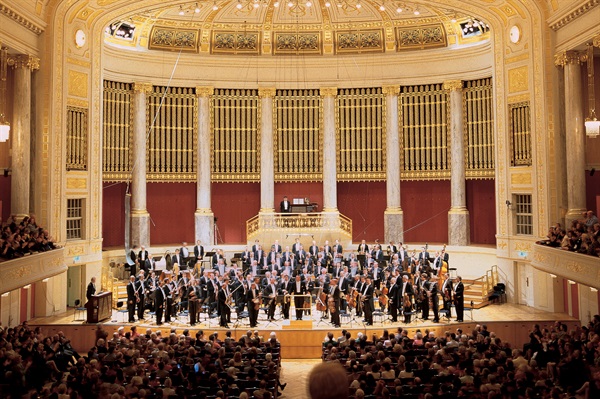
In the heart of the building (which consists of more than 600 rooms) lies the Konzerthaus’s flagship, the Grosser Saal (Great Hall). Designed with a sense of space and classical balance, its stage has provided the setting for many memorable concerts over the years. In this room, artists, audiences and atmosphere blend into a harmonious triad.
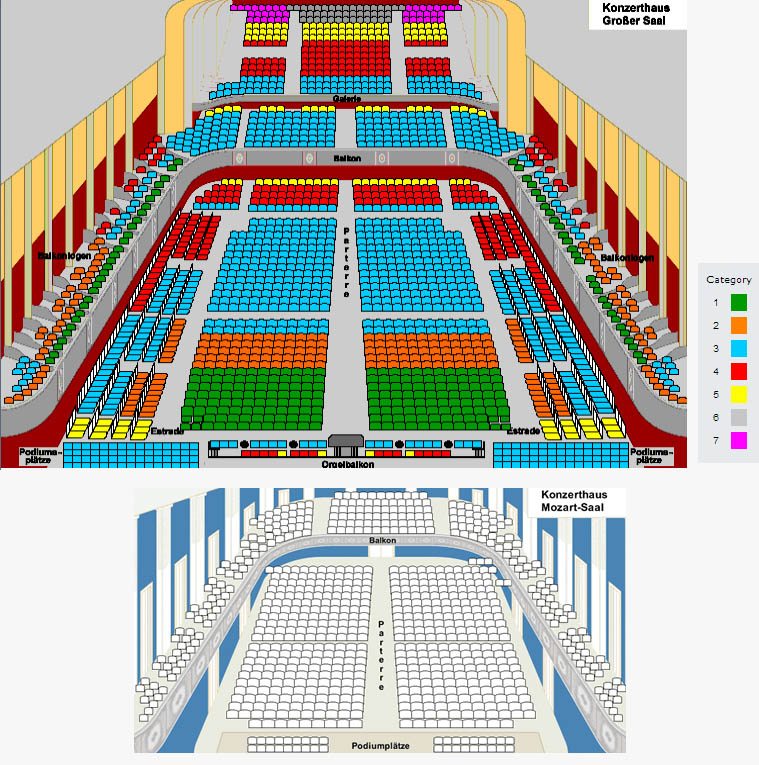
Home to world-famous orchestras, virtuoso soloists, renowned conductors and legendary jazz musicians, the Great Hall can accommodate an audience of 1,800 and offers the perfect venue for a wide variety of musical activity. The Great Hall has emerged from the major renovation with renewed splendour and, despite improvements in technical installation and audience comfort has continued to conserve its original elegance. Its unique atmosphere ideally lends itself to the broad range of artistic activities offered by the Vienna Konzerthaus.
Mozart Hall
Open and relaxing, welcoming and intimate, with its incomparable appeal, the Mozart Hall constitutes a jewel of international musical life. The perfect setting for all types of chamber music, from lute and Lieder recitals to string quartets and chamber orchestras, it can accommodate an audience of around 700 – an ideal size in which to experience the intimacy of chamber music and recital performances.
The Mozart Hall enjoys world-wide acclaim on account of its unique acoustics. This distinction makes it a top favourite with leading ensembles and soloists – as well as a popular venue for recordings. This was taken into account during the major renovation of the building: as with all other rooms in the Konzerthaus, the Mozart Hall is directly linked to a recording studio and a technical control room.
Schubert Hall
With its festive character, the Schubert-Saal presents the perfect model of a music salon, the restored use of the windows follwing the renovation having returned the room to its elegant, airy appearance.
Equipped with around 320 seats, it lends itself to a wide range of chamber-music concerts, as well as to receptions, dinners and lectures. It is home to the popular lunchtime concert series, as well as to events which enable promising young musicians to experience a professional concert stage. Many a musical career has been launched in the Schubert Hall of the Vienna Konzerthaus.
Seating capacity: 320
Auditorium: 240 m²
Podium: 50 m²
Related events