 en
en 
 de
de it
it fr
fr es
es ru
ru jp
jp ro
ro








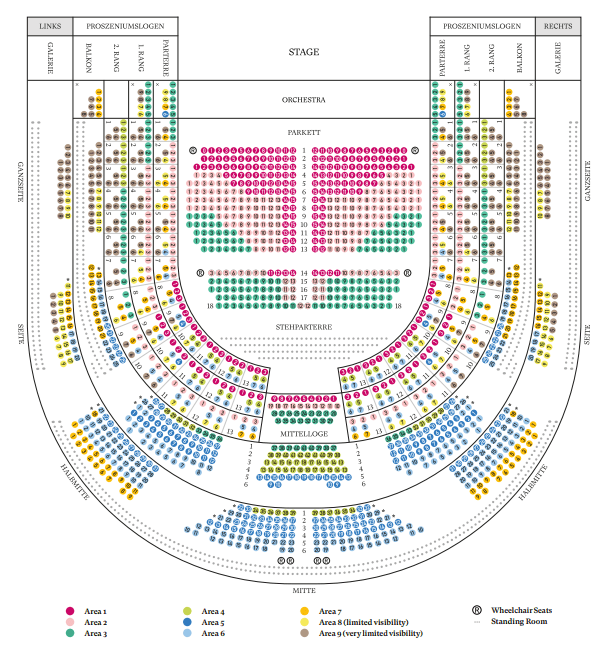
 Vienna State Opera
 Sat 03 Oct 2026 - Mon 12 Oct 2026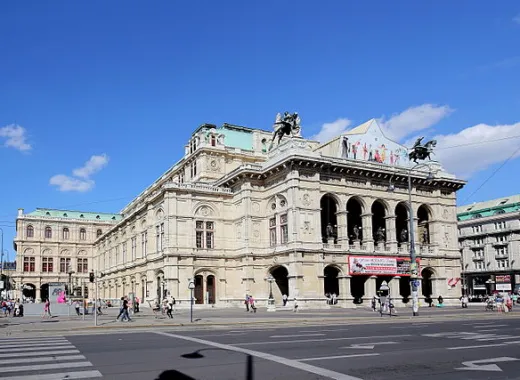
Public Transport
Subway lines: U1, U2, U4
Trams: 1, 2, D, J, 62, 65
Buses: 59A
Local Railway: Badner Bahn
Stops: Karlsplatz / Opera
Taxi stands are available nearby.
Parking
Parking is only € 6, - for eight hours!
The Wiener Staatsoper and the ÖPARK Kärntner Ring Garage on Mahlerstraße 8, under the “Ringstraßengalerien”, offer the patrons of the Vienna State Opera a new, reduced parking fee. You can park in the Kärntner Ring Garage for up to 8 hours and pay only a flat fee of € 6, -. Just validate your ticket at one of the discount machines inside the Wiener Staatsoper. The normal rate will be charged for parking time greater than 8 hours. The validation machines can be found at the following coat checks: Operngasse, Herbert von Karajan-Platz, and the right and left and balcony galleries.
Important: In order to get the discount, please draw a ticket and do not use your credit card when entering the garage!
After devaluing your ticket in the Wiener Staatsoper you can pay comfortably by credit card or cash at the vending machines.
The machines accept coins and bills up to 50.- Euro. Parking time longer than 8 hours will be charged at the normal rate.
History
The structure of the opera house was planned by the Viennese architect August Sicard von Sicardsburg, while the inside was designed by interior decorator Eduard van der Nüll. It was also impacted by other major artists such as Moritz von Schwind, who painted the frescoes in the foyer, and the famous "Zauberflöten" (“Magic Flute”) series of frescoes on the veranda. Neither of the architects survived to see the opening of ‘their’ opera house: the sensitive van der Nüll committed suicide, and his friend Sicardsburg died of a stroke soon afterwards.
On May 25, 1869, the opera house solemnly opened with Mozart's Don Giovanni in the presence of Emperor Franz Joseph and Empress Elisabeth.
The popularity of the building grew under the artistic influence of the first directors: Franz von Dingelstedt, Johann Herbeck, Franz Jauner, and Wilhelm Jahn. The Vienna opera experienced its first high point under the direction of Gustav Mahler. He completely transformed the outdated performance system, increased the precision and timing of the performances, and also utilized the experience of other noteworthy artists, such as Alfred Roller, for the formation of new stage aesthetics.
The years 1938 to 1945 were a dark chapter in the history of the opera house. Under the Nazis, many members of the house were driven out, pursued, and killed, and many works were not allowed to be played.
On March 12, 1945, the opera house was devastated during a bombing, but on May 1, 1945, the “State Opera in the Volksoper” opened with a performance of Mozart's THE MARRIAGE OF FIGARO. On October 6, 1945, the hastily restored “Theaters an der Wien” reopened with Beethoven's FIDELIO. For the next ten years the Vienna State Opera operated in two venues while the true headquarters was being rebuilt at a great expense.
The Secretary of State for Public Works, Julius Raab, announced on May 24, 1945, that reconstruction of the Vienna State Opera would begin immediately. Only the main facade, the grand staircase, and the Schwind Foyer had been spared from the bombs. On November 5, 1955, the Vienna State Opera reopened with a new auditorium and modernized technology. Under the direction of Karl Böhm, Beethoven’s FIDELIO was brilliantly performed, and the opening ceremonies were broadcast by Austrian television. The whole world understood that life was beginning again for this country that had just regained its independence.
Today, the Vienna State Opera is considered one of the most important opera houses in the world; in particular, it is the house with the largest repertoire. It has been under the direction of Dominique Meyer since September 1, 2010.



 RM Europa Ticket GmbH
  Call now
 Book now