


Carmen

Order tickets
PreviousAugust 2026
Mo
Tu
We
Th
Fr
Sa
Su


Carmen - Georges Bizet (1838 - 1875) | OPERA
Opéra-comique in four acts
(composed 1873–1875, premiered 1875)
Libretto by Henri Meilhac and Ludovic Halévy
after the novella Carmen by Prosper Mérimée
New production


In French with German and English surtitles


Synopsis

Place: Seville, Spain, and surrounding hills
Time: Around 1820


Act 1

A square, in Seville. On the right, a door to the tobacco factory. At the back, a bridge. On the left, a guardhouse.

A group of soldiers relaxes in the square, waiting for the changing of the guard and commenting on the passers-by ("Sur la place, chacun passe"). Micaëla appears, seeking José. Moralès tells her that "José is not yet on duty" and invites her to wait with them. She declines, saying she will return later. José arrives with the new guard, which is greeted and imitated by a crowd of urchins ("Avec la garde montante").


As the factory bell rings, the cigarette girls emerge and exchange banter with young men in the crowd ("La cloche a sonné"). Carmen enters and sings her provocative habanera on the untameable nature of love ("L'amour est un oiseau rebelle"). The men plead with her to choose a lover, and after some teasing she throws a flower to Don José, who thus far has been ignoring her but is now annoyed by her insolence.


As the women go back to the factory, Micaëla returns and gives José a letter and a kiss from his mother ("Parle-moi de ma mère!"). He reads that his mother wants him to return home and marry Micaëla, who retreats in shy embarrassment on learning this. Just as José declares that he is ready to heed his mother's wishes, the women stream from the factory in great agitation. Zuniga, the officer of the guard, learns that Carmen has attacked a woman with a knife. When challenged, Carmen answers with mocking defiance ("Tra la la... Coupe-moi, brûle-moi"); Zuniga orders José to tie her hands while he prepares the prison warrant. Left alone with José, Carmen beguiles him with a seguidilla, in which she sings of a night of dancing and passion with her lover—whoever that may be—in Lillas Pastia's tavern. Confused yet mesmerised, José agrees to free her hands; as she is led away she pushes her escort to the ground and runs off laughing. José is arrested for dereliction of duty.


Act 2

Lillas Pastia's Inn

A month has passed. Carmen and her friends Frasquita and Mercédès are entertaining Zuniga and other officers ("Les tringles des sistres tintaient") in Pastia's inn. Carmen is delighted to learn of José's release from a month's detention. Outside, a chorus and procession announces the arrival of the toreador Escamillo ("Vivat, vivat le Toréro"). Invited inside, he introduces himself with the "Toreador Song" ("Votre toast, je peux vous le rendre") and sets his sights on Carmen, who brushes him aside. Lillas Pastia hustles the crowds and the soldiers away.


When only Carmen, Frasquita and Mercédès remain, the smugglers Dancaïre and Remendado arrive and reveal their plans to dispose of some recently acquired contraband ("Nous avons en tête une affaire"). Frasquita and Mercédès are keen to help them, but Carmen refuses, since she wishes to wait for José. After the smugglers leave, José arrives. Carmen treats him to a private exotic dance ("Je vais danser en votre honneur ... La la la"), but her song is joined by a distant bugle call from the barracks. When José says he must return to duty, she mocks him, and he answers by showing her the flower that she threw to him in the square ("La fleur que tu m'avais jetée"). Unconvinced, Carmen demands he shows his love by leaving with her. José refuses to desert, but as he prepares to depart, Zuniga enters looking for Carmen. He and José fight, and are separated by the returning smugglers, who restrain Zuniga. Having attacked a superior officer, José now has no choice but to join Carmen and the smugglers ("Suis-nous à travers la campagne").


Act 3

A wild spot in the mountains

Carmen and José enter with the smugglers and their booty ("Écoute, écoute, compagnons"); Carmen has now become bored with José and tells him scornfully that he should go back to his mother. Frasquita and Mercédès amuse themselves by reading their fortunes from the cards; Carmen joins them and finds that the cards are foretelling her death, and José's. The women depart to suborn the customs officers who are watching the locality. José is placed on guard duty.


Micaëla enters with a guide, seeking José and determined to rescue him from Carmen ("Je dis que rien ne m'épouvante"). On hearing a gunshot she hides in fear; it is José, who has fired at an intruder who proves to be Escamillo. José's pleasure at meeting the bullfighter turns to anger when Escamillo declares his infatuation with Carmen. The pair fight ("Je suis Escamillo, toréro de Grenade"), but are interrupted by the returning smugglers and girls ("Holà, holà José"). As Escamillo leaves he invites everyone to his next bullfight in Seville. Micaëla is discovered; at first, José will not leave with her despite Carmen's mockery, but he agrees to go when told that his mother is dying. As he departs, vowing he will return, Escamillo is heard in the distance, singing the toreador's song.


Act 4

A square in Seville. At the back, the walls of an ancient amphitheatre

Zuniga, Frasquita and Mercédès are among the crowd awaiting the arrival of the bullfighters ("Les voici ! Voici la quadrille!"). Escamillo enters with Carmen, and they express their mutual love ("Si tu m'aimes, Carmen"). As Escamillo goes into the arena, Frasquita warns Carmen that José is nearby, but Carmen is unafraid and willing to speak to him. Alone, she is confronted by the desperate José ("C'est toi ! C'est moi !"). While he pleads vainly for her to return to him, cheers are heard from the arena. As José makes his last entreaty, Carmen contemptuously throws down the ring he gave her and attempts to enter the arena. He then stabs her, and as Escamillo is acclaimed by the crowds, Carmen dies. José kneels and sings "Ah! Carmen! ma Carmen adorée!"; as the crowd exits the arena, José confesses to killing the woman he loved.

Program and cast

Teodor Currentzis - Musical Direction
Gabriela Carrizo (Peeping Tom) - Stage / Choreography
Christof Hetzer - Set / Costumes
Tom Visser - Lighting
Raphaëlle Latini - Assistant Director
Christian Arseni - Dramaturgy


Cast
Asmik Grigorian - Carmen
Jonathan Tetelman - Don José
Kristina Mkhitaryan - Micaëla
Davide Luciano - Escamillo
Iveta Simonyan - Frasquita
Anita Monserrat - Mercédès
Matthias Winckhler - Zuniga
Liviu Holender - Moralès
Michael Arivony - Le Dancaïre
Mingjie Lei - Le Remendado


Eurudike De Beul, Amparo Cortés, Boston Gallacher, Balder Hansen, Chey Jurado, Seungwoo Park, Romeu Runa, Charlie Skuy, Eliana Stragapede - Performers from Peeping Tom


Ensembles
Utopia Choir
Vitaly Polonsky - Choreography Preparation
Bachchor Salzburg
Michael Schneider - Choreography Preparation
Salzburg Festival and Theater Children’s Choir
Wolfgang Götz, Regina Sgier - Choreography Preparation
Utopia Orchestra

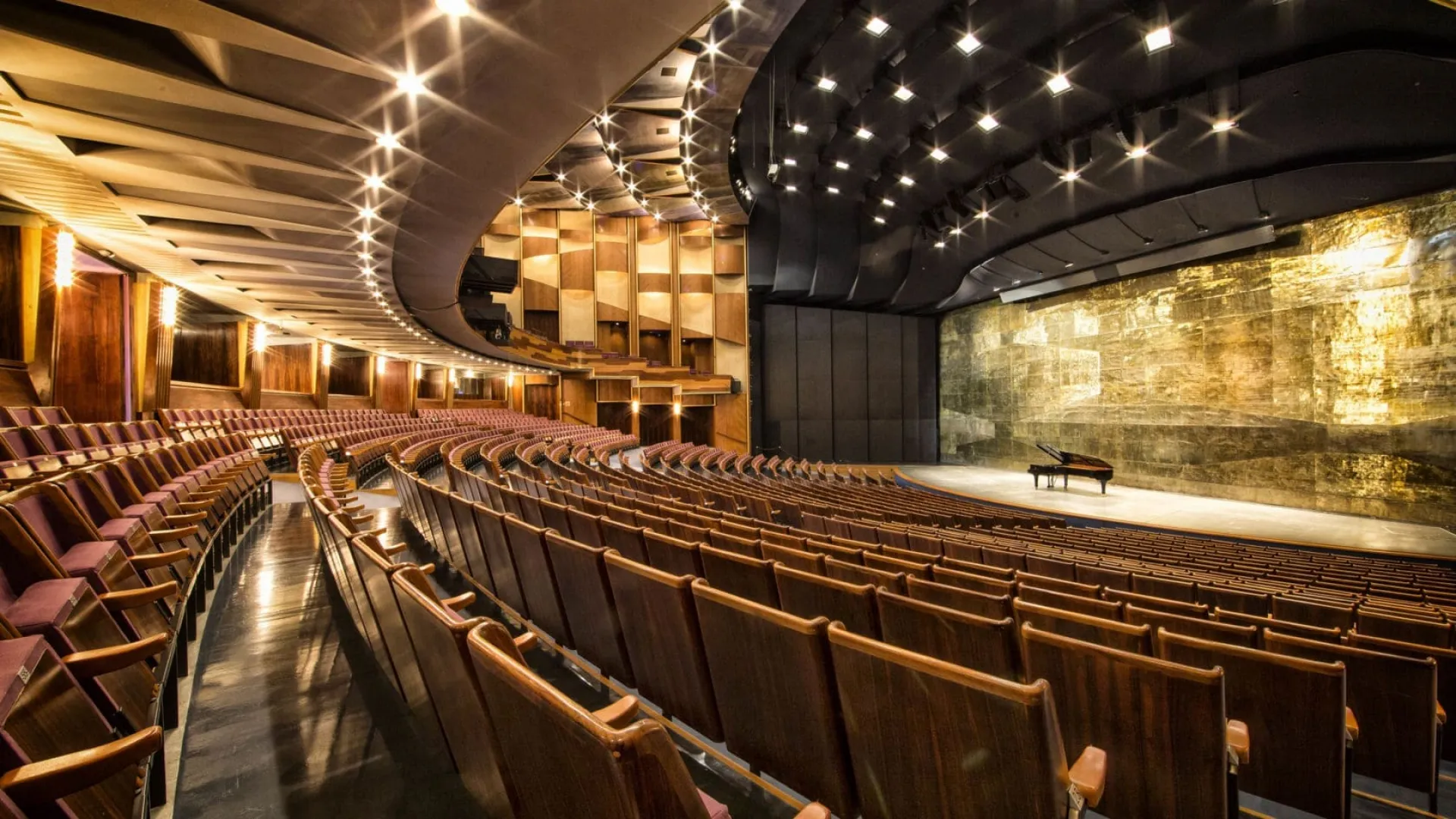
Großes Festspielhaus

The plans for a Grosses Festspielhaus (Large Festival Hall), where the former archiepiscopal princely stables were located, were drawn up primarily by the architect Clemens Holzmeister; Herbert von Karajan also made many suggestions for the building project, in particular regarding the design of the theatre hall. Every effort was made and no expense spared so as to “insert” between the three-centuries-old façade of the former court stables and the Mönchsberg a theatre with an opera stage whose structure and technical equipment would still meet highest international demands after fifty years. Between autumn 1956 and the early summer of 1960, 55,000 cubic metres of rock were blasted away to create the relevant space. The building was largely financed from the state budget and as a result the Republic of Austria is the owner of the Grosses Festspielhaus.


The Grosses Festspielhaus was opened on 26 July 1960 with a festive ceremony and the performance of Der Rosenkavalier by Richard Strauss conducted by Herbert von Karajan. Even though the new stage was undoubtedly impressive in its dimensions, voices were raised even then expressing regret that it would hardly be suitable for staging operas by Mozart which require a more intimate setting. The ground plan of the auditorium is almost square, nearly 35 metres long and from the stalls as well as from the circle offers ideal acoustic conditions and sight-lines for 2,179 seats. The iron stage curtain weighs 34 tonnes and in the middle is one metre thick. The ground steel plates were created by Rudolf Hoflehner; the main curtain behind it was designed by Leo Wollner.


The décor for the concert hall was renewed in 1993 by Richard Peduzzi. Five bronze doors with handles designed by Toni Schneider-Manzell allow the public access from the Hofstallgasse. The façade is ornamented by a Latin inscription by the Benedictine monk Professor Thomas Michels (Order of St. Benedict):Sacra camenae domus concitis carmine patet quo nos attonitos numen ad auras ferat (The holy house of the muse is open for lovers of the arts, may divine power inspire us and raise us to the heights).


Mostly local materials were used for fitting out the Grosses Festspielhaus: the reinforced concrete columns in the entrance foyer were covered with the conglomerate rock removed from the wall of the Mönchsberg; the floor is made of Adnet marble. Low beam lighting in the sloping ceiling and panel dishes made of glass from Murano create a solid lighting design. Two sculptures created by Wander Bertoni in Carrara marble represent music and drama. The four large-scale paintings in the form of crosses on the theme Dreams with the Wrong Solutions, which were bought by the Austrian patron of the arts and collector Karlheinz Essl and made available on loan to the Salzburg Festival, are by the New York painter and sculptor Robert Longo (1993).


The interval hall adjoining the entrance foyer is largely based on the original ground plan of the archiepiscopal princely stables. The floor of green serpentine is new and contains mosaics of horses by Kurt Fischer. On the wall is a steel relief by Rudolf Hochlehner entitled Homage to Anton von Webern. Through the arch built by Fischer von Erlach one can look out onto the horse statue and fountain and the Schüttkasten which was acquired by the Salzburg Festival in 1987. A separate access on the left of the interval foyer leads via an escalator and steps to the underground car park for the old town centre of Salzburg.


The furnishings for a Patrons’ Lounge on the first floor of the Grosses Festspielhaus were financed by the American patrons of the arts Donald and Jeanne Kahn, who later became major sponsors of the Salzburg Festival. Since 1995 it has served as a reception area for patrons, sponsors as well as their guests and is also used for press conferences and various other functions in connection with the Salzburg Festival.


Specifications Grosses Festspielhaus

Stage width: 100 m Stage depth: 25 m

Proscenium width: 30 m

Proscenium height: 9 m

Five lifting podia, 18 x 3 m each; speed max. 0.25 m / sec.; loading capacity 20 tons each

Hydraulic stage machinery (double attachment of ABB)

Gridiron: 155 hoists with a loading capacity of 500 kg each, a third of them hydraulically driven and electronically controlled

Lighting: 825 adjustable electric circuits with a power of over 5000 watts each; digital light console; depot of around 2,000 individual lights

Electroacoustics: sound control board with 16 inputs, 16 main outputs and 4 auxiliary outputs; sockets for loudspeakers and microphones throughout the entire stage and auditorium.


Related events