Ballet
Choreography William Forsythe, Emma Portner, Maurice Béjart. Music James Blake, Maurice Ravel.
Three-part evening ("Blake Works I" 2016, "Kreation" 2025, "Boléro" 1961)
Duration est. 3 hours
Introductions take place one hour before the start of each performance (except on première evenings) in the 1st tier in the anteroom to the Königsloge.
Seating is limited, duration approx. 20 min.
Whether the word “wave” reminds us of a beach by the sea, the radio or a football stadium – the idea of energy is always in there somewhere. An energy that looks for its path and awakens the impression of liveliness. Waves often spread in circles, going out in all directions from a centre point. Waves and circles play a role in a different way in the triple bill ballet programme, Waves and Circles – they are extolled, are visible or are tangible.
William Forsythe’s 2016 ballet, Blake Works I, is based on seven songs by the British singer, James Blake. If the songs’ texts are introverted and the sounds are fragile, playful, trained in classical dance technique, Forsythe’s choreography, provides a refined counterpoint with speed, brilliance and virtuosity.
Canadian choreographer Emma Portner represents a dance style that is entirely composed of the possibilities of the digital age. She is now creating a German company at the Bayerisches Staatsballett for the first time. Musically her Megahertz (working title) piece is based on a chronologically immensely expansive song by the British musician, Paddy McAloon. Words, music, movement, light and video effects fuse here into one fascinating unit.
Maurice Ravel’s orchestral piece, Boléro (1928), may today be mostly familiar as a concert hall piece, but it did in fact originally accompany a ballet. Maurice Béjart presented a choreography in 1961, which was correspondingly standard-setting. Béjart’s version draws on the structure of Ravel’s music. The person in the middle dancing on a table embodies the melody, while the others, forming a circle around the centre, embody the rhythm. Bejart commented: “I wanted to get the melody out of it. The melody that pushes on again and again and tirelessly rolls on like a wave.”
TOPIC
James Blake’s third album, The Colour in Anything, was released in May 2016. In July that very year William Forsythe had already produced his piece Blake Works I at the Ballet de l’Opéra national de Paris, choreographed around seven of the album’s songs. Forsythe was therefore truly working with absolutely brand new music. And the fascination with Blake’s voice and the ethereal sounds of his songs continued. Forsythe has since created four more pieces set to music by James Blake, either for dancers and audiences in a venue or for the digital sphere.
A further album of importance for Waves and Circles appeared in 2003, entitled, I trawl the Megahertz. Behind this album is the British musician Paddy McAloon, who, with the album’s re-release in 2019 took on the name of his old band, Prefab Sprout. Due to an eye disease McAloon simply had to listen to the radio for a good while. The sounds on the airwaves and turning the tuner on the radio with snippets of music and snatches of sentences in many ways left their mark on the album and also explain the title. The opening track blows away conventions on several levels. It is 22 minutes long, and instead of singing delivers instrumental sounds with an “overvoicing” in English on a text by McAloon. This exceptional musical creation is the motor for Emma Portner for her new choreography with the Bayerisches Staatsballett.
Maurice Ravel wrote his world famous Boléro in 1928, and actually due to an emergency, as the dancer Ida Rubinstein had asked him for a piece of ballet music, so the original plan had to be abandoned due to no fault of his own. Bronislava Nijinska, Vaslav Nijinsky’s sister, created the choreography set to Ravel’s unique music, with which a two-piece melody is constantly repeated for an entire quarter of an hour over an evenly drummed rhythm. A magnificent crescendo is produced by changing the instrumentation and increasing the volume. Driven by Ravel’s unstoppable rising music, in his own words, Maurice Béjart relates a “story of desire”. Originally, a single woman danced in the centre on a table, surrounded by a horde of men. The gender relations can also be turned around since 1979.
 en
en 
 de
de it
it fr
fr es
es ru
ru jp
jp ro
ro








 National Theatre Munich
 Sun 19 Jul 2026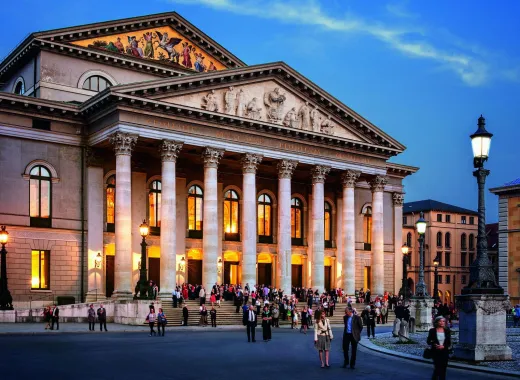




 RM Europa Ticket GmbH
  Call now
 Book now