en
en v
Phone
Cart0 Tickets
Total: 0€
Account
Calendar
Search
Menu
X

Fidelio

VenueVienna State Opera
CalendarSat 09 Jan 2027 - Mon 18 Jan 2027
Synopsis/Details


Fidelio – Ludwig van Beethoven | Opera

Opera in two acts
Text: Stephan von Breuning & Georg Friedrich Treitschke & Joseph Sonnleithner
after J.N. Bouilly
Text adaptation: Paulus Hochgatterer
Language: German


Act 1 – approx. 70 minutes
Intermission – approx. 25 minutes
Act 2 – approx. 60 minutes


Storyline


Backstory

The governor of a Spanish state prison, Don Pizarro, runs a reign of terror in his institution. Innocent people become political victims of his brutal grasp. Don Florestan from Seville wants to clear up these arbitrary acts, but ends up in the hands of the violent man himself. He has been languishing in inhumane solitary confinement for over two years.

His friends believe him to be dead, but his wife Leonore has not yet given up on the missing man. As she believes Florestan to be a prisoner, she hires herself out to the jailer Rocco as a closer. Dressed in men's clothes and under the name Fidelio, she performs hard labor, earns the trust of her superior and even wins the love of his daughter Marzelline.


Act 1

Jaquino tries in vain to win Marzelline's affections. Since Fidelio has been in the house, she has not listened to his wooing. Fidelio returns from errands in Seville. Rocco is again impressed by his new assistant's skill and sense of duty: Fidelio and Marzelline are soon to become a couple. Marzelline and Rocco dream of a comfortable future, Jaquino sees his prospects dwindling and Fidelio dreads the uncertainty. Then Don Pizarro appears. He learns from a confidential letter that the minister is on the trail of his abuse of office: a surprise visit is to be made to him for good. Pizarro reacts promptly: a guard watches the main street, a trumpet signal is to announce the visit. Florestan, the most prominent victim, must be disposed of as quickly as possible.

As Rocco refuses to commit murder, the governor will carry out the deed himself. The only thing the jailer has to do first is dig him a grave in the dungeon. Marzelline and Fidelio ask Rocco to allow the lighter prisoners out for a short time. Full of joy, the prisoners enjoy the warm spring sunshine. Fidelio is dismayed to learn of Rocco's new assignment and wants to share his hard labor in the dungeon: Will she help prepare her husband's grave? Outraged, Pizarro has noticed the prisoners' walk and will accept no justification. Only the urgent plan to murder Florestan prevents dire sanctions.


Act 2

In the dungeon, the exhausted Florestan ponders his fate. His situation seems hopeless to him; only the awareness of fulfilled duty comforts him. In an ecstatic vision, he feels transported to heavenly freedom by an angel with the features of Leonore. Rocco and Fidelio laboriously uncover a cistern. Florestan finally finds out who is in charge of this prison and wants to inform his wife in Seville. Fidelio now knows for certain who she is dealing with. A little refreshment with bread and wine seems to be Florestan's last joy, for Pizarro is already approaching. But as he prepares to strike a fatal blow, Fidelio stands in front of the prisoner: "Kill his wife first!" She holds a pistol in front of the pursuing man, and the trumpet sounds.

The arrival of the minister promises a turnaround: liberation for the oppressed, punishment for the oppressor. Pizarro hurries out of the dungeon, Rocco breaks away from his old master, Leonore and Florestan sink happily into each other's arms. - The people and the prisoners eagerly greet the minister, Don Fernando. On behalf of the king, he announces a general amnesty and the end of political despotism. In Florestan, he recognizes his friend who had been declared dead. Leonore is allowed to loosen the chains of the long humiliated man, Pizarro is arrested.

  • ⌖  Arrival Information
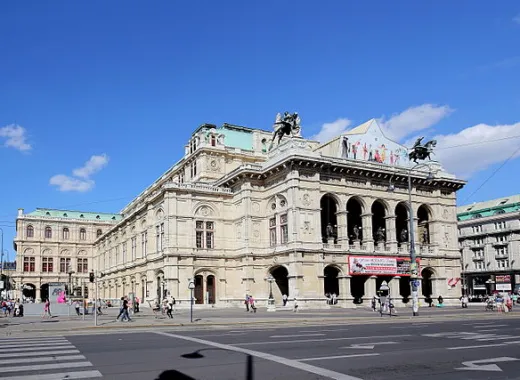
    •    The Vienna State Opera is located at Opernring 2, 1010 Vienna, and is easily accessible by public transport, bicycle, taxi or car.
       
    • › Public Transport – Metro U1, U2, U4 (Karlsplatz); Tram 1, 2, D, 71 (Oper, Karlsplatz); Bus 59A; Badner Bahn (Vienna Opera Station).
    • › By Bicycle – Bicycle stands are available on both sides of the Opera House.
    • › By Taxi – Taxi stands are located nearby, with taxis available at the main entrance after performances.
    • › By Car & Parking – Several parking garages are within walking distance: Operngarage (Herbert-von-Karajan-Platz, approx. 150 m); Kärntnerringgarage (Mahlerstraße 8, approx. 200 m); Opernringhof (Elisabethstraße 2, approx. 150 m).
  • ✧  Dress Code

    • › Dress Code: Guests are encouraged to dress elegantly for their visit. Flip-flops, undershirts worn as tops and very short shorts are not permitted. Head coverings that obstruct other guests' views are also prohibited.
  • ◷  Duration Details
    • › Duration – The start and end times are indicated for each performance date. Further details about the duration, acts and intermissions can be found on the individual performance pages, where available. Please note that performance information may be subject to change
    • › Admission – We ask you to arrive punctually for the performances. Late arrivals can only be admitted during the intermission. It is not possible to be admitted after intermission-during the performance.
  • ⎔  Accessibility
    • › Accessibility –  Due to its historic structure, the Vienna State Opera has limited accessibility. However, facilities are available to make visits as comfortable as possible for visitors with reduced mobility. All seating areas are accessible by elevator, and wheelchair-accessible toilets are available on both levels.
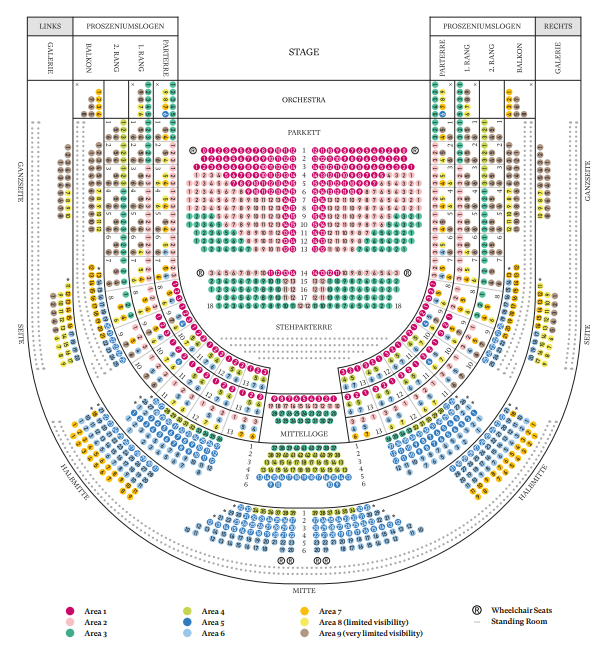
    • › Wheelchair Spaces – The opera house offers 22 wheelchair spaces: four in the stalls and 18 in the gallery (subject to availability).
    • › Access – The step-free entrance is located on the Herbert-von-Karajan-Platz side, at the beginning of the arcades (87 cm wide). The stalls and gallery elevator can be reached via the inclined lift in the opera foyer, near the Opera Café. The gallery elevator measures 95 × 140 cm, with an 80 cm door clearance. Checkrooms, interval buffets and accessible toilets are available on both levels.
  • ☷  Visitor Guidelines
    • › Photography & video – Photography, filming and the use of smartphones are not permitted during performances. Private photography is allowed during intermissions and curtain calls. Smartphones and cameras are strictly prohibited in the proscenium boxes throughout the performance.
    • › Cell phones – Please switch off your mobile phone or activate flight mode and keep it stored away during the performance to avoid disturbing performers and other visitors.
    • › Cloakroom – Coats, jackets and bulky items such as bags or backpacks must be left in the free cloakrooms located near the entrances, on both sides of the balcony and in the gallery. Box guests can use the cloakroom in their box.
Cast

Don Fernando: Clemens Unterreiner
Don Pizarro: Tomasz Konieczny
Florestan: David Butt Philip
Leonore: Jennifer Holloway
Rocco: Tareq Nazmi
Marzelline: Florina Ilie
Jaquino: Daniel Jenz


Musical direction: Cornelius Meister
Production: Nikolaus Habjan
Set design: Julius Theodor Semmelmann
Costumes: Denise Heschl
Lighting: Franz Tscheck
Video: Judith Selenko
Puppet construction: Bruno Belil
Text adaptation: Paulus Hochgatterer

Venue
Vienna State Opera

Public Transport
 

Subway lines: U1, U2, U4
Trams: 1, 2, D, J, 62, 65
Buses: 59A
Local Railway: Badner Bahn
Stops: Karlsplatz / Opera

Taxi stands are available nearby.
 

Parking


Parking is only € 6, - for eight hours!

The Wiener Staatsoper and the ÖPARK Kärntner Ring Garage on Mahlerstraße 8, under the “Ringstraßengalerien”, offer the patrons of the Vienna State Opera a new, reduced parking fee. You can park in the Kärntner Ring Garage for up to 8 hours and pay only a flat fee of € 6, -. Just validate your ticket at one of the discount machines inside the Wiener Staatsoper. The normal rate will be charged for parking time greater than 8 hours. The validation machines can be found at the following coat checks: Operngasse, Herbert von Karajan-Platz, and the right and left and balcony galleries.

Important: In order to get the discount, please draw a ticket and do not use your credit card when entering the garage!

After devaluing your ticket in the Wiener Staatsoper you can pay comfortably by credit card or cash at the vending machines.

The machines accept coins and bills up to 50.- Euro. Parking time longer than 8 hours will be charged at the normal rate.
 

History


The structure of the opera house was planned by the Viennese architect August Sicard von Sicardsburg, while the inside was designed by interior decorator Eduard van der Nüll. It was also impacted by other major artists such as Moritz von Schwind, who painted the frescoes in the foyer, and the famous "Zauberflöten" (“Magic Flute”) series of frescoes on the veranda. Neither of the architects survived to see the opening of ‘their’ opera house: the sensitive van der Nüll committed suicide, and his friend Sicardsburg died of a stroke soon afterwards.


On May 25, 1869, the opera house solemnly opened with Mozart's Don Giovanni in the presence of Emperor Franz Joseph and Empress Elisabeth.
The popularity of the building grew under the artistic influence of the first directors: Franz von Dingelstedt, Johann Herbeck, Franz Jauner, and Wilhelm Jahn. The Vienna opera experienced its first high point under the direction of Gustav Mahler. He completely transformed the outdated performance system, increased the precision and timing of the performances, and also utilized the experience of other noteworthy artists, such as Alfred Roller, for the formation of new stage aesthetics.


The years 1938 to 1945 were a dark chapter in the history of the opera house. Under the Nazis, many members of the house were driven out, pursued, and killed, and many works were not allowed to be played.


On March 12, 1945, the opera house was devastated during a bombing, but on May 1, 1945, the “State Opera in the Volksoper” opened with a performance of Mozart's THE MARRIAGE OF FIGARO. On October 6, 1945, the hastily restored “Theaters an der Wien” reopened with Beethoven's FIDELIO. For the next ten years the Vienna State Opera operated in two venues while the true headquarters was being rebuilt at a great expense.


The Secretary of State for Public Works, Julius Raab, announced on May 24, 1945, that reconstruction of the Vienna State Opera would begin immediately. Only the main facade, the grand staircase, and the Schwind Foyer had been spared from the bombs. On November 5, 1955, the Vienna State Opera reopened with a new auditorium and modernized technology. Under the direction of Karl Böhm, Beethoven’s FIDELIO was brilliantly performed, and the opening ceremonies were broadcast by Austrian television. The whole world understood that life was beginning again for this country that had just regained its independence.


Today, the Vienna State Opera is considered one of the most important opera houses in the world; in particular, it is the house with the largest repertoire. It has been under the direction of Dominique Meyer since September 1, 2010.

Accomodation

Buy now

Gift vouchers

Gift someone an unforgettable night at the opera.
Choose a gift coupon and let them pick the performance they love—music, drama, and world-class artistry, all in one elegant experience.
Official Tickets for Europe's Most Famous Opera Houses, Classical Concerts etc.
Instagram
Payment
Google Play
App Store
© 2026 RM Europa Ticket GmbH
Whatsapp