



en
en v
Phone
Cart0 Tickets
Total: 0€
Account
Calendar
Search
Menu
X

Levit, Fischer And Czech Philharmonic

VenueRudolfinum
CalendarFri 21 May 2027
Synopsis/Details

1810 | Egmont 

I was greatly occupied with my revisions for Fidelio, but when I received an offer to create the incidental music for Egmont in 1809 I did not hesitate for a second. Goethe’s language always set me in the right mood and incited me to write. Moreover, I was profoundly moved by Egmont’s story, all the more so given that it takes place in Flanders – the land of my forebears. In the overture I outlined the main points in the plot. It begins with the indictment by the Spanish judges in the low strings, with Klärchen’s tender plea for mercy for her beloved heard above them – first in the oboe and bassoon, then in the flutes and clarinets. Egmont’s heroism in the final moments before his death is expressed in the closing deafening fortissimo. Heroism as a call to fight against oppression and tyranny.  


1803 | Piano Concerto No. 3 

I have fond memories of the premiere of my third piano concerto, held at the Theater an der Wien on the 5th of April, 1803. We only had a single rehearsal for the entire programme and, moreover, the best of Vienna’s musicians had been hired by the competition who decided to present Haydn’s Creation that same evening. We began at eight in the morning and by half past two in the afternoon everyone was so exhausted that Prince Lichnowsky promptly sent for large baskets of bread, smoked meats and wine and invited all the musicians to the table. They ate their fill and the creative and friendly atmosphere was immediately restored! The theatre’s new music director Ignaz von Seyfried agreed to be my page-turner at the concert. (He chuckles.) But it might be better if he described the event himself. “I saw empty pages with here and there what looked like Egyptian hieroglyphs. Beethoven played most of the piano part from memory, and whenever he reached the end of some invisible passage, he gave me a surreptitious nod and I turned the page. My anxiety not to miss such a nod amused him greatly and the recollection of it at our convivial dinner after the concert sent him into gales of laughter.” There you have it. And they say I was a grouch and not predisposed to merriment! 


Mass in honour of Admiral Nelson 

While Beethoven embraced the ideas of the French Revolution spreading like an avalanche across Europe, his teacher Haydn viewed them with distrust. In 1798 the political and financial instability of the Habsburg monarchy filled him with similar concerns. This is also why he initially gave his new work – Mass in D minor – the title Missa in angustiis (Mass for Troubled Times). The work was a commission for Prince Nikolaus II, the grandson of Nikolaus I, “the Magnificent”, Haydn’s benefactor of many years from the house of Esterházy. The subtitle Nelson Mass arose spontaneously out of Haydn’s great regard for the British Admiral Horatio Nelson who, at the beginning of August 1798, when the composer was working on his Mass in D minor, defeated Napoleon’s fleet at Aboukir Bay (Battle of the Nile). Among Haydn’s thirteen masses, the Mass in D minor, together with The Creation and The Seasons, represents the culmination of his vocal-instrumental oeuvre. It will be a rewarding experience to hear this work performed by one of the greatest authorities on Haydn’s music, the founder of the Austrian-Hungarian Haydn Philharmonic and the Haydn Festival in Eisenstadt, Hungarian conductor Ádám Fischer. For his lifetime contribution to classical music, which reflects his many projects with such institutions as the Bayreuth and Salzburg festivals, the Metropolitan Opera in New York, Milan’s Teatro alla Scala and the Berlin and Vienna Philharmonics, Ádám Fischer received the coveted International Classical Music Award in 2022. 

Cast

Programme

Ludwig van Beethoven: Egmont, předehra ke Goethově tragedii op. 84

Ludwig van Beethoven: Piano Concerto No. 3 in C minor Op. 37

Joseph Haydn: Mass in D minor Hob.XXII:11 “Nelsonmesse”


Performers

Czech Philharmonic

Ádám Fischer – conductor

SILENTIUM! ensemble

Tereza Válková – choirmistress

Igor Levit – piano

Venue
Rudolfinum

The Rudolfinum, one of the most noteworthy buildings in Prague, was built between 1876 and 1884 according to the designs of architects Josef Zítek and Josef Schulze. Originally intended as a multipurpose cultural building in Prague, the Rudolfinum was inagurated on February 7, 1885. It carried out its mission until 1919, when it was converted to the House of Commons of the Czechoslovak Republic. Concert activity was restored to the Rudolfinum during the German occupation, but full rehabilitation, particularly of the gallery, did not take place until 1992. After a general reconstruction by architect Karel Prager in 1992, the Rudolfinum became the home of the Czech Philharmonic and the Rudolfinum Gallery.


Dvorana – Ceremony Hall

The central space in the gallery portion of the Rudolfinum was designed by Josef Zítek and Josef Schulz as an entrance hall to the art gallery. After 1918, however, this space was converted into a parliamentary cafeteria, and after World War II it served as a gymnasium for the Prague Conservatory. At the end of the 1980s, Ceremony Hall was threatened with reconstruction – but plans to tear down the main staircase to make room for another concert hall did not go through, and the hall retained its original appearance. Of particular interest in Ceremony Hall are 25 empty spaces on its walls, which were originally intended to be filled in with frescos. The majority of the eminent Czech painters, however, boycotted the 1891 fresco competition in protest over the large number of German artists involved in the construction of the Rudolfinum.


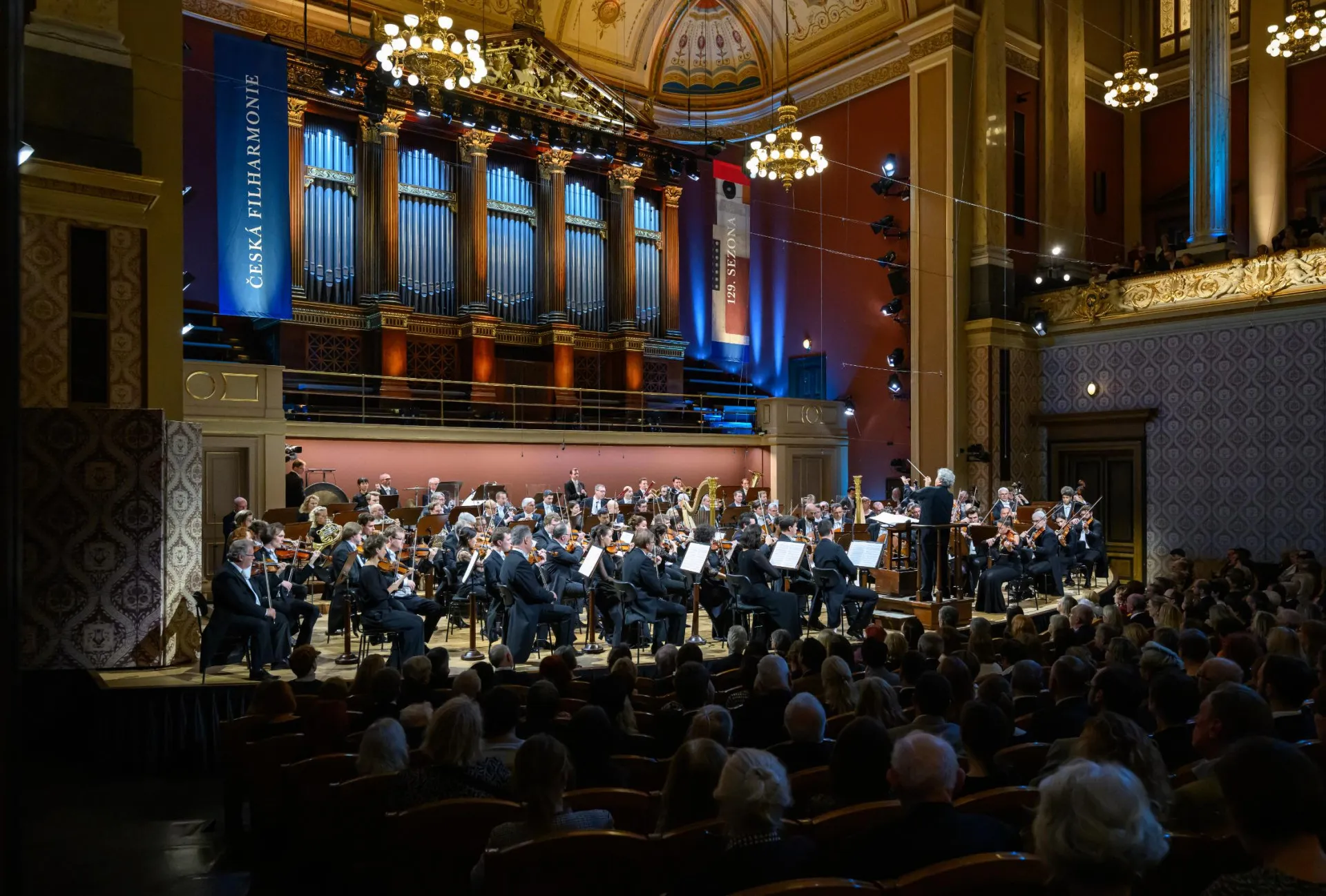
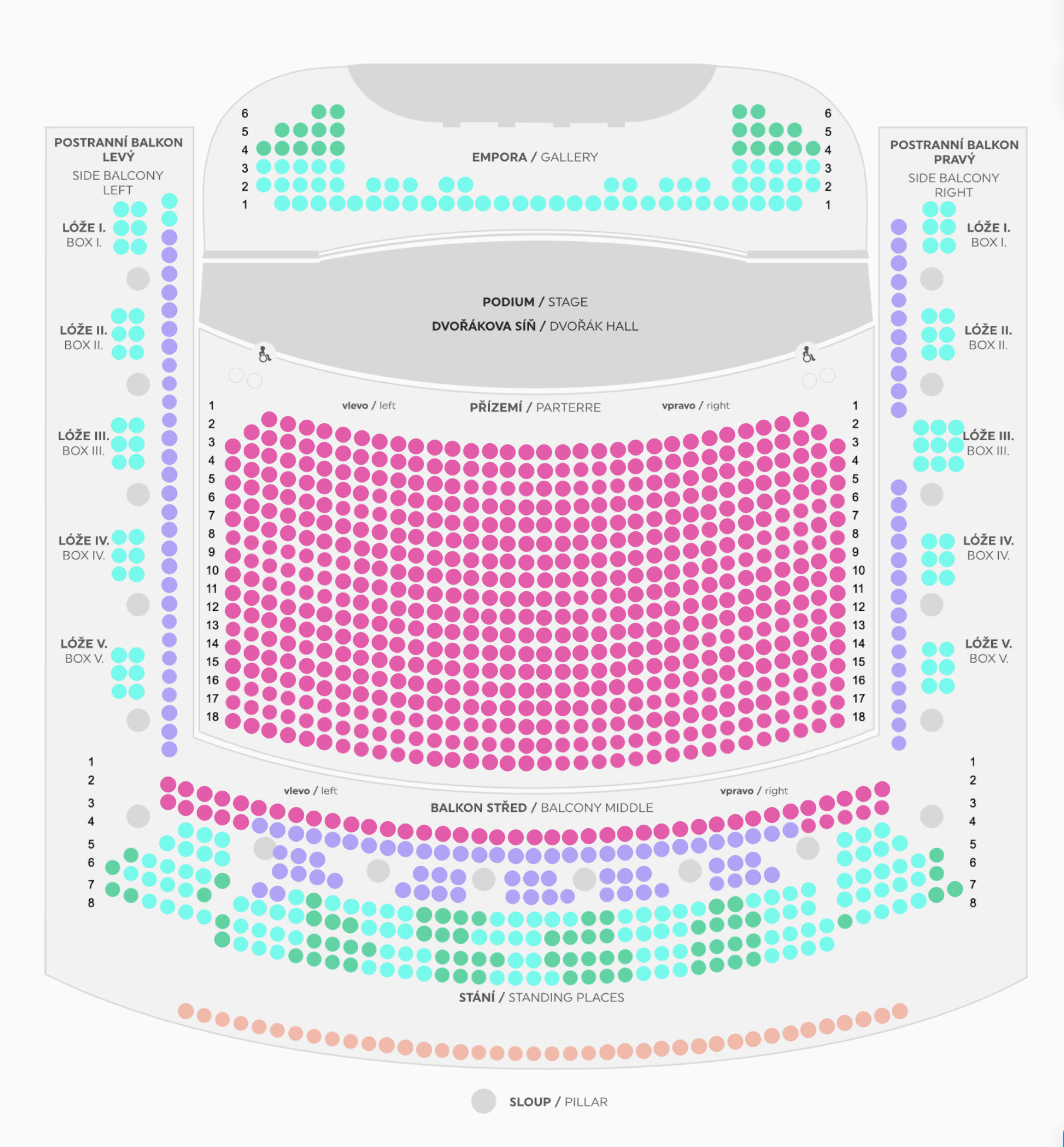
Dvořák Hall

The Czech Philharmonic took the stage in this world-famous concert hall in 1896, performing for its first-ever concert under the baton of Antonín Dvořák himself. The hall remained a space for concerts and performances until 1918, at which time it became a boardroom for the new parliament of the Czechoslovak Republic. The stage and the organ loft became a tribunal (garnished with a statue of President T.G. Masaryk), from which parliamentary leaders presided over proceedings. The hall's original character (and purpose) was restored
in 1940–1942 according to a project conceived by Antonín Engel and Bohumír Kozák, and it has remained in this form through to the present. In accordance with Josef Zítek and Josef Schulz's original proposal, the central visual element in the hall is an organ, which was made in Frankfurt, Germany. During the hall's stint as a parliamentary meeting place, the organ was housed in Brno. When it returned to the Rudolfinum in 1940, its register was extended. Dvořák Hall's final update took place in 1992 when the entire Rudolfinum building underwent reconstruction.


When travelling by public transport, get off at the Staroměstská metro station (Line A), tram stop (trams nos. 17, 18 and 53) or bus stop (no. 207).
Parking is available at the underground parking facility on Jan Palach Square. The facility is not part of the Rudolfinum premises.


Accomodation

Buy now

Gift vouchers

Gift someone an unforgettable night at the opera.
Choose a gift coupon and let them pick the performance they love—music, drama, and world-class artistry, all in one elegant experience.
Official Tickets for Europe's Most Famous Opera Houses, Classical Concerts etc.
Instagram
Payment
Google Play
App Store
© 2026 RM Europa Ticket GmbH
Whatsapp