


en
en v
Phone
Cart0 Tickets
Total: 0€
Account
Calendar
Search
Menu
X

Pagliacci

VenueTeatro San Carlo Naples Italy
CalendarWed 10 Mar 2027 - Wed 17 Mar 2027
Synopsis/Details

Synopsis

Place: Calabria, near Montalto, on the Feast of the Assumption

Time: between 1865 and 1870


Prologue

During the orchestral introduction, Tonio, dressed as his commedia dell'arte character Taddeo, pokes his head through the curtain, advances, and addresses the audience. ("Si può?... Si può?... Signore! Signori! ... Un nido di memorie"). He reminds the audience that actors have feelings too, and that the show is about real people. Tonio returns behind the curtain, which then rises for the main action.


Act 1

At three o'clock in the afternoon, the commedia troupe enters the village to the cheering of the villagers. Canio describes the night's performance: the troubles of Pagliaccio. He says the play will begin at ventitré ore, an agricultural method of time-keeping that means the play will begin an hour before sunset. As Nedda steps down from the cart, Tonio offers his hand, but Canio pushes him aside and helps her down himself.

The villagers suggest drinking at the tavern. Canio and Beppe accept, but Tonio stays behind. The villagers tease Canio that Tonio is planning an affair with Nedda. Canio warns everyone that while he may act the foolish husband in the play, in real life he will not tolerate other men making advances to Nedda. Shocked, a villager asks if Canio really suspects her. He says no, and sweetly kisses her on the forehead. As the church bells ring vespers, he and Beppe leave for the tavern, leaving Nedda alone.


Nedda is frightened by Canio's vehemence ("Qual fiamma avea nel guardo"), but the birdsong comforts her ("Stridono lassù"). Tonio returns and confesses his love for her, but she laughs. Enraged, Tonio grabs Nedda, but she takes a whip, strikes him and drives him off. Silvio, who is Nedda's lover, comes from the tavern, where he has left Canio and Beppe drinking. He asks Nedda to elope with him after the performance and, though she is afraid, she agrees. Tonio, who has been eavesdropping, leaves to inform Canio so that he might catch Silvio and Nedda together. Canio and Tonio return and, as Silvio escapes, Nedda calls after him, "I will always be yours!"

Canio chases Silvio, but does not catch him and does not see his face. He demands that Nedda tell him the name of her lover, but she refuses. He threatens her with a knife, but Beppe disarms him. Beppe insists that they prepare for the performance. Tonio tells Canio that her lover will give himself away at the play. A heartbroken Canio is left alone to put on his costume and prepare to laugh ("Vesti la giubba" – "Put on the costume").


Act 2

As the crowd arrives, Nedda, costumed as Colombina, collects their money. She whispers a warning to Silvio, and the crowd cheers as the play begins.

Colombina's husband Pagliaccio has gone away until morning, and Taddeo is at the market. Alone, she anxiously awaits her lover Arlecchino, who comes to serenade her ("O Colombina") from beneath her window. Taddeo returns and confesses his love, but she mocks him. She lets Arlecchino in through the window. He boxes Taddeo's ears and kicks him out of the room, and the audience laughs.

Arlecchino and Colombina dine, and he gives her a sleeping potion to use later, "so that when Pagliaccio returns, she can drug him and elope with Arlecchino." Taddeo then bursts in, warning them that Pagliaccio is suspicious of his wife and is about to return. As Arlecchino escapes through the window, Colombina tells him, "I will always be yours!"


As Pagliaccio enters, he hears Colombina speak this line and, now as Canio, exclaims "Nome di Dio! Quelle stesse parole!" – "Name of God! Those same words!" He tries to continue the play, but loses control and demands to know her lover's name. Nedda, hoping to keep to the performance, calls Canio by his stage name "Pagliaccio" to remind him of the audience's presence. He answers with his arietta: "No! Pagliaccio non son!" – "I am not Pagliaccio!" He sings that if his face is pale, it is not from the stage makeup but from the shame she has brought him. The crowd is impressed by his emotional performance and cheers him, without realizing that it is real.

Nedda, trying to continue the play, admits that she has been visited by the innocent "Arlecchino". Canio, furious and forgetting the play, demands the name of her lover. Nedda swears she will never tell him, and it becomes apparent that they are not acting. Side-stage, Beppe asks Tonio to intervene, but Tonio refrains and prevents Beppe from halting the action. Silvio begins to fight his way toward the stage. Canio, grabbing a knife from the table, stabs Nedda. As she dies, she calls: "Help! Silvio!" Silvio attacks Canio, but Canio kills him as well. The horrified audience then hears the celebrated final line:


"La commedia è finita!!" – "The comedy is finished!"

  • Where is Teatro San Carlo located?
    • Teatro San Carlo is located at Via San Carlo, 98, 80132 Naples, Italy, in the heart of Naples, next to Piazza del Plebiscito and close to the Royal Palace and Galleria Umberto I.
  • How early should I arrive before the Concert?
    • We recommend arriving at least 30 minutes before the scheduled start time. This allows enough time to reach the entrance, have your ticket checked and find your seat.
  • What should I wear?
    • There is no need to wear formal evening attire. Smart casual or elegant clothing is recommended. Comfortable but presentable attire is appropriate for the theatre environment.
  • Can I enter the auditorium if I arrive late?
    • Late entry to the auditorium may not be permitted once the performance has started. Latecomers may be admitted during the first available interval, depending on the theatre's rules and the nature of the performance.
  • Can I bring a large bag or backpack?
    • Large bags and backpacks should not be taken into the auditorium. If available, they should be left in the theatre's designated cloakroom or storage area.
  • Can I bring food or drinks into the auditorium?
    • No. Food and beverages are not permitted inside the auditorium during the performance or interval.
Cast

Opera in Italian with supertitles in Italian and English
Duration: about one hour and 45 minutes, without interval

Drama in a prologue and two acts on the author's libretto
Music by Ruggiero Leoncavallo

Director | Daniel Oren
Direction and Scene | Franco Zeffirelli taken by Stefano Trespidi
Costumes | Raimonda Gaetani
Luci | Vinicio Cheli


Interpreters
Nedda | Carolina López Moreno / Karen Gardeazabal*
Canio | Fabio Sartori / Yusif Eyvazov*
Tonio | Ariunbaatar Ganbaatar / Daniel Luis de Vicente*
Silvio | Simone Del Savio / Andrea Piazza*
Peppe | Matteo Mezzaro


Orchestra, Choir and Choir of White Voices of the San Carlo Theater
Choir Master | Fabrizio Cassi
Master of the White Voices Choir | Stefania Rinaldi


Production of the Rome Opera House

Venue
Teatro San Carlo Naples Italy


Teatro di San Carlo Napoli; San Carlo Opera House; Real Teatro di San Carlo Naples.


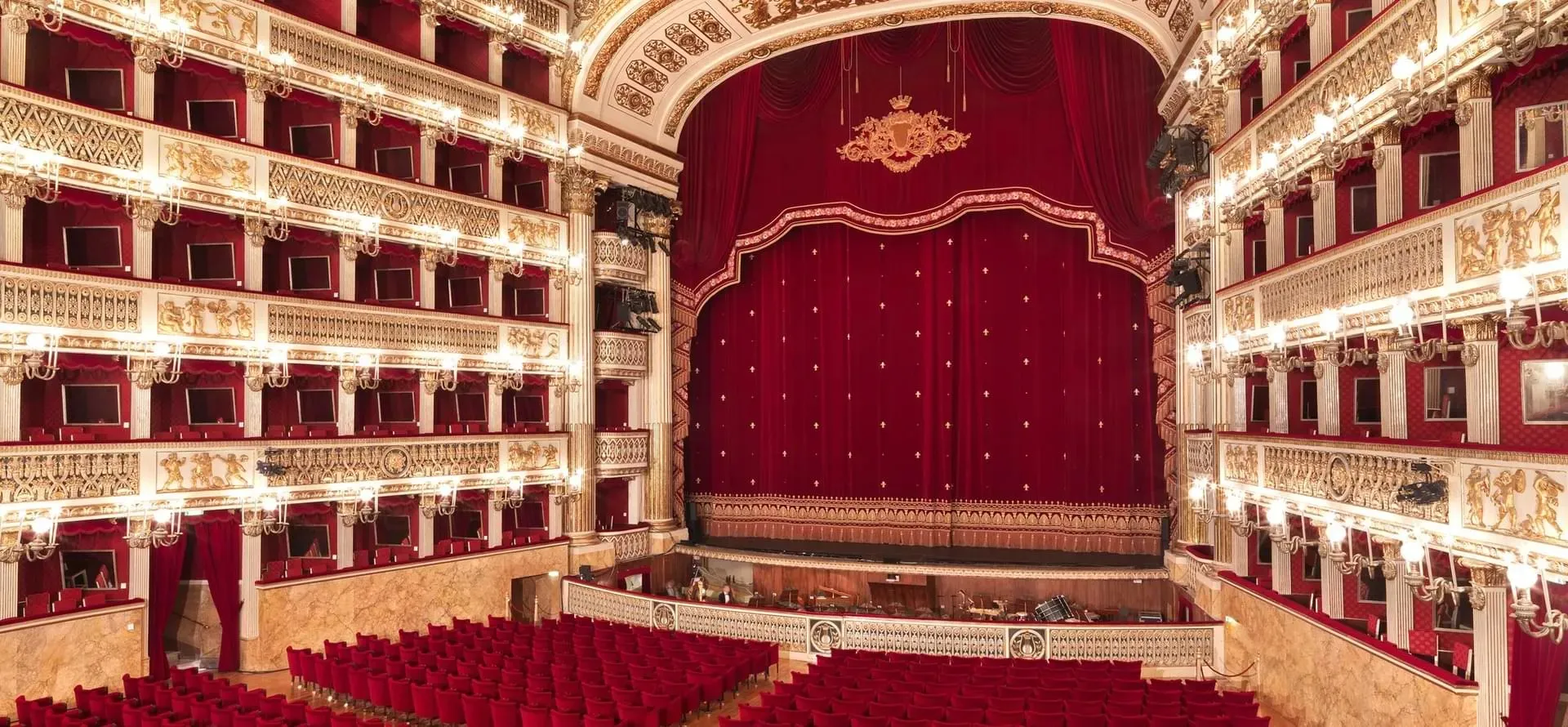
The Real Teatro di San Carlo (Royal Theatre of Saint Charles), its original name under the Bourbon monarchy but known today as simply the Teatro di San Carlo, is anopera house in Naples, Italy. It is located adjacent to the central Piazza del Plebiscito, and connected to the Royal Palace.


It is one of the oldest continuously active venue for public opera in the world, opening in 1737, only five years after the Manoel Theatre in Malta and decades before both the Milan's La Scala and Venice's La Fenice theatres. 


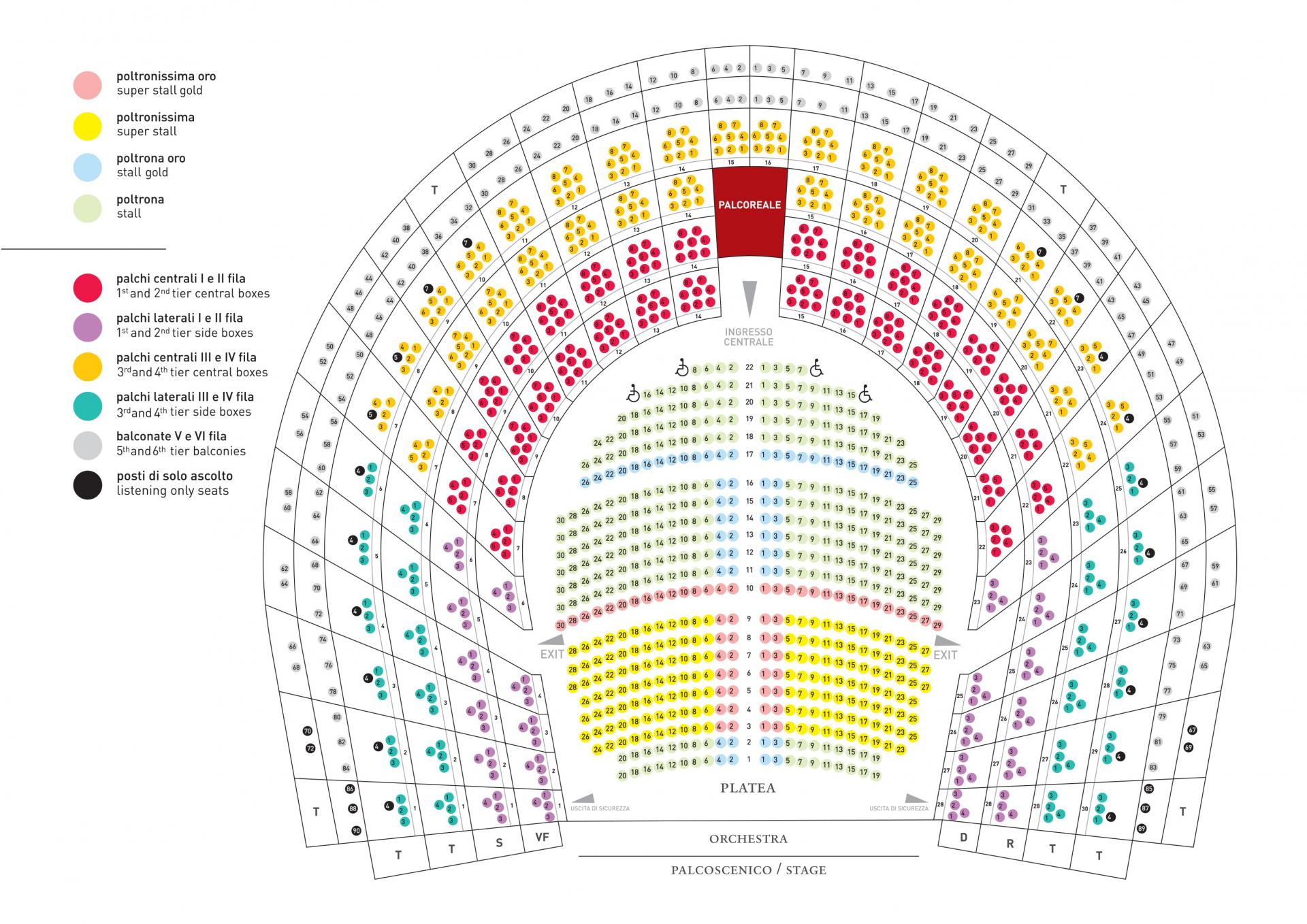
The opera season runs from late January to May, with the ballet season taking place from April to early June. The house once had a seating capacity of 3,285.but nowadays has been reduced to 1414 seats.[3] Given its size, structure and antiquity was the model for the following theatres in Europe.


History of the opera house


Commissioned by the Bourbon King Charles VII of Naples (Carlo VII in Italian), Charles wanted to endow Naples with a new and larger theatre to replace the old, dilapidated, and too-small Teatro San Bartolomeo of 1621, which had served the city well, especially after Scarlatti had moved there in 1682 and had begun to create an important opera centre which existed well into the 1700s.


Thus, the San Carlo was inaugurated on 4 November 1737, the king's name day, with the performance of the opera Domenico Sarro's Achille in Sciro, which was based on the 1736 libretto by Metastasio which had been set to music that year by Antonio Caldara. As was customary, the role of Achilles was played by a woman, Vittoria Tesi, called "Moretta"; the opera also featured soprano Anna Peruzzi, called "the Parrucchierina" and tenor Angelo Amorevoli. Sarro also conducted the orchestra in two ballets as intermezzi, created by Gaetano Grossatesta, with scenes designed by Pietro Righini. The first seasons highlighted the royal preference for dance numbers, and featured among the performers famous castrati.


In the late 18th century, Christoph Willibald Gluck was called to Naples by the impresario Tufarelli to direct his 1852 Clemenza di Tito at the theatre, and Johann Christian Bach in 1761-62 brought two operas, Catone in Utica and Alessandro nell'Indie.


1737: Construction of the Teatro di San Carlo


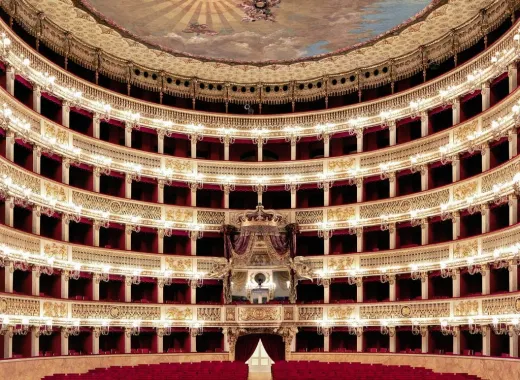
The new opera house was designed by Giovanni Antonio Medrano, a military architect, and Angelo Carasale, the former director of the San Bartolomeo. The horseshoe-shaped auditorium is the oldest in the world. It was built at a cost of 75,000 ducats. The hall was 28.6 meters long and 22.5 meters wide, with 184 boxes, including those of proscenium, arranged in six orders, plus a royal box capable of accommodating ten people, for a total of 1,379 seats. Including standing room, the theatre could hold over 3,000 people. The fastidious composer and violinist Louis Spohr reviewed the size and acoustic properties of this opera house very thoroughly on 15 February 1817 and concluded that:


there is no better place for ballet and pantomime. Military movements of infantry and cavalry, battles, and storms at sea can be represented here without falling into the ludicrous. But for opera, itself, the house is too large. Although the singers, Signora Isabella Colbran, [Prima Donna of the Teatro San Carlo opera company and Rossini's future wife], and the Signori Nozzari, Benedetti, etc., have very strong voices, only their highest and most stentorian tones could be heard. Any kind of tender utterance was lost.


Much admired for its architecture, its gold decorations, and the sumptuous blue upholstery (blue and gold being the official colours of the Bourbons), the San Carlo was now the biggest opera house in the world.[6] In relation to the power of the existing Bourbon Kingdom of the Two Sicilies, Beauvert notes that the design of the house, with its 184 boxes lacking any curtains was so that "no one could avoid the scrutiny by the sovereign" who had his private access from the Royal Palace.


In 1809 Domenico Barbaia was appointed manager of the royal opera houses in Naples and remained in charge until 1841. He soon established a reputation for innovative and dazzling productions, which attracted both the public and leading singers to the opera house.


 

Accomodation

Buy now

Gift vouchers

Gift someone an unforgettable night at the opera.
Choose a gift coupon and let them pick the performance they love—music, drama, and world-class artistry, all in one elegant experience.
Official Tickets for Europe's Most Famous Opera Houses, Classical Concerts etc.
Instagram
Payment
Google Play
App Store
© 2026 RM Europa Ticket GmbH
Whatsapp