 en

 de
 it
 fr
 es
 ru
 jp
 ro








 Rudolfinum
 Sun 16 May 2027

The Rudolfinum, one of the most noteworthy buildings in Prague, was built between 1876 and 1884 according to the designs of architects Josef Zítek and Josef Schulze. Originally intended as a multipurpose cultural building in Prague, the Rudolfinum was inagurated on February 7, 1885. It carried out its mission until 1919, when it was converted to the House of Commons of the Czechoslovak Republic. Concert activity was restored to the Rudolfinum during the German occupation, but full rehabilitation, particularly of the gallery, did not take place until 1992. After a general reconstruction by architect Karel Prager in 1992, the Rudolfinum became the home of the Czech Philharmonic and the Rudolfinum Gallery.
Dvorana – Ceremony Hall
The central space in the gallery portion of the Rudolfinum was designed by Josef Zítek and Josef Schulz as an entrance hall to the art gallery. After 1918, however, this space was converted into a parliamentary cafeteria, and after World War II it served as a gymnasium for the Prague Conservatory. At the end of the 1980s, Ceremony Hall was threatened with reconstruction – but plans to tear down the main staircase to make room for another concert hall did not go through, and the hall retained its original appearance. Of particular interest in Ceremony Hall are 25 empty spaces on its walls, which were originally intended to be filled in with frescos. The majority of the eminent Czech painters, however, boycotted the 1891 fresco competition in protest over the large number of German artists involved in the construction of the Rudolfinum.
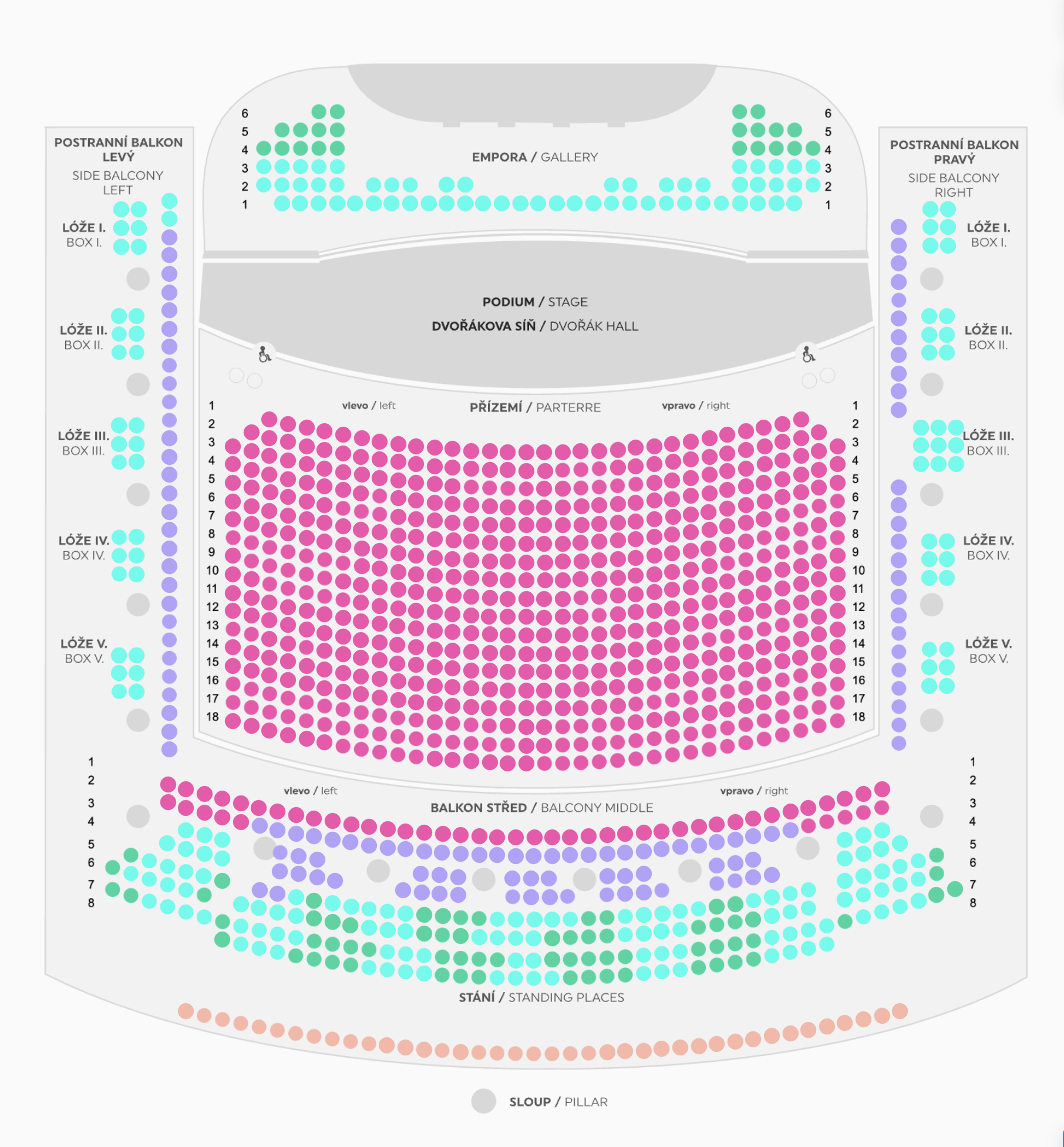
Dvořák Hall
The Czech Philharmonic took the stage in this world-famous concert hall in 1896, performing for its first-ever concert under the baton of Antonín Dvořák himself. The hall remained a space for concerts and performances until 1918, at which time it became a boardroom for the new parliament of the Czechoslovak Republic. The stage and the organ loft became a tribunal (garnished with a statue of President T.G. Masaryk), from which parliamentary leaders presided over proceedings. The hall's original character (and purpose) was restored
in 1940–1942 according to a project conceived by Antonín Engel and Bohumír Kozák, and it has remained in this form through to the present. In accordance with Josef Zítek and Josef Schulz's original proposal, the central visual element in the hall is an organ, which was made in Frankfurt, Germany. During the hall's stint as a parliamentary meeting place, the organ was housed in Brno. When it returned to the Rudolfinum in 1940, its register was extended. Dvořák Hall's final update took place in 1992 when the entire Rudolfinum building underwent reconstruction.
When travelling by public transport, get off at the Staroměstská metro station (Line A), tram stop (trams nos. 17, 18 and 53) or bus stop (no. 207).
Parking is available at the underground parking facility on Jan Palach Square. The facility is not part of the Rudolfinum premises.



 RM Europa Ticket GmbH
 Call now
 Book now