


en
en v
Phone
Cart0 Tickets
Total: 0€
Account
Calendar
Search
Menu
X

The Barber Of Seville

VenueTeatro San Carlo Naples Italy
CalendarWed 16 Jun 2027 - Wed 23 Jun 2027
Synopsis/Details

Synopsis

Place: Seville, Spain

Time: 17th century


Act 1

The square in front of Bartolo's house

In a public square outside Bartolo's house a band of musicians and a poor student named Lindoro are serenading, to no avail, the window of Rosina ("Ecco, ridente in cielo"; "There, laughing in the sky"). Lindoro, who is really the young Count Almaviva in disguise, hopes to make the beautiful Rosina love him for himself – not his money. Almaviva pays off the musicians who then depart, leaving him to brood alone. Rosina is the young ward of the grumpy, elderly Bartolo and she is allowed very little freedom because Bartolo plans to marry her once she is of age and thus appropriate her considerable dowry.


Figaro approaches singing (Aria: "Largo al factotum della città"; "Make way for the factotum of the city"). Since Figaro used to be a servant of the Count, the Count asks him for assistance in helping him meet Rosina, offering him money should he be successful in arranging this (duet: "All'idea di quel metallo"; "At the idea of that metal"). Figaro advises the Count to disguise himself as a drunken soldier, ordered to be billeted with Bartolo, so as to gain entrance to the house. For this suggestion, Figaro is richly rewarded.

A room in Bartolo's house with four doors


The scene begins with Rosina's cavatina, "Una voce poco fa" ("A voice a little while ago"). (This aria was originally written in the key of E major, but it is sometimes transposed a semitone up into F major for coloratura sopranos to perform, giving them the chance to sing extra, almost traditional, cadenzas, sometimes reaching high Ds or even Fs.)


Knowing the Count only as Lindoro, Rosina writes to him because she is interested in getting to know him better. As she is leaving the room, Bartolo enters with the music teacher Basilio. Bartolo is suspicious of the Count, and Basilio advises that he be put out of the way by creating false rumours about him (this aria, "La calunnia è un venticello" – "Calumny is a little breeze" – is almost always sung a tone lower than the original D major).


When the two have gone, Rosina and Figaro enter. Figaro asks Rosina to write a few encouraging words to Lindoro, which she has actually already written. (Duet: "Dunque io son...tu non m'inganni?"; "Then I'm the one...you're not fooling me?"). Although surprised by Bartolo, Rosina manages to fool him, but he remains suspicious. (Aria: "A un dottor della mia sorte"; "To a doctor of my class").


Count Almaviva, disguised as a soldier and pretending to be drunk, enters the house and demands to be quartered there. In fear of the drunken man, Berta the housekeeper rushes to Bartolo for protection. Bartolo tells the "soldier" that he (Bartolo) has an official exemption which excuses him from the requirement to quarter soldiers in his home. Almaviva pretends to be too drunk and belligerent to understand, and dares Bartolo to brawl. While Bartolo searches his cluttered desk for the official document which would prove his exemption, Almaviva whispers to Rosina that he is Lindoro in disguise, and passes a love-letter to her. Bartolo suspiciously demands to know what is in the piece of paper in Rosina's hands, but she fools him by handing over her laundry list. Bartolo and the Count argue loudly. Basilio enters; then Figaro, who warns that the noise of the argument is rousing the whole neighborhood. Finally, the noise attracts the attention of the Officer of the Watch and his troops, who crowd into the room. Bartolo demands that the Officer arrest the "drunken soldier". The Officer starts to do so, but Almaviva quietly reveals his true identity to the Officer, and he (the Officer) backs off. Bartolo and Basilio are astonished and mystified; Figaro laughs quietly at them. (Finale: "Fredda ed immobile, come una statua"; "Cold and still, just like a statue"). The confusion intensifies and causes everyone to suffer headaches and auditory hallucinations ("Mi par d'esser con la testa in un'orrida fucina; dell'incudini sonore l'importuno strepitar"; "My head seems to be in a fiery forge: the sound of the anvils deafens the ear").


Act 2

A room in Bartolo's house with a piano

Count Almaviva again appears at the doctor's house, this time disguised as Don Alonso, a priest and singing tutor who is substituting for the supposedly ailing Basilio. To gain Bartolo's trust, Don Alonso tells him he has intercepted a note from Lindoro to Rosina, and says that Lindoro is a servant of Count Almaviva who has dishonorable intentions towards Rosina. While Almaviva pretends to give Rosina her singing lesson ("Contro un cor"; "Against a heart"), Figaro arrives to shave Bartolo. Not wanting to leave Rosina alone with the singing teacher, Bartolo insists Figaro shave him right there in the music room. Basilio suddenly appears for his scheduled music lesson, but he is bribed by a full purse from Almaviva and persuaded to leave again, with much discussion of how ill he looks. (Quintet: "Don Basilio! – Cosa veggo!"; "Don Basilio! – What do I see?"). Bartolo overhears the lovers conspiring, and angrily drives everybody away. Berta vents about the crazy household ("Il vecchiotto cerca moglie").

A room in Bartolo's house with a grille looking out onto the square.


Bartolo orders Basilio to have the notary ready to marry him to Rosina that evening. Basilio leaves and Rosina arrives. Bartolo shows Rosina the letter she wrote to "Lindoro" and persuades her that this is proof that Lindoro is merely a flunky of Almaviva and is toying with her at Almaviva's behest. Rosina believes the story and agrees to marry Bartolo.


During an instrumental interlude, the music creates a thunder storm to indicate the passage of time. Almaviva and Figaro climb up a ladder to the balcony and enter Rosina's room through a window. Rosina accuses Almaviva, whom she believes to be Lindoro, of betraying her. Almaviva reveals his identity and the two reconcile. While Almaviva and Rosina are enraptured by one another, Figaro keeps urging them to leave. Two people are heard approaching the front door. They are Basilio and the notary. The Count, Rosina, and Figaro attempt to leave by way of the ladder, but discover it has been removed. Using bribes and threats, Almaviva coerces the notary into marrying him to Rosina, with Basilio and Figaro as the legally required witnesses. Bartolo barges in, accompanied by the Officer and the men of the watch, but too late; the marriage is already complete. The befuddled Bartolo is pacified by being allowed to retain Rosina's dowry. The opera concludes with an anthem to love ("Amor e fede eterna, si vegga in noi regnar!"; "May love and faith eternally be seen to reign in us").

  • Where is Teatro San Carlo located?
    • Teatro San Carlo is located at Via San Carlo, 98, 80132 Naples, Italy, in the heart of Naples, next to Piazza del Plebiscito and close to the Royal Palace and Galleria Umberto I.
  • How early should I arrive before the Concert?
    • We recommend arriving at least 30 minutes before the scheduled start time. This allows enough time to reach the entrance, have your ticket checked and find your seat.
  • What should I wear?
    • There is no need to wear formal evening attire. Smart casual or elegant clothing is recommended. Comfortable but presentable attire is appropriate for the theatre environment.
  • Can I enter the auditorium if I arrive late?
    • Late entry to the auditorium may not be permitted once the performance has started. Latecomers may be admitted during the first available interval, depending on the theatre's rules and the nature of the performance.
  • Can I bring a large bag or backpack?
    • Large bags and backpacks should not be taken into the auditorium. If available, they should be left in the theatre's designated cloakroom or storage area.
  • Can I bring food or drinks into the auditorium?
    • No. Food and beverages are not permitted inside the auditorium during the performance or interval.
Cast

Opera in Italian with supertitles in Italian and English
Duration: about 3 hours, without interval

Funny melodrama in two acts
Music by Gioachino Rossini
Booklet by Cesare Sterbini

Director | Ottavio Dantone
Directed by Filippo Crivelli taken by Luca Baracchini
Scene | Emanuele Luztiza
Costumes | Santuzza Calì
Lights | Nunzio Perrella


Interpreters
The Count of Almaviva | Maxim Mironov / César Cortés*
Don Bartolo | Paolo Bordogna / Riccardo Novaro*
Rosina | Chiara Amarù / Ekaterine Buachidze*
Figaro | Roberto de Candia / Vincenzo Taormina*
Don Basilio | Michele Pertusi / Francesco Leone*
Fiorello/Official | Huang Yeshen**


Orchestra and Choir of the San Carlo Theater
Choir Master | Fabrizio Cassi


Production of the San Carlo Theater

**Academy of the San Carlo Theater

Venue
Teatro San Carlo Naples Italy


Teatro di San Carlo Napoli; San Carlo Opera House; Real Teatro di San Carlo Naples.


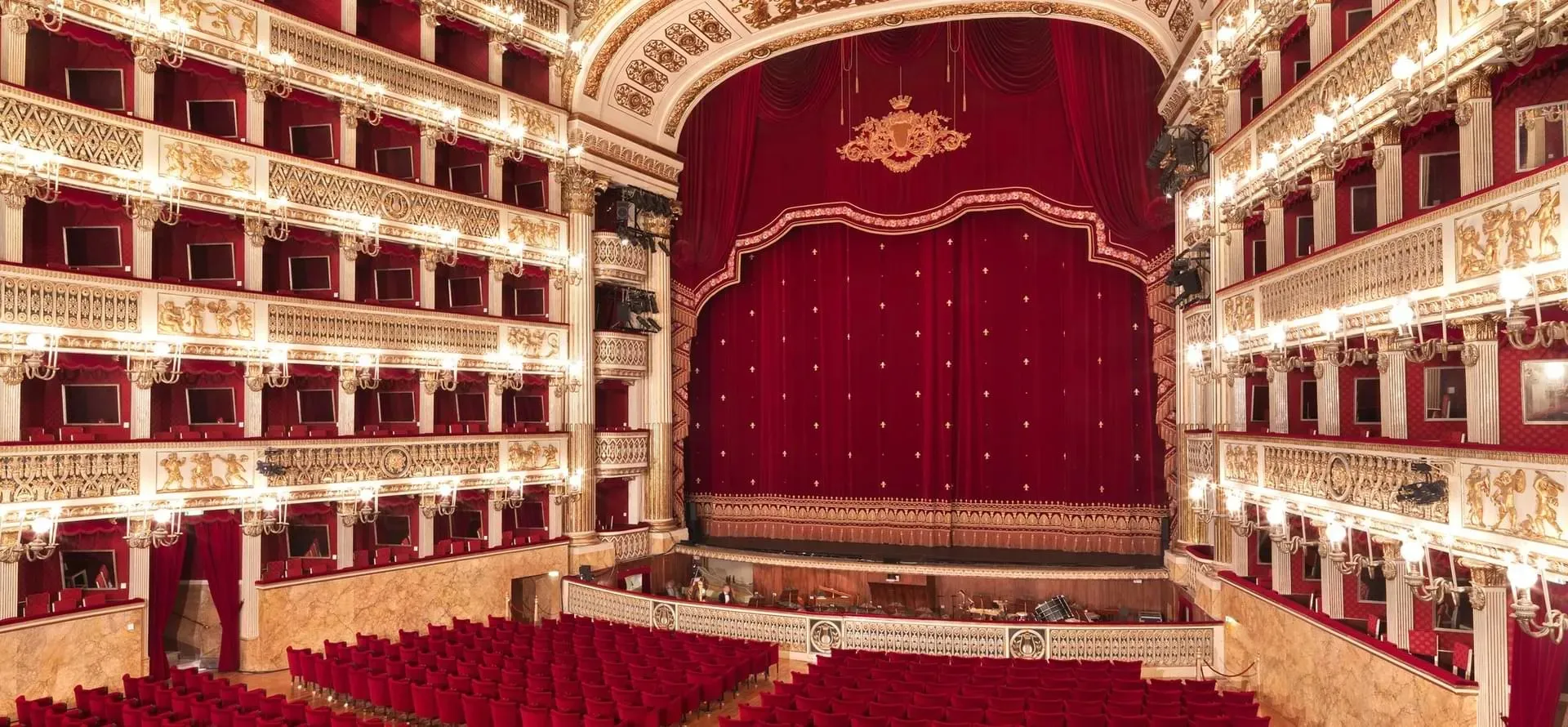
The Real Teatro di San Carlo (Royal Theatre of Saint Charles), its original name under the Bourbon monarchy but known today as simply the Teatro di San Carlo, is anopera house in Naples, Italy. It is located adjacent to the central Piazza del Plebiscito, and connected to the Royal Palace.


It is one of the oldest continuously active venue for public opera in the world, opening in 1737, only five years after the Manoel Theatre in Malta and decades before both the Milan's La Scala and Venice's La Fenice theatres. 


The opera season runs from late January to May, with the ballet season taking place from April to early June. The house once had a seating capacity of 3,285.but nowadays has been reduced to 1414 seats.[3] Given its size, structure and antiquity was the model for the following theatres in Europe.


History of the opera house


Commissioned by the Bourbon King Charles VII of Naples (Carlo VII in Italian), Charles wanted to endow Naples with a new and larger theatre to replace the old, dilapidated, and too-small Teatro San Bartolomeo of 1621, which had served the city well, especially after Scarlatti had moved there in 1682 and had begun to create an important opera centre which existed well into the 1700s.


Thus, the San Carlo was inaugurated on 4 November 1737, the king's name day, with the performance of the opera Domenico Sarro's Achille in Sciro, which was based on the 1736 libretto by Metastasio which had been set to music that year by Antonio Caldara. As was customary, the role of Achilles was played by a woman, Vittoria Tesi, called "Moretta"; the opera also featured soprano Anna Peruzzi, called "the Parrucchierina" and tenor Angelo Amorevoli. Sarro also conducted the orchestra in two ballets as intermezzi, created by Gaetano Grossatesta, with scenes designed by Pietro Righini. The first seasons highlighted the royal preference for dance numbers, and featured among the performers famous castrati.


In the late 18th century, Christoph Willibald Gluck was called to Naples by the impresario Tufarelli to direct his 1852 Clemenza di Tito at the theatre, and Johann Christian Bach in 1761-62 brought two operas, Catone in Utica and Alessandro nell'Indie.


1737: Construction of the Teatro di San Carlo


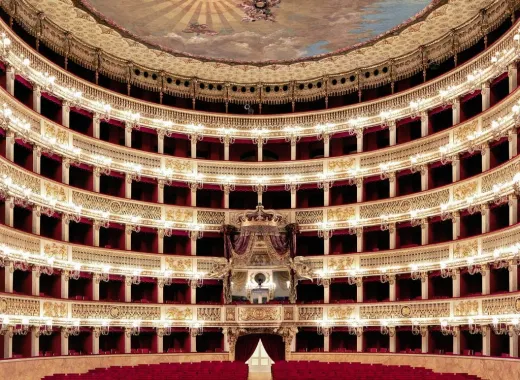
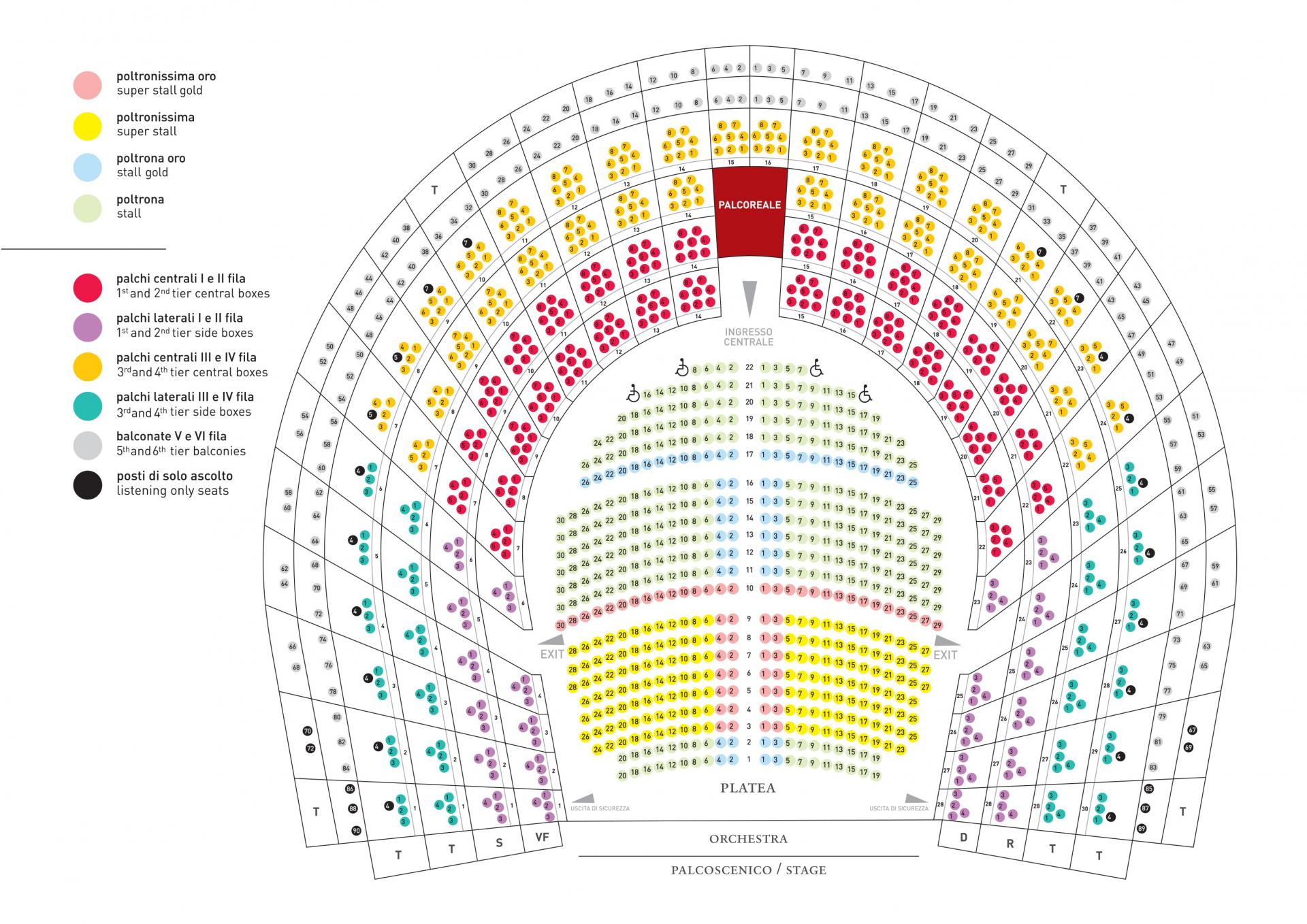
The new opera house was designed by Giovanni Antonio Medrano, a military architect, and Angelo Carasale, the former director of the San Bartolomeo. The horseshoe-shaped auditorium is the oldest in the world. It was built at a cost of 75,000 ducats. The hall was 28.6 meters long and 22.5 meters wide, with 184 boxes, including those of proscenium, arranged in six orders, plus a royal box capable of accommodating ten people, for a total of 1,379 seats. Including standing room, the theatre could hold over 3,000 people. The fastidious composer and violinist Louis Spohr reviewed the size and acoustic properties of this opera house very thoroughly on 15 February 1817 and concluded that:


there is no better place for ballet and pantomime. Military movements of infantry and cavalry, battles, and storms at sea can be represented here without falling into the ludicrous. But for opera, itself, the house is too large. Although the singers, Signora Isabella Colbran, [Prima Donna of the Teatro San Carlo opera company and Rossini's future wife], and the Signori Nozzari, Benedetti, etc., have very strong voices, only their highest and most stentorian tones could be heard. Any kind of tender utterance was lost.


Much admired for its architecture, its gold decorations, and the sumptuous blue upholstery (blue and gold being the official colours of the Bourbons), the San Carlo was now the biggest opera house in the world.[6] In relation to the power of the existing Bourbon Kingdom of the Two Sicilies, Beauvert notes that the design of the house, with its 184 boxes lacking any curtains was so that "no one could avoid the scrutiny by the sovereign" who had his private access from the Royal Palace.


In 1809 Domenico Barbaia was appointed manager of the royal opera houses in Naples and remained in charge until 1841. He soon established a reputation for innovative and dazzling productions, which attracted both the public and leading singers to the opera house.


 

Accomodation

Buy now

Gift vouchers

Gift someone an unforgettable night at the opera.
Choose a gift coupon and let them pick the performance they love—music, drama, and world-class artistry, all in one elegant experience.
Official Tickets for Europe's Most Famous Opera Houses, Classical Concerts etc.
Instagram
Payment
Google Play
App Store
© 2026 RM Europa Ticket GmbH
Whatsapp