




en
en v
Phone
Cart0 Tickets
Total: 0€
Account
Calendar
Search
Menu
X

The Nutcracker

VenueCarlo Felice Theater
CalendarThu 03 Dec 2026 - Sun 06 Dec 2026
Synopsis/Details


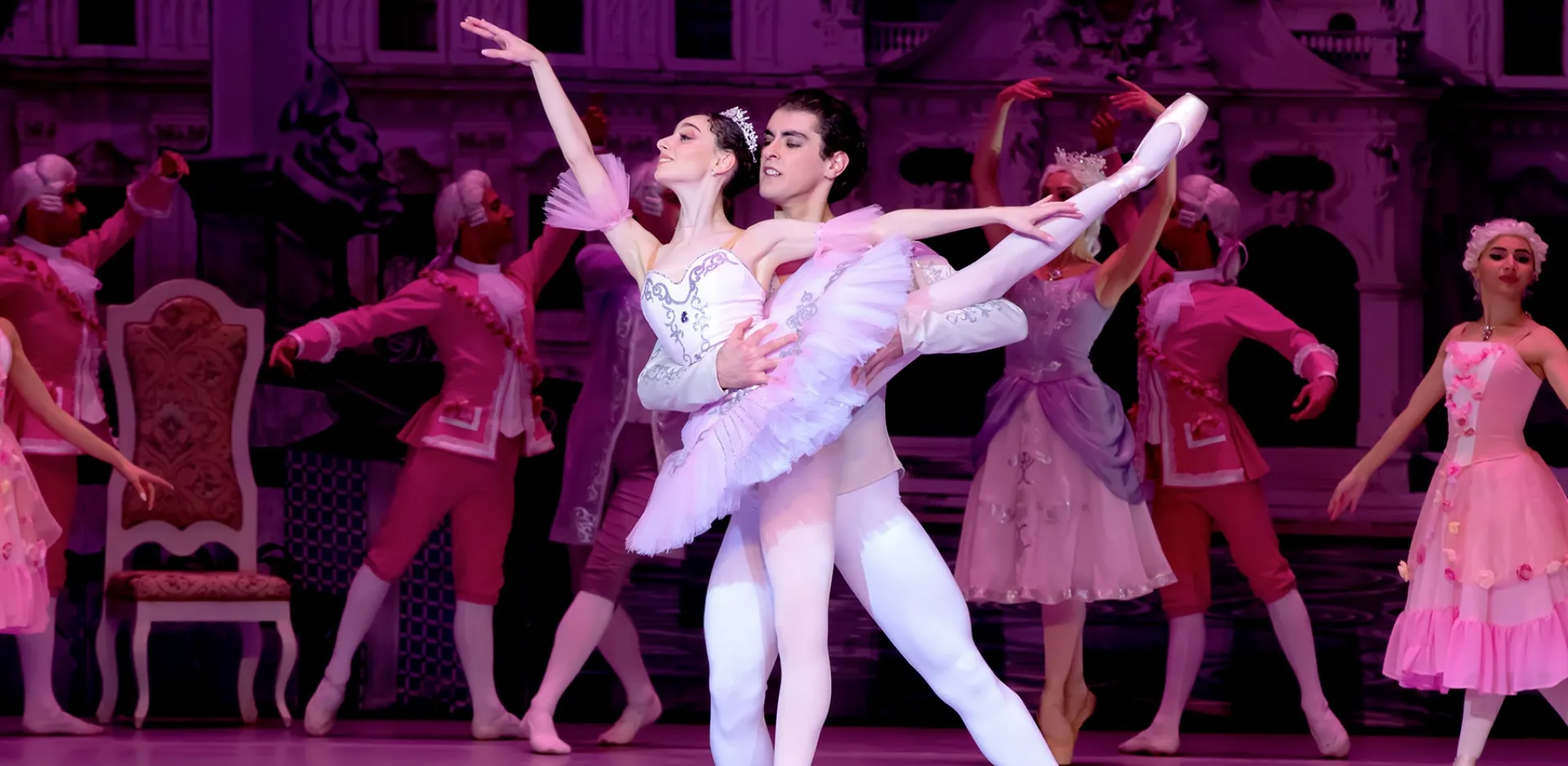
The Armenian National Opera and Ballet Theatre in Tchaikovsky’s ballet, conducted by Karen Durgaryan

Ballet in two acts by Pyotr I’ič Tchaikovsky, from the short story Nußknacker und Mausekönig by Ernst Theodor Amadeus Hoffmann


Plot 

Below is a synopsis based on the original 1892 libretto by Marius Petipa. The story varies from production to production, though most follow the basic outline. The names of the characters also vary. In the original Hoffmann story, the young heroine is called Marie Stahlbaum and Clara (Klärchen) is her doll's name. In the adaptation by Dumas on which Petipa based his libretto, her name is Marie Silberhaus.[5] In still other productions, such as Balanchine's, Clara is Marie Stahlbaum rather than Clara Silberhaus.


Act I

Scene 1: The Stahlbaum Home

The ballet is set in Nuremberg, Germany on Christmas Eve in the 1820s, where family and friends have gathered in the parlor to decorate the Christmas tree in preparation for the party. Once the tree is finished, the children are summoned.

When the party begins,[22] presents are given out to the children. Suddenly, as the owl-topped grandfather clock strikes eight, a mysterious figure enters the room. It is Drosselmeyer— a local councilman, magician, and Clara's godfather. He is also a talented toymaker who has brought with him gifts for the children, including four lifelike dolls who dance to the delight of all.[23] He then has them put away for safekeeping.

Clara and her brother Fritz are sad to see the dolls being taken away, but Drosselmeyer has yet another toy for them: a wooden nutcracker doll, which the other children ignore. Clara immediately takes a liking to it, but Fritz accidentally breaks it. Clara is heartbroken, but Drosselmeyer fixes the nutcracker, much to everyone's relief.

During the night, after everyone else has gone to bed, Clara returns to the parlor to check on the nutcracker. As she reaches the small bed, the clock strikes midnight and she looks up to see Drosselmeyer perched atop it. Suddenly, mice begin to fill the room and the Christmas tree begins to grow to dizzying heights. The nutcracker also grows to life size. Clara finds herself in the midst of a battle between an army of gingerbread soldiers and the mice, led by their king.

The nutcracker appears to lead the gingerbread men, who are joined by tin soldiers, and by dolls who serve as doctors to carry away the wounded. As the seven-headed Mouse King advances on the still-wounded nutcracker, Clara throws her slipper at him, distracting him long enough for the nutcracker to stab him.

Scene 2: A Pine Forest

The mice retreat and the nutcracker is transformed into a human prince. He leads Clara through the moonlit night to a pine forest in which the snowflakes dance around them, beckoning them on to his kingdom as the first act ends.


Act II

The Land of Sweets

Clara and the Prince travel to the beautiful Land of Sweets, ruled by the Sugar Plum Fairy in the Prince's place until his return. He recounts for her how he had been saved from the Mouse King by Clara and transformed back into himself. In honor of the young heroine, a celebration of sweets from around the world is produced: chocolate from Spain, coffee from Arabia,[28][29] tea from China,[30] and candy canes from Russia all dance for their amusement; Marzipan shepherdesses perform on their flutes; Mother Ginger has her children, the Polichinelles, emerge from under her enormous hoop skirt to dance; a string of beautiful flowers perform a waltz. To conclude the night, the Sugar Plum Fairy and her Cavalier perform a dance.

A final waltz is performed by all the sweets, after which the Sugar Plum Fairy ushers Clara and the Prince down from their throne. He bows to her, she kisses Clara goodbye, and leads them to a reindeer-drawn sleigh. It takes off as they wave goodbye to all the subjects who wave back.

In the original libretto, the ballet's apotheosis "represents a large beehive with flying bees, closely guarding their riches". Just like Swan Lake, there have been various alternative endings created in productions subsequent to the original.

Cast

Music by
Pyotr Ilyich Tchaikovsky

Conductor
Arman Urazgaliev

Choreography
Yuri Grigorovich

Restaged by Ruslan Pronin

Set Design
Simon Virsaladze

Costume Design
Lyudmila Ius
Elena Netsvetaeva-Dolgaleva

Astana Opera Ballet Company

Orchestra and Children’s Choir of the Teatro Carlo Felice

Children’s Choir Director
Gino Tanasini

Venue
Carlo Felice Theater

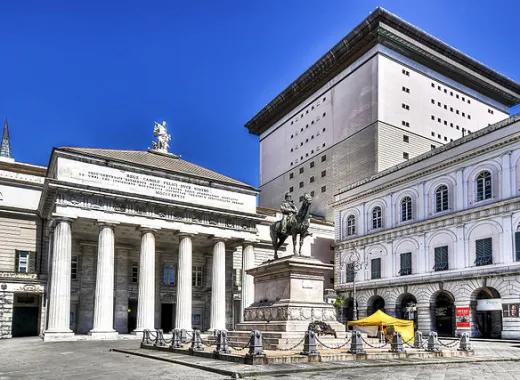
  Built on the area of Carlo Felice, the new theater, built by Aldo Rossi, recovers an idea already present in Paul Chessa projects and Carlo Scarpa: the creation of a piazza covered with 400 square meters, where the theater it was the ideal link between Galleria Mazzini and Piazza De Ferrari. Distant instead from an architectural point of view are the same Galleria Mazzini and the theater. the square is an open foyer; the walls are covered with stone slabs, and are enriched with columns and metal beams. There are two requirements that the architects wanted to keep in mind in the implementation of the new Carlo Felice theater: first, the need to rebuild it exactly where it was and secondly the desire to equip the new facility with the latest technology. From the latter need arises the imposing fly tower about 63 meters high. In practice the old theater work of Barabino remain the columns, the portico, the Latin inscription and the terrace that overlooks Via XXV Aprile which is accessed by one of the foyer; the current structure is very compact and geometric, the fly tower is a very linear in height developed rectangular, adorned only by a cornice.The auditorium, the foyer and services for the public are contained in a smaller box, where they emphasize the porch and the porch. As for the construction of the new theater are the stone were used for the exterior, plaster and iron, for the interior marble and wood. It is durable material that suggests an image of eternity, security and survival of the building over time. From the covered square, descending a staircase, you enter a room with a capacity of about 200 seats. Equipped with a small stage and independent from the rest of the theater, the hall hosts conferences, lectures and musical events. The interior of the theater entrance wide staircase leads to the closet and still climbing, the first foyer which has an area of 660 square meters and is decorated with frescoes and tapestries. the lantern A characteristic feature of the new Carlo Felice is the lantern visible in the foyer overlooking the lobby; it's a kind a light cone that runs through the building in all its height and it runs through all the plans, bringing the light from the roof to the indoor square. The tower Absolutely unique is the scenario in which they operate the technical units; right in the scenic tower, which houses the machine to move the shows, come together in a delicate balance human labor and sophisticated gear.In fact, the theater has four stages, a main stage, a back stage behind the first two stages and less aligned with each other and managed by integrated electronic and computerized. These scenic handling facilities, computerized lighting, sophisticated booths director for filming and acoustics among the best in Italy are among the features that make the Carlo Felice a factory of emotions among the most important in Italy.


 

Buy now

Gift vouchers

Gift someone an unforgettable night at the opera.
Choose a gift coupon and let them pick the performance they love—music, drama, and world-class artistry, all in one elegant experience.
Official Tickets for Europe's Most Famous Opera Houses, Classical Concerts etc.
Instagram
Payment
Google Play
App Store
© 2026 RM Europa Ticket GmbH
Whatsapp