Synopsis
Act 1
In Mustafà Bey's palace in Algiers, the potentate's sad wife, Elvira, is complaining to her confidante, Zulma, that her husband no longer loves her. The eunuch servants sadly state that, in the bey's household, women live only to suffer. Mustafà appears, accompanied by the corsair captain, Ali. Elvira pleads for her husband's pity, but Mustafà turns away in disgust and anger. He orders everyone out of the room, except for Ali, whom he commands to show him his Italian slave, Lindoro, as Mustafà has resolved to give the bored Elvira to the Italian. Having himself grown fed up with the tender fawning of the harem ladies, Mustafà is yearning for a temperamental Italian woman. He informs Ali that if he does not obtain him a woman like that within six days, then he will have him impaled.
Lindoro is pining for his far-away love. Mustafà informs him that he's going to marry him off. Lindoro struggles to come up with excuses for why he cannot accept the marriage proposal, but Mustafà eagerly pushes his wife on his new slave.
A new corsair ship sails into the harbour. Among the newly arrived Italian slaves is an extraordinary woman named Isabella, who went to sea in order to seek her true love, Lindoro, but then was taken captive herself. However, she has not fallen into despair, as she is well aware that her feminine charm and guile are enough to defeat any man. The corsairs also drag out another captive: Taddeo, whose unrequited love for Isabella is the reason for his current predicament. They lie to Ali that they are uncle and niece, there directly from the Italian city of Livorno. Ali happily exclaims that Isabella will be the glory of Mustafà's harem! Taddeo is crestfallen: now it's not just Lindoro he has to worry about; because of him, now he has to contend with Mustafà too. Irritated, Isabella puts a stop to her companion's attack of jealousy.
Lindoro and Elvira face each other hesitantly: neither of them is eager to marry the other. Mustafà bursts in on them to announce that he is allowing a Venetian ship to go free – and Lindoro may journey home on it with his new wife. Desperately, Elvira pleads with her husband not to make her go away, but Mustafà cuts her off impatiently. Ali enters in order to report the arrival of the Italian woman. Mustafà is immediately overcome by excitement: he is impatiently waiting for his wife to depart so that he can win over the Italian woman.
Isabella is solemnly led before Mustafà, who is completely smitten with the woman. Isabella immediately sees what kind of man she is dealing with and how she can use him to achieve her aim. Taddeo bursts into the room, pursued by Ali. Mustafà is ready to have the troublemaker impaled, but Isabella tells him that Taddeo is her uncle, leading to an instant show of mercy. Elvira, Zulma and Lindoro come before Mustafà to plead with the bey one more time before their journey. Isabella and Lindoro are astonished to recognise each other. Upon learning that the bey plans to give his own wife to Lindoro, the Italian woman loudly exclaims that the woman must stay. She also declares that Lindoro will be her own slave. Mustafà won't have any of this, but eventually he is incapable of saying “no” to the demanding Isabella.
Act 2
The eunuchs conclude that the Italian woman has made a fool out of Mustafà. The bey sends Elvira and Zulma to tell Isabella that he wishes to have coffee alone with her in half an hour. Elvira warns her husband that it will be no simple matter to seduce the clever woman. Mustafà, however, has already planned out how to achieve his aim: he will attempt to soften the heart of his adored Isabella through her uncle.
Left alone with Lindoro, Isabella angrily castigates him for abandoning her. It is only with great difficulty that he manages to convince her that he hasn't got the slightest intention of marrying Mustafà's wife and that he has never betrayed his love for Isabella. The beautiful woman eventually relents and, together with her beloved, starts planning their escape.
Taddeo rushes before Mustafà and pleads to be rescued from the fellow who is chasing him with a stake. Mustafà assures Taddeo that he has no wish for him to come to any harm – on the contrary: he appoints him his deputy, the kaimakam. In exchange for awarding him his new position, the bey asks Taddeo to intercede with his “niece” on Mustafà's behalf. The reluctant Taddeo is forced to consent.
While primping herself to prepare for her reception with Mustafà, Isabella tells Elvira point-blank that she has only herself to blame for the fact that the bey has tired of her. She does, however, offer to teach her how men have to be handled. Mustafà sends for Isabella, telling Taddeo that if he sneezes, that is the signal for him to leave him alone with Taddeo's “niece”. The Italian woman appears before Mustafà, who proudly reports that he has appointed her “uncle” to the post of kaimakam. The bey sneezes to signal Taddeo to withdraw, but the new kaimakam stubbornly refuses to move, no matter how much the bey snorts his nose. Lindoro and Isabella are greatly amused by the two buffoons. Isabella leads Elvira before the bey and demands that he reconcile with the poor woman. The raging Mustafà resolves that he will make them all pay for making a fool out of him.
Ali concludes that Mustafà deserved to be outwitted by the sly Italian woman.
Taddeo informs Lindoro that he is not really Isabella's uncle – he is in fact her true love; Lindoro merely finds this amusing and asks Taddeo to help him trick Mustafà. They let the bey know that Isabella would like to hold a ceremony initiating Mustafà as a pappataci – that is, to bestow on him a made-up title awarded to “admirers of the fairer sex”, whereupon all he will have to do in life is eat and sleep. Meanwhile, Isabella is preparing the plan for their escape: she dresses up the Italian slaves as pappataci and, with a rousing speech, gets them ready to go home. After Mustafà arrives, they initiate him with great pomp into the pappataci, seat him next to the new kaimakam Taddeo and have food and drink brought for them. As the two amorous clowns munch away, Isabella, Lindoro and the other Italian slaves board a ship. Taddeo is the first to notice the subterfuge, and rushes to the ship in time before it departs: even if he has to give up his hopes for love, at least he can go home. Only much later does Mustafà realise that he has been played for a fool. In his shame, he begs for Elvira to take him back. Peace is restored at last.
 en
en 
 de
de it
it fr
fr es
es ru
ru jp
jp ro
ro







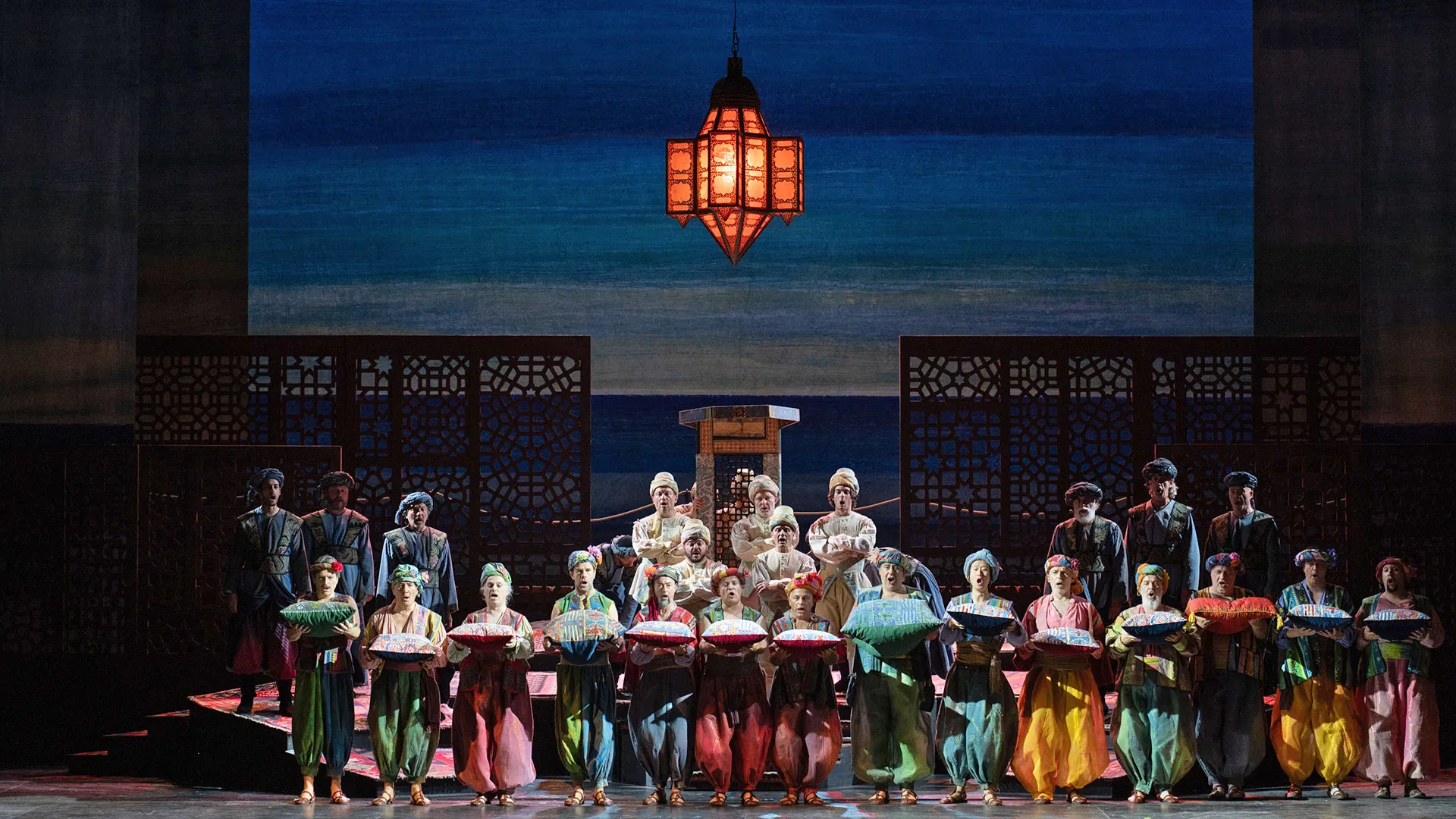
 Carlo Felice Theater
 Fri 19 Feb 2027 - Sun 28 Feb 2027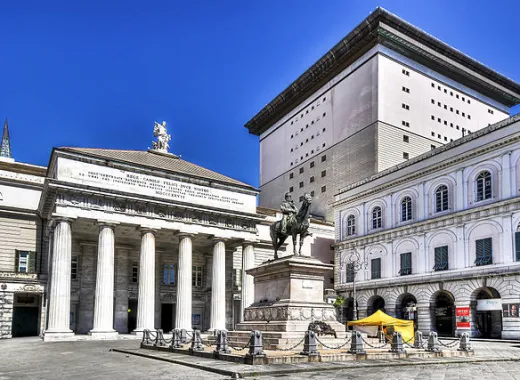



 RM Europa Ticket GmbH
  Call now
 Book now